OT Lectionary October 19th Trinity 18 Isaiah 45:1-7

Our passage for today comes from the second part of the book of Isaiah, and therefore dates from the period when Israel was in exile in Babylon. Towards the end of their imprisonment God sent a prophet, known only to us as ‘Deutero-Isaiah’, to proclaim their coming release and repatriation. Today’s passage forms the epicentre of his message, and it contains some deeply counter-cultural messages if we can unpack the background and understand them.


We must begin with the prevailing view of God, or rather ‘gods’. It worked a bit like the Anglican parish system – depending on where you lived, there was a particular god who ruled over your patch. So it was a common feeling among the exiles who, in spite of the fact that they should have known better, became infected with this worldview, and therefore thought they had moved out of Yahweh’s patch and so now were beholden to the gods of Babylon. There was also a sense of conflict among the different gods, a kind of ‘my-god-can-beat-up-your-god’ mentality, which suggested that Yahweh was just one among many, and might well be liable to lose when playing an away match. This passage, like much of Deutero-Isaiah, sets out to subvert these worldviews.


So the previous chapter contains a vicious attack on idols and those who manufacture them, as satirical as any stand-up comic today. The message is that Yahweh alone is God, there simply is no-one else with whom to fight, and certainly no-one to whom he might lose the fight. The chapter comes to a climax in v 24-26 with the declaration that God is the Redeemer, the Creator and the Lord, who promises that Jerusalem will be restored and reinhabited.
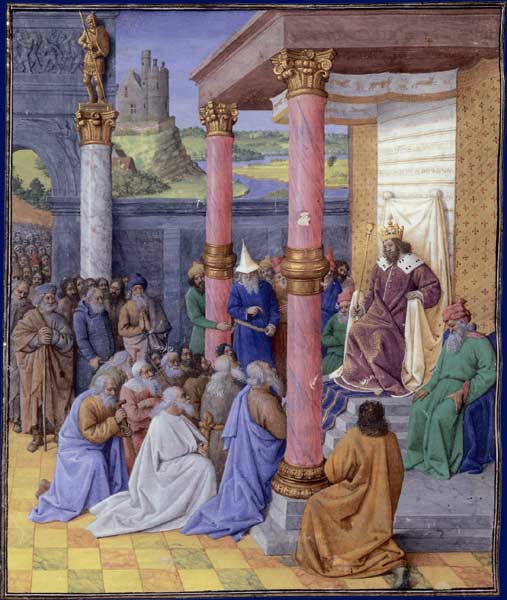
 File:Cyrus II le Grand et les Hébreux.jpg

But then ‘Cyrus’ walks onto the stage. Whohe? In fact he would have been something of a celeb to the Israelites, but the way he is described would have shocked their socks off. He was the king of Persia, the latest up-and-coming nation, who in fact was to go on and rule over one of the largest empires ever in the area. Yet he is described by the prophet as God’s ‘shepherd’, at whose command Jerusalem is to be rebuilt. But an even greater shock comes in 45:1 where Cyrus is announced as God’s ‘anointed’ – the word is literally ‘Messiah’. What came to pass was that Persia conquered Babylon (you can read that story in the book of Daniel) and decided to let the Israelite slaves return home. All this, the prophet claims, is what God is doing, moving the nations and leaders around like pieces on a chessboard for his purposes and for the good of his people. Not only is he the only God: he is also more than able to use pagan rulers to further his purposes.


So how would we react if a preacher told us that the one true God has called ISIS to fulfil his purposes, or to have referred to Usama bin Laden the ‘Messiah’? I think we have a similar degree of shock here among the exiles at the prophet’s words. Yet we are still tempted to believe that we have a powerless God, who has been defeated by the combined forces of secularism, the multi-faith society and Richard Dawkins. We are still tempted to divide the world into two – the bits God rules over (ie church) and the rest where he has little power. We need Isaiah’s radical message as much as ever, although we need to remember that the exiles had been living as slaves, and believing their delusions for a long time before it was heard.

OT Lectionary October 12th Trinity 17 Isaiah 25:1-9

To understand today’s passage we need first to understand the concept of ‘apocalyptic’ literature. The word literally means ‘unveiling’ and is applied to the kind of writing, usually coming from times of great tribulation and persecution, when our eyes are lifted from the present troubles to the final page, on which God will have the ultimate victory and everything will be fine. We’re most familiar with this genre from the book of Revelation, but there is plenty more of it throughout the Bible, and Isaiah chapters 24-27 have been called ‘Isaiah’s Apocalypse’. Like all apocalyptic literature it is gloriously vague as to geography and timescale: ‘on that day’ is used seven times over these four chapters, but never with any indication of exactly what day. Similarly ‘this mountain’ (v 7) is never identified. It is also difficult to place from which period of Israel’s history this passage originates, although the evidence would suggest that it comes from difficult times.

So all this vagueness notwithstanding, what was the point of writing this stuff, and what truths can this text tell us? The idea of apocalyptic is always to encourage, to help people stay focussed, remain steadfast through the trials, and somehow to find the strength to keep plodding on. It does this by encouraging the readers to see past the trouble to the outcome. For a marathon runner it might be the vision of the winners’ podium; for a dieter it could be a picture of the new slimmed-down you: for persecuted Israel it is a banquet. Enemies will have been defeated by the hand of God (v 2, 5), and yet the original call of Abraham to bless all nations is being fulfilled by the inclusivity of the feast which is ‘for all peoples’ (v 6). As you might expect the banquet is no Tesco Value kind of meal: there is no ‘Christian Quiche’ or ‘Beige Buffet’ in sight. Only the best will do for God’s purposes.

Then, in line with apocalyptic vagueness, there are even greater purposes behind God’s final action: ‘the shroud that enfolds all peoples’ (whatever that is) will be taken away, ‘the people’s disgrace’ will be removed, and death itself will be swallowed up. The God who has been a refuge in hard times (v 4) becomes the warrior who will not just hide people from trouble but will deal with those causing the trouble at root level. The punchline comes in v 9, where the people are encouraged to anticipate the final dénouement, and to celebrate the fact that in spite of it all God has been with them and for them.


Christians are often accused of ‘triumphalism’ (which I define as ‘wanting your triumph too early’), and of an excessive concern with ‘pie in the sky when you die’. This passage, like so many others in Scripture, forbids triumphalism by taking seriously the present evil, but also promises exactly ‘pie in the sky’, even if we don’t have to die to get it. Every strand of the NT motivates Christians by holding before them the promise of future reward, from the Sermon on the Mount, which is all about being rewarded, through to Revelation and its glimpses of final glory. I love the quote from CS Lewis:


“If there lurks in most modern minds the notion that to desire our own good and earnestly to hope for the enjoyment of it is a bad thing, I submit that this notion has crept in from Kant and the Stoics and is no part of the Christian faith.

“Indeed, if we consider the unblushing promises of reward and the staggering nature of the rewards promised to us in the Gospels, it would seem that our Lord finds our desires not too strong, but too weak.

“We are half-hearted creatures, fooling about with drink and sex and ambition when infinite joy is offered us, like an ignorant child who wants to go on making mud pies in the slum because he cannot imagine what is meant by the offer of a holiday at the sea.

“We are far too easily pleased.”

(C S Lewis, The Weight of Glory.)


God will have the last word – let that encourage you!


Old Testament Lectionary October 5th Trinity 16 Isaiah 5:1-7


Every now and then you encounter a Bible passage which doesn’t work nearly as well in English as it does in the original, in this case Hebrew. There are a couple of puns which really drive home this tragic message, and the whole genre of the text shows a subtle recasting of two well-known literary styles. Let’s try to unpack it and gain the full impact of the prophet’s words.

The text, we are told in 5:1 is a love song, a popular form of literature at the time, as indeed it is today. It is clearly a love song between the prophet and his God, but there is a sudden twist in v 3 where God becomes the speaker and the love song turns into a funeral lament. The nation of Israel become the loved but unfaithful other half, and the prophet vanishes from view until he returns, as narrator and interpreter, in v 7. It is in the context of this narration that two key puns are used: God has looked for justice (mishpat), but instead he finds bloodshed (mispach). He expected righteousness (tsedaqah) but all he can find is a cry (tse’aqah), presumably of distress. God has done everything he can to create the conditions under which his vineyard will grow and thrive (v 2), but in spite of it all the harvest has been rotten and rancid (‘bad fruit’ in v 2 is a bit of an undertranslation of the Hebrew). And then, just in case we are left in any doubt, we’re given the interpretation of this parable/love song/lament in v 7: God’s vineyard is the Israelite nation, and because of our refusal to bear the right fruit we’re bound for exile and punishment.

The theology here is to be restated by Paul in Romans 1: when we give up on God he gives up on us. His patience is not infinite, despite what we might like to think, and when his vineyard is not producing that for which he hoped he decides not to keep flogging a dead horse: his judgement in v 5-6 is active as well as passive: he will stop doing the cultivation which is needed, and instead he will actively break down and remove its protection.

So what of the Church, the ‘Israel of God’? We may put up our hands to a certain sense of not quite being what God would like us to be, although of course we don’t go in for any of the crimes which the prophet outlines as he continues this chapter. But this side of the cross, surely God would never turn against us? As soon as I find myself entertaining those kinds of thoughts I can’t help but wonder whether I might be guilty of the same kind of presumption the pre-exilic Jews were guilty of: they had the Temple of the Lord; they were the chosen race, so God must be mighty pleased with them. I’m an Anglican, and we have Canterbury Cathedral, and in any case Jesus died for us. Whether or not God will judge his church, or indeed whether or not he has, is something you might like to reflect upon.

OT Lectionary 28th September Trinity 15 Ezekiel 18:1-4, 25-32


Don’t you just love politicians? If they get something right they take the credit, but if they get it horribly wrong they just blame the previous government from the other side of the House, who, while they were in power, got the country into such a mess that it is taking ages for us to undo it and right all the wrongs of their administration. School children have a slightly less mature version of this: when caught out in some mischief the response can all too easily be ‘He made me do it, Miss!’


The people of Israel, in exile far from home in Babylon, are playing this game too. You can’t blame us, Ezekiel, for getting ourselves into this mess. It was all those previous generations who ignored God and lived evil and idolatrous lives who went off the rails, while we are now paying the price. That’s the meaning of the common proverb of the time about eating sour grapes.


Ezekiel needs to refute this opinion, and its underlying implication that God just isn’t fair. It’s easy to feel like that at times, but for God’s people the starting point must be that if there’s a dispute God must be right and we must be wrong, otherwise he is not God in any normal sense of the word. ‘Will not the judge of all the earth do right?’ asks Abraham in Genesis 18, obviously expecting the answer ‘Yes!’ But God is not just fair, he is merciful too, and again and again in this passage he holds out hope for forgiveness, if only his people will return to him in repentance.


This passage teaches us much about sin, guilt and forgiveness, much which many of us still need to learn. Firstly, that God remains unconvinced by the blame game. Ever since Adam told God that Eve had given him the fruit to eat, and she blamed it on the snake, the human race has tried to wriggle out of a sense of guilt and shame by putting the responsibility for it elsewhere. But this doesn’t wash with God, and never has. ‘The one who sins is the one who will die’, he explains in v 4.We all have individual responsibility for our actions, and we can never put the blame on someone else.


Secondly, it teaches us that we have choices to make, and that we must bear their consequences. Of course this doesn’t work in the short term, or else the Bible wouldn’t contain those agonising passages about why evil people appear to prosper while the innocent suffer. But in the scope of eternity our choices matter, whether they be choices to sin or to repent.


Thirdly, this text speaks, as we have said, of the mercy of God. Against the commonly–held view that God is only there to have fun smiting people at any excuse, Ezekiel affirms that God takes no delight in the death of anyone but, as the liturgy puts is, he would rather they turned from their wickedness and lived. God is neither a spoilsport nor a monster, and genuinely holds us his creatures in love, although never the indulgent kind in which it doesn’t matter what we get up to.

File:Senator Gordon Wilson.jpg

Therefore, the text seems to ask, why on earth don’t we take advantage of that mercy? Why is it so deeply embedded into human nature that we’d rather moan at God and blame others than simply turn round and accept his forgiveness? Why does it seem the hardest thing in the world to put our hands up, admit our wrong, receive forgiveness and restoration? Have you noticed how often on the telly someone who has had something horrible happen to them or their family tells us that they feel ‘bitter’? And how rarely and how notable it is when someone expresses forgiveness to the perpetrators, someone like Gordon Wilson of Enniskillen? Why hang on to sin and bitterness when forgiveness is so much easier and more rewarding. If Christians haven’t learnt that lesson, what hope is there for the rest?


OT Lectionary September 21st St Matthew Proverbs 3:13-18

To be honest I’m not that big on Saints: they have to be handled with extreme caution. The kinds of churches which most go on about them can easily be the kinds of churches where Christian people (or ‘saints’ as the NT calls them) end up feeling deskilled, ordinary and not quite up to the mark, and never likely to end up in a stained glass window. However much preachers tell us we ought to learn from their examples, emulate their holiness, and so on, I never find myself entirely convinced: I usually end up feeling told off instead. However, today is St Matthew the Apostle’s day, so here goes. At least Proverbs might not do us much harm.

It’s easy to see why this passage goes with Matthew: it’s about choosing wisdom rather than wealth, which Matthew went on to do. In the OT wisdom literature ‘Wisdom’ is often personified. The clearest example of this is in Proverbs 8 where ‘she’ is depicted as a wise woman who calls out to people as it were to buy her wares, to embrace wisdom rather than folly, ‘wisdom’ meaning, of course, what the French would call savoir-faire or ‘knowing what to do’. It is not primarily deep philosophy: it is much more about knowing what would be the sensible thing to do in the many decisions with which life presents us.

So in chapter 3 to choose wisdom brings several benefits. Blessedness, profit, value, long life, riches, honour, delight and peace. There is an interesting mix of things which the ‘secular’ world might value and those which would be rather lower on the agenda: profit and riches sound good, but ‘blessedness’ is a bit more vague. The implication, though, is that Matthew, in turning his back on the tax business, and no doubt the corruption, fiddling and profit which went with it, in order to follow Jesus, was choosing the better thing. We’re not told, of course, that Matthew was a villain before his call, but the story of Zaccheus perhaps illustrates Matthew’s call a bit further.

We live in a culture where money is pretty much everything. For some the issue is addiction and greed, for others the corrupt use of wealth, while for some it is the anxiety of knowing where the next bit is going to come from. Few of us have learnt St Paul’s secret of being content with our lot (Phil 4:12), and I can’t help but wonder whether there were times when Matthew looked back and wondered how much easier his life might have been if he had simply told Jesus to push off. Whether Matthew ended up being martyred for his faith is a matter of contention, but there is no doubt that he must have suffered some of the hardships which Jesus promised to those who became his followers.

So what does Matthew make you want to ask of yourself? I sometimes wonder whether a different job might have brought me a bit more fame and fortune than has been my lot as a poor vicar, especially when I see my kinds earning double what I do. On a good day I think wisdom is actually worth more, although I wonder whether poverty and wisdom necessarily go together. But all in all I’m glad I chose to follow Jesus, leave behind my dreams of being a rock star or a top executive. I know that one day it will turn out to have been worth every penny, when I hear my Father say to me ‘Well done, good and faithful servant’.

OT Lectionary Sunday 13th September Trinity 13 Genesis 50:15-21


Two words can sum up the thrust of today’s OT passage: grace and mercy. Joseph’s brothers, those who left him half-dead and then sold him into slavery, are worried because now that Dad has died the respect which Joseph has had for him might run out and he might wreak an awful revenge on them from his position of power. So, whether out of fear for their lives or genuine repentance (it’s hard to tell which from the text – maybe it was a mixture of both) they grovel before him asking that he will forgive them. Joseph’s response shows both grace and mercy, but something else besides which we will come to in a minute.

And old children’s song helpfully tells us that

‘Grace is when God gives us/the things we don’t deserve’

and

‘Mercy is when God does not/give us what we deserve’

Joseph shows both to his brothers, putting away their sins against him, and promising to provide for them into the future. It would be interesting to speculate just what his tears in v 17 were about. Gratitude that they had finally apologised to him? Horror that they should think him capable of such revenge? Maybe, but I wonder also whether his tears were about glimpsing the bigger picture. Showing grace and mercy are human activities, and very good ones too, but behind it all Joseph is able to see the hand of a loving and powerful God.

He has already made the point, in chapter 45, that what they intended as harm for him was used by God to a greater purpose. He repeats the point here, as evidence that to take the path of revenge would be to go counter to God’s larger purposes. I think there is something here for those of us who suffer, and something for those who must forgive.

Let’s begin with forgiveness. I have written elsewhere[i] about an important paper on the nature of forgiveness, so I won’t repeat is here. but I am interested that Joseph does three things. He looks their sin fair and square in the face and calls it what it is – ‘You intended to harm me’ v 20. No excuses: he tells it like it is. Secondly he refuses to take revenge, even though it was well within his power to do so. The most helpful definition of forgiveness I have heard is ‘Handing back to God the right to punish those who have hurt us’. Most of our angst and bitterness comes from the fact that we would like to take revenge ourselves, but most of the time we don’t have the ability to. To give back to God the right to punish sets us free from all that agonised bitterness.

But then Joseph goes one step further: he ‘spoke kindly to them’ v 21. Much of the time this is a step too far. We can forgive people, if we use the definition above, without having to trust them, or even to like them. Much of the time the wisest way is simply to avoid them. But Joseph somehow manages to maintain relationship with those who were so cruel to him.

I think that third step is optional, so don’t beat yourself up if you simply can’t be around those who have hurt you so much. However, the first two are essential.

And once we gain the perspective which comes from having genuinely forgiven, that makes it easier to seek God’s larger purposes. I know how much this hurt, but what did God give me, or build into me through it. what is there, in the harm intended by others, which he has turned to his purposes?

[i] Leach, J God’s Upgrades … My Adventures (Milton Keynes: Authentic, 2014) p 168ff.


Coming soon – my new Wednesday blog ‘Through the Bible in Just Over a Year’ – 600 words introducing each book of the Bible, and how we might read it today as Christian disciples.

OT Lectionary September 7th Trinity 12 Ezekiel 33:7-11

There is an interesting dynamic of ‘tipping points’ in today’s passage from the prophet Ezekiel. Firstly, chapter 33 forms a kind of pivot point between 1 – 32, which are predominantly about judgement, and 34-48, which have much more to say about restoration. As though to emphasise this great pivot the news comes to Ezekiel in v 21 that ‘The City has fallen!’ We can’t really imagine the significance of this for the exiles, but the destruction of 9/11 doesn’t come close. It is as though we heard that Westminster, Canary Wharf and Canterbury Cathedral had all been blown to bits in a single act of warfare.

So this passage sets before the people the need for repentance, and the role that the prophet has in calling them to it. The image of the ‘watchman’, one which Ezekiel commonly uses, relates to those placed on city walls to give early warning of imminent attack. But the danger here is less about the physical destruction of their home capital, and more about the internal eating away of their society by the cancer of immorality and godlessness.

But there is a smaller, more subtle pivot in the centre of the passage for today. By the time we get to v 10 the people apparently need no further calls to repentance: they are only too well aware of their offences and sins, and the results of them. Ezekiel’s word to them must now be different. No longer is he to give a warning of judgement: now his message is one of hope and restoration, and repentance as the way to it.

This corrects two common caricatures we may have unconsciously slipped into regarding prophets and their God. So often we think of those with prophetic giftings as miserable people who can only speak of gloom and destruction: indeed many modern-day prophets only serve to reinforce this caricature. This in turn can lead us to the belief that God himself is a miserable punisher. One of my bosses used to say that the job of the Holy Spirit is to ‘comfort the disturbed and disturb the comfortable’, and we have something of that here. To presumptuous and self-satisfied sinners God’s word is a harsh one, but to those who realise their own need of repentance he speaks mercy and restoration. This of course can’t help but raise the question ‘Where am I?’ and ‘What would God want to say to me?’ Clearly to speak words of peace to sinners who are completely unrepentant is as useless and counter-productive as calling to repentance those who are already broken-hearted. But so often all we want is to hear God saying to us that everything is just dandy.

There is also an interesting question here about how this passage might relate to evangelism. In the past it was thought to be all about calling sinners to repentance: indeed that is the thrust of most of the preaching recorded in Acts. But now the fashion has changed, and in a society which doesn’t really ‘do’ sin our call is more likely to be about comfort than confrontation. Maybe we need to rethink what the call of God on our generation really is.


OT Lectionary August 31st Trinity 11 Jeremiah 15:15-21

Deeply Counter-cultural


My daughter always laughs when I use this phrase: apparently it is one of my buzz-words and she tries to spot it coming when she hears me preach. I’m usually unapologetic, though, and I certainly would be if I were preaching on this section of Jeremiah.  Rembrandt. The Prophet Jeremiah Mourning  over the Destruction of Jerusalem.

Jeremiah’s calling, which became clear in the first chapter of his book, was a prophetic one which involved uprooting, tearing down, destroying and overthrowing (Jer 1:10). This calling had to be worked out in the context of a massive culture-change, as the old order of life in Israel was to be shattered and replaced by a period of exile. His job was basically to prepare the nation for the fact that everything they knew and held dear was about to come to an end. That’s what you call ‘deeply counter-cultural’.

 But what is it like to have been given such a ministry? Our passage for today gives us a bit of insight into what Jeremiah must have felt like, and it is not a pretty sight. He was the victim of persecution and reproach (v 15), of isolation (v 17), and of unending pain and incurable wounds (v 18). His attitude to the God who has set this calling on him swings wildly, even in this short passage: God remembers him and cares for him (v 15), but a few verses later he accuses God of having abandoned him and let him down (v 18).

 The prophetic calling is never an easy one, but in my experience it is far easier when the people to whom you are called know their own need of God. The unknown guy we call ‘Deutero-Isaiah’, for example, had a ministry of reassurance to those who were coming to the end of the exile, and his words are some of the most beautiful and oft-quoted in the OT. But Jeremiah, writing a few decades earlier, had an altogether more difficult task: telling those who believed that everything in the garden was rosy that in fact they were in deep deep trouble. If your favourite definition of a leader is ‘one who defines reality’, then you’ll know that when life appears to be going smoothly people are actually not very interested in reality at all, and those who have the nerve to try to define it can get themselves in a serious mess.

 So how does the God whom Jeremiah believes has messed him around so much respond to his prophet’s plight? I wonder if we might paraphrase v 19 as something like ‘You can give it all up if you like! You can go back to speaking comfortable but worthless words, and of course you won’t be speaking in my name, but that’s your choice. But there is a better way: people might turn to you, if they hear the authenticity of my words through your voice, but whatever you do don’t turn to them, don’t just feed them the platitudes they want to hear.’ This is the prophetic calling in a nutshell: never easy but only authentic if God is behind your words.

 There is also an interesting point to come out of God’s protestations of protection and salvation for his servant. V 20-21 are promises from God, but what exactly was the cash value of them to Jeremiah? God would protect him, rescue him and save him, but he was still thrown in a pit and left for dead, and persecuted and vilified throughout his life. So where were God’s protection and rescue then? I can only conclude that God’s ideas of protection and mine vary slightly: if I pray for a comfortable life and a lack of conflict, maybe what God actually protects me from is losing the plot and becoming comfortably apostate. As someone once said ‘God will never harm you. You might die, but he’ll never harm you.’


OT Lectionary 24th August Trinity 10 Isaiah 51:1-6

(I’ve chosen not to go for St Bartholomew, as you probably will be less interested in the OT if you’re going to celebrate him this Sunday. I should transfer him to Monday if I were you: I’m sure he wouldn’t mind.)


As with last week there seems to be some unnecessary filleting by the lectionary-makers, and v 7-8 are also clearly a part of this passage. (By the way, it is OK to read more than the lectionary tells you to!) but unlike last week there has been no return from exile yet, and the people are still far from home struggling with questions of identity and purpose. The prophet encourages them to look: indeed this passage is full of looking. Clearly they are people looking for God in the geographical and theological disorientation they feel during the exile: ‘Listen to me … you who seek the Lord.’ (v 1) So where is he to be found?


First, says the prophet, look back. Look to Sarah and Abraham, those founders of our once great nation, your ancestors from whom you are descended. God called them, and as a result of his power you exist today. You are no accident, no unwanted mistake. The unusual term ‘quarry’ (v 1) means in Hebrew an empty hole: perhaps there is an allusion here to Sarah’s empty womb, and a reminder that emptiness is not the last word. But you can look even further back than that if you want more reassurance: right back to Eden (v 3). There is another promise here of restoration and joy to replace barrenness and aridity.

 Then, continues the prophet, you might like to look forwards. God’s justice and restoration is coming – you only have to lift up your eyes and look for it (v 6). We ‘look forward’ to a birthday or holiday because we believe it really is coming: in the same way the prophet encourages Israel to eager expectation instead of drowning in the drudgery of the here-and-now.

 Take a look at the created world, urges the prophet (v 6). All that you see around you is nothing more than a temporary place for you to live, rather as Babylon is. When you look to the future you’ll see all this lot vanish (v 6), and along with it you’ll also see a disappearing act from all those who are currently oppressing you (v 8).

 But then, crucially, they are to take a look around. It is a major theme of Isaiah to remind the people of the original calling given to Abraham, to be blessed and to bless. Again and again Israel has grasped at the first part but forgotten the second and become narrow and exclusive, so even as he tells them to prepare for freedom, he reminds them of this calling, which makes them God’s chosen people: it is the nations who will be enlightened by God’s instruction, and the nations and islands who will be liberated along with Israel if only they will do what they are supposed to be doing. When God’s people stop looking inward and realise that the good things of God are for those currently outside, there is blessing in abundance for all who will come to him.


OT Lectionary 17th August Trinity 9 Isaiah 56:1-8

Inclusive – but not too much!


This is clearly a passage about inclusion, and why the lectionary editors felt the need to fillet out verses 2-5 I just don’t understand, hence my dealing with the whole section. This chapter marks the start of what has been called ‘Trito Isaiah’ – the third section of our one book, dating from after 316BC when the Jewish exiles began to return from Babylon to rebuild the Temple. It is the story of a great gathering, where those who have been scattered with be gathered to offer prayer and worship to God. The Israelites had felt themselves to have been ‘scattered’ when they left Jerusalem for the exile, losing their sense of home and nationhood, but as far as the author is concerned that has been dealt with in the return from Babylon.

 BANGKOK,THAILAND- NOVEMBER 6 : Thousands of whistle-blowing demonstrators protest by against the controversial amnesty bill at Silom Rd. on November 6,2013 in Bangkok,Thailand.  - stock photo

But God wants more, a message which came to the exiles via an earlier prophet in Is 49:6. So this gathering is not just about ‘the tribes of Jacob’: it is a gathering of those who for various reasons have previously been excluded from God’s people. There are two groups of people: foreigners and eunuchs. The former term is self-explanatory, but note that it would include many of those who for centuries have been the bane of Israel’s life: Philistines, Amorites and all the other ‘ites’ who have been the enemies of God’s people in the past. The latter symbolise those who, while being racially Jewish, have been excluded from the worshipping community by some defect. Leviticus 21-23 provide further details!


So this chapter provides a vision of an enormous gathering to whom all are welcome, and especially those who previously could not have got in even if they had wanted to. As such it is an attractive vision for a fragmented and bloodthirsty world, and v 1 provides encouragement for those who have become cynical about God ever actually doing something about the state of the world and its injustice, And tempted simply to join in with the greed and evil all around. ‘Hang on in there, and keep the faith’ says the prophet, ‘because the divine denouement is coming soon!’


But as always in the pages of Scripture this utopian gathering allows the possibility of exclusion as well as inclusion. The Hebrew word ‘ger’, often translated ‘alien’ refers throughout the OT to someone not racially Jewish but who has become at least partly a member of the community, and it is used widely in today’s society to tell us that we must welcome all immigration and give equal rights to illegal immigrants. In fact this is far from the truth: the ‘ger’ was first and foremost someone who had bought into the Jewish religious system and was obeying the law. To use the term to encourage us for form an LEP with the local gurdwara is a gross misuse of the concept, and this passage is equally clear that those who will be included in this gathering are not just those who happen to be foreign or otherwise outcast, but those who are already living for God. It is striking that this commitment to God is evidenced by three things: keeping the Sabbath, binding themselves to God, and worshipping him. This further evidences itself in refraining from doing evil (v 2), making godly choices (v4), and remaining faithful (v 4, 6). In other words, God’s inclusivity has limits, and this passage is most certainly not an argument for the universalist position.


It behoves us in the church to avoid the twin dangers of prejudice and exclusion of those who are not ‘PLU’ (people like us) on the one hand, and on the other of becoming more inclusive than God is himself.