Lectionary Psalms

For those who want a change from the Gospel

Sunday before Lent – Psalm 50

To go with our Gospel reading about the Transfiguration, we have today a Psalm about God appearing. As we are on the edge of the season of Lent, we are reminded that our hope is about more than losing weight due to abstention from chocolate or alcohol: it is about changing gear and taking time so that we might encounter God anew, as he comes to us in this holy season. The Psalm looks as though it comes from the Jerusalem Temple (v.2), and it has been suggested that it might date from the times of great reforms and renewals, either under Hezekiah (around 700 BC) or Josiah (around 660 BC). There is much speculation, most of it inconclusive, about which liturgical occasions it might have been used for.

The Psalm falls neatly into three parts. The first, which makes up our lectionary excerpt, is an introductory preface, which leads into a change of voice as God himself speaks to the people. This in turn is divided into two oracles, the first addressing ‘my people’ (v.7) and the second ‘the wicked’ (v.16). The subject matter of the two parts is around the same issue – appropriate worship – but the ideas are very different, depending on one’s relationship with God. First the worship-leaders announce that God is about to appear (v.1-6), then God addresses those whom he calls his own (v.7-15), and finally there are words of warning from God to the wicked (v.16-23). As such, the Psalm is usually classified as a ‘prophetic liturgy’ where priests and prophets work together in worship.

What is interesting, though, is the specific issue which is dealt with, that of sacrifice. It becomes clear that both groups are actually worshippers. The first group, God’s people, are apparently doing all the right things, but have perhaps misunderstood why. God doesn’t need their animal sacrifices. Some systems of religion believed that when they sacrificed they were offering food to their gods, who might otherwise go hungry. But Yahweh has all he needs and more, what he is looking for is the hearts behind the sacrifices. He wants his people to offer him thanks and acknowledge their need of his help in times of trouble. Both of these are things are neglected in our culture, and probably among those who are God’s people too. Paul in Romans one tells us that the culpable sins of the human race are to fail to acknowledge and honour God and to give him the thanks which he is due. People with thankful hearts and humble dependence are those whom God requires.

But the second group also appear to be worshippers, reciting God’s laws and taking his covenant on their lips. Their problem is that they are not living out what they profess. They won’t listen to God’s wisdom, but rather cast it behind them, a Hebrew phrase meaning to disregard or deliberately neglect. Rather they associate with thieves and adulterers, speak evilly, and lie and slander. Worse than that, they actually have come to believe that God doesn’t mind such behaviour, but rather than condoning it he is about to bring judgement for it.

If this Psalm does date from a time of renewal and reform, it is easy to see the two groups who need to know that he is about to appear. Some are indeed worshipping, but in a kind of self-sufficient way which fails to understand the nature of God’s demands on them, and fails to cry out to him instinctively, as the first port of call, in trouble. The second group are also saying the right stuff, but not backing it up with the ways they live.

I’ll leave you to make any comparisons to church life today, and how we might be falling short of God’s demands in various ways. But I was struck by the sense that it is not just the Transfiguration story which matches this Psalm, but also the parable of the wheat and weeds. The Church is a mixed economy, and like the farm workers we are not called to decide what should be there and what needs tearing out. The time for that will come, just as the time for judgement on Israel will come. But our task for now is to make sure that we are the wheat, not the weeds. Perhaps Lent can help us to do that.

Lectionary Psalms

For those who want a change from the Gospel

2 before Lent – Psalm 104

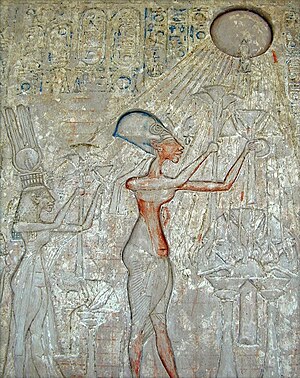
Today’s Psalm passage comes from one of the longer Psalms, 104, and as usual I want to take a look at the whole thing, not just the odd verses plucked, somewhat illogically, from the end of it in our lectionary. The first thing to note about the Psalm is that it looks like a piece of plagiarism! We have a poem which was found in the tomb of Egyptian Pharaoh Ay, who ruled briefly in the 14th Century BC. It is usually thought to have been written by predecessor Pharaoh Akhenaten who began his reign around the 1350s BC. Akhenaten was a great religious reformer, and he championed the worship of the sun-god Aten. The poem, called ‘The Great Hymn of Aten’ is a hymn of praise to him, and this photo, taken at the time, shows him and his family worshipping the sun.

The text shows such a striking resemblance to Psalm 104 that they cannot possibly be unrelated. There is also a close link with the first account of creation, in Genesis 1.

This raises interesting questions about the relationship between these two poems. The Psalm is usually classified as a Nature Psalm, or Hymn to God the Creator, and although we don’t really know when or by whom it was written, it is not impossible that it came from David himself, and therefore quite early in the big story of Israelite worship. If that is so then the Gen 1 account of creation could well be dependent on it, and it might be the case that both of them drew inspiration from the Egyptian poem, but replacing Aten with Yahweh. After all the Genesis 1 story does the same thing with a Babylonian creation story called the Enuma Elish which is at least 1500 years older than the Hymn to Aten. The biblical writers, of course, insist that it was Yahweh, not Marduk, who cut the sea monster in half and created heaven and earth from the two bits. So we needn’t be worried by our faith borrowing or recasting ideas from other faiths or myths: it goes on all the time. We all know, for example, what is meant by Pandora’s box, and the story tells us an important truth without requiring us to believe in Pandora.

So what does this Psalm tell us about God the creator? It begins as the psalmist calls himself to praise in the common phrase ‘Praise the Lord, my soul’. Sometimes we need to remind ourselves to bow before the majesty of God, and much of our hymnody does this job: Praise, my soul, the King of Heaven is perhaps the best example. But the Psalm moves on address God personally, and in particular his power as the founder of the world, in terms which we have said reflect Gen 1. The different species he creates are listed, and then as we come to our fragment we are reminded not just that God created, but also that he sustains what he has made. All creation is nurtured from the hand of God, and the terrible picture of what would happen if he hid and refused this nurture are described. In him is the power to renew or to destroy.

The final verses express the praise of the worshipper, a commitment to praise and rejoice all his life, and a final curse on those who disobey him, or refuse to join in with the worship. Like a closing bracket round the whole Psalm, he calls himself back to praise.

Whilst the literary origins of the Psalm are interesting, I was particularly struck, this time I read it, by the Psalmist’s need to call himself to praise, not once but twice. Indeed there is ample reason for gratitude to God spelt out in the Psalm and evident in the beauty of the world around us, but still it seems that he has to remind himself to be thankful. I can remember going with my vicar when I was a curate to an ecumenical prayer meeting with, among others, a bunch of New Church leaders. As soon as someone said ‘Let’s pray’ they were off, with shouts of praise, muttered ‘Hallelujahs’ and speaking in tongues, while we Anglicans sat quietly waiting for our turn to articulate a prayer. I said to my boss afterwards ‘They’re so emotional, aren’t they?’ to which his reply was ‘No, we’re emotional; they’re committed!’. We were sitting quietly waiting to feel moved into some kind of prayer, while they were going to pray come what may. That kind of commitment to give thanks to God, and even to live lives of gratitude 24/7, is something which the Psalmist recognised, and as a liturgist (one who writes wors for others to use) he encourages us all to remember who God is, what he has done, and what he is doing among us now. And as Christians we’d also want to praise with thanksgiving for what we know he is going to do in the future in the new creation.

Lectionary Psalms

For those who want a change from the Gospel

Candlemas – Psalm 24

I’ve chosen to use the readings for Candlemas today, as I reckon many churches will celebrate this festival, when our attention turns from what has been happening over the Christmas period to what will happen at Easter. The Psalm is a well known one, but its original meaning is hard to decipher. There are two questions to ask of it: is it a literary unity, in other words was it written as a complete Psalm or collected together from three fragments, and when might it originally have been used?

It does fall neatly into three sections, each of a slightly different genre, but there is an overall logic to it too. V.1-2 are a short hymn which celebrates Yahweh as the creator, v.3-6 form what has been called a torah or law setting out the conditions for entry to worship, and v.7-10 are what has been called a ‘gate liturgy’ which looks as though it was used antiphonally between two groups of people, perhaps priests and congregation. The mention of ‘ancient doors’ suggests a date during the monarchy, between the time of Solomon, when the first Temple was built, and its destruction in 586 BC. In the Septuagint, the Greek translation of the OT, the Psalm is headed with a direction for its use on the first day of the week, but that would have been added some time later.

Two possible suggestions have been made for its original setting, both of which have problems. The first is that it was composed for the bringing of the Ark of the Covenant from the house of Obed Edom into the Temple, as recorded in 2 Samuel 6 and 1 Chronicles 13, and the second is that it was used as a processional liturgy for the Ark, which symbolised the presence of Yahweh, as it was returned to its place in the Most Holy Place. However, we have no evidence that once it had been placed in the Temple, it was ever carried about or used in processions again. So really we just don’t know.

But what we do know is that it is somehow about the presence of Yahweh coming to the Temple, where he could be met and encountered by worshippers. So the logic of the Psalm seems to be a reminder of who God is, seen in his creative power and his lordship over all that he has made, a reminder of his moral qualities and therefore the kind of people who may appropriately meet him in worship, and finally the arrival of his presence, or his glory, among the congregation. As such, it forms a good checklist for us as we come to worship, and ties in with the Candlemas theme of God suddenly appearing among his people, both for judgement and consolation.

For worship-leaders it’s not always easy to know how to begin services, and different people, as well as different occasions, demand different setting-off points. A joyful Easter shout of ‘Alleluia! Christ is risen!’ works less well on Good Friday! Some like to begin with silence to focus on God, others with a section of upbeat praise. But maybe this Psalm provides a helpful reminder of what is really important. Before we let God into our presence it’s good to focus first on who he is, and then on who we are, probably in that order. To remind ourselves that we come into the presence of a mightily powerful God, who made and sustains all that exists, is not only good for us but also subverts all those voices which would seek to marginalise our faith as a hobby for a few weird people who happen to like that sort of thing. It restores our perspective. And then secondly we come conscious of the righteousness of God and by contrast our own need of repentance, or realigning our lives with him after a week when so many other pressures may have caused our awareness of him to slip. The words give us a chance to make sure once again that our hands are clean and our hearts pure. V.5 also reminds us that to meet with God means to be blessed.

So while we may not know what kind of an entrance liturgy this Psalm was, it can certainly help us in our approach to the worship of our God.

Lectionary Psalms

For those who want a change from the Gospel

Epiphany 3 – Psalm 128

It isn’t easy to identify the genre of this Psalm, not because there is too little information, but rather because there is too much. At first sight it appear to have something to do with a wedding, which would explain why it is set for today alongside the marriage feast of the Lamb and the wedding at Cana. But we’re also told that it is a Song of Ascents, a section of the Psalter from Ps 120-134, and in its form it appears to resemble a Wisdom Psalm. So what are these genres, and what might they mean to us?

The Songs of Ascents are short Psalms  which are commonly believed to be a discrete collection used during pilgrimages to the Jerusalem Temple. I like to picture streams of pilgrims gathering from all directions and converging to climb up the hill to the Temple, singing as they go. Some of them suggest this more than others, for example Ps 121 – 3, but like the Psalter as a whole they reflect a whole range of experiences and emotions with which the pilgrims would no doubt be travelling. Ps 126 suggests that this collection was post-exilic, and the Temple in question would be that restored and rebuilt under Ezra.

Wisdom Psalms give sound advice on how to live godly lives, and while this never goes amiss it doesn’t seem particularly to be associated with pilgrimage nor marriage. So it isn’t at all clear what this text was designed to do, or how it should be used. Let’s look in more detail at the text and see what it is actually saying.

It appears to fall into two parts. V.1-4 start the Psalm off with a beatitude, parallel in form to those pronounced by Jesus in Matt 5, ‘Blessed are all who fear the Lord …’ This represents the Wisdom part, which, like much wisdom literature, extols the virtues of living good and godly lives. Paradoxically Wisdom literature in the Bible both proclaims blessing and prosperity for those who fear the Lord and live in obedience to him, but also tackles the hard questions about those times when this seems to be anything  but true. Our Psalm promises fruitfulness for the godly in normal, everyday areas of life: fruitful labour, harmonious marriages, happy family life and longevity. Fear God and life will be great. The Psalm isn’t interested in a more nuanced discussion of the relationship between godliness and prosperity, as Job, for example is. It takes for granted that obedience will produce blessing.

But then there is a change of tone, and someone else is speaking, not explaining how blessings may be found, but pronouncing a blessing on both the individuals and the nation as a whole. This voice has led people to suggest that this is a priestly blessing, pronounced over the people by the religious leaders, and our own practice of using the blessing at the end of services points to this as a final liturgical act at the end of the pilgrimage as the people dispersed to their homes, less a Song of Ascents and more a Song of Descent. There is, of course, no reason other than tradition to keep acts of blessing to the end of worship. I can imagine a service where people are blessed as the service starts, with a pronouncement of God’s favour on them as they come together for worship, as well as his blessing as they disperse and live for him for another week.

As a priest I find pronouncing the blessing one of the high spots of the service, and not just because that means it is nearly over! It is an immense privilege not just to pray for the people, but actually to pronounce God’s blessing over them, in a way which I believe will actually make a difference to them in the days ahead. Personally I never fail to find it a moving and powerful end to services, and now that I am retired and am more frequently blessed than blessing, I still relish this final moment when someone invokes God’s favour on me.

But I often wonder how people receive what I so enjoy giving them. What kind of theology of blessing do people operate with, and do they value it as much as I do? As those words are said, accompanied often by the sign of the cross, the basis on which God does bless us, what is going on for people? Maybe this week we might give our attention anew to the blessing, whether we are giving or receiving it.

Lectionary Psalms

For those who want a change from the Gospel

Epiphany 2  –  Psalm 139

There is a legend about todays Gospel from the end of John 1 which maybe sheds some light on the strange affirmation that Jesus knew Nathanael while he was still under the fig tree, which brings for the response ‘Rabbi, you are the Son of God; you are the King of Israel!’. This seems a bit OTT if Jesus had noticed him earlier that day or something, but legend has it that Nathanael was abandoned as a baby and left to die under a fig tree. If Jesus is saying ‘I have known you even from your birth’, that would make his response a bit more appropriate. It is no doubt this motif of being known by God which made Psalm 139 appropriate for today’s lectionary.

This is the first example we have encountered in this series of an individual Psalm, and by piecing together the clues in the text we can create a pretty good idea of its meaning, and therefore its application. As many readers will know, at one stage of our ministry we were accused and ultimately driven out of our parish. I never claimed to be entirely innocent – it always takes two to tango – but I did believe that the character assassination was unjust and deeply damaging to us as a family. Now imagine that I had been accused of, for example, leading the church into the practice of, say, Voodoo rather than orthodox Christianity. Just for the record, that wasn’t the problem, but bear with me. What might I want to say to refute these false accusations? The answer is Psalm 139!

The first six verses begin with the certainty that God knows that I am innocent; in fact he knows everything there is to know about me. Then the Psalm moves on to claim that even if I did want to escape from God, presumably because of my ‘secret guilt’, there is absolutely nowhere I could go to escape him. Not only does God know me now, but he knows my history, right from before I was born. Indeed it was he who formed and shaped me in my mother’s womb. If I am claiming innocence in front of a God that involved in my life, I’d have to be pretty daft or very hardened and arrogant to believe that I could pull the wool over his eyes. This is the equivalent of someone saying nowadays ‘I swear on the life of my children’. Not a helpful oath, but a very powerful one. In fact, says v.17-18, God is so precious to me that I would never, nor could never abandon him. The accusations against me simply do not make any sense.

But then there is an abrupt change of mood in v.19, surprise surprise filleted out in our lectionary. The Psalm becomes ‘imprecatory’, in other words the psalmist calls down curses on his enemies, something which is a common theme in the Psalms and which I’m sure we’ll encounter again in this series. But is that really what is going on here? Is the falsely accused victim calling on God to avenge him by destroying those who accuse him? It certainly looks like that, and if you have ever been in that position you will know what a natural human tendency it is to want to get revenge. But there is another way of reading this. I might not necessarily want to call down God’s wrath on all who in fact are involved in Voodoo, but I would certainly want to disassociate myself from them and their practices in the strongest of terms. Rather than being guilty of promoting Voodoo in the church, I would want them as far away from me as possible (v.19). I would want to make clear that such religion strikes at the heart of the God I know and worship, and who knows me so well (v.20), and that I hate everything they stand for (v.20-21). These verses seem like a deliberate distancing of the psalmist from the things of which he is being accused. Far from being thick with them, he says, I despise the whole system and everything about it. We are on diametrically opposite sides (v.22) That does put the opening line about wanting them dead into a slightly better context.

Finally the psalmist goes right back to where he started. In v.1 God has searched his heart, but in v.23-24 he is invited to do so again. This might be a further reinforcement of his claim of innocence of the charges pressed against him, but it might also be a very humble invitation to God to have another look, just in case there is any self-deception which has crept in there.

I really hope that you never have to face this kind of false accusation, but if you do, maybe Psalm 139 can fuel your prayer and lead to your vindication. Maybe we could use it to pray for all our Christian brothers and sisters around the world who face this kind of persecution on a daily basis.

Lectionary Psalms

For those who want a change from the Gospel

Epiphany – Psalm 72

This year we shall have a general election. Personally I love staying up all night watching the results come in, either with increasing joy or despair. The last few years have seen a dramatic decline in the levels of regard we hold our national leaders in, and in the trust we place in them. Lying does that, but we are all the worse for it because we all feel a little less confident in our leaders, and a little less inclined to believe a word that comes out of their mouths. This Psalm helps us regain some perspective. It’s classified as an Enthronement Psalm, and it may have been composed for a Royal Coronation, or it might have been used an the annual New Year festival for the celebration and reaffirmation of the King (if such an even ever actually happened – see last week’s post). The title, which was not of course original to the Psalm, tells us that it is ‘of’ or possibly ‘to’ Solomon, which has led scholars to suggest that it was composed for his enthronement, but if it was it may still have been used liturgically in future years – that’s how liturgy works. It certainly appears to come from sometime before the exile, after which the monarchy never reappeared, and it suggests an origin within the dynasty of David. But in any case it sets out the hope for what the new (or existing) king will be and do. As such it provides a great meditation on effective leadership, which we do well to think about as we prepare to choose leaders for our nation. This Psalm celebrates and/or prays for a king who will bring four particular qualities, righteousness, safety, prosperity and stability, and we could do worse than pray for these qualities among our leaders.

Righteousness and justice v.1-7. The Psalm begins with a prayer for the King to be righteous and to rule with justice. This will show itself in his defence of the poor and afflicted: indeed his reign will bring the refreshment and fruitfulness of gentle rains on crops, like a shower on a hot and dusty day. Righteousness is not the same as self-righteousness, which has unattractive negative connotations: it simply means the inability to do anything which is unjust or evil. It is interesting that the Psalm starts here, but the rest flows from it.

Safety v.8-14. This section of the Psalm may raise some hackles, as it appears to be a prayer for empire and world domination, of the kind we are nowadays all wringing our hands over. But in context it is saying something very different, in fact two very different things. The first thing to realise is that Israel was a small nation constantly under threat from the nations around, who regarded her with great hostility. Therefore a good monarch would need to be a warrior in order to protect the nation from these threats. The prayer for all nations to serve him is not necessarily about him being a crushing tyrant, but rather that he had saved the people from crushing tyrants. Again it is the weak and needy who will suffer most, so the defence of the realm flows from that desire for justice. The second idea here, though, is that this Psalm was almost certainly read messianically, and so in fact the long-term goal was indeed world domination, as the reign of God through his messianic King would extend to the whole earth, so that justice and righteousness would be a worldwide way of life.

Prosperity v.15-16. Another result of a righteous rule is that the nation would prosper. This too rings alarm bells, especially in British ears, with our instinctive dislike of the American ‘Prosperity Gospel’ preachers, who teach that we’ll get rich personally if we’re Christians, or even Christians who give to their particular ministries. But again that idea is a misreading of the text. Perhaps the word ‘flourishing’ is a more positive term to use. A righteous and just rule allows people to flourish, so that the nation becomes the best it could possibly be under the right leadership. That’s the idea here.

Stability v.17-18. The recent aim of our government, in one of its many three-word slogans, to be ‘strong and stable’ was a right instinct, even if the reality was far from evident. So the prayer here is not for a succession of different PMs in quick succession, but for a King who would reign over a period of continual righteousness, safety and prosperity. Indeed this theme is mentioned throughout the Psalm.

So how do we get such leaders? The Psalm end with a prayer of thanks to God, the implication of which is that such leaders are given by God, for the blessing of his people. One day we believe that the whole world will be filled with his glory, so maybe this Psalm is a useful one in our prayers towards that election day.

Lectionary Psalms

For those who want a change from the Gospel

Christmas 1/New Years Eve  –  Psalm 148

Psalm 148 is a pretty straightforward text, belonging to the genre of ‘Hymns’. It calls on all creation to worship God. There doesn’t seem to be any particular occasion at which it might have been used liturgically, so it’s the kind of hymn you’d find in the ‘general’ section of hymnbooks.

The Psalm falls neatly into two halves. V.1-6 are addressed to the heavenly world, and both physical and spiritual beings are invited to join in the song of praise. The angels as well as the solar system are told to worship. Then in v.7-14a the earthly world is addressed, including sea creatures, the weather, geographic features, animals and finally humans. In Hebrew thought the earthly and heavenly realms were thought to comprise the whole created world: In Gen 1:6-8 we see this double-decker system, with the addition here of the waters above the heavens, from which rain came.

But why this great paean of praise? The text gives us the reasons to praise God, again in two sections.  The heavenly world must praise God because he was the one who put them there in the first place, and who holds them all in place. The earthly realm, on the other hand, is called to praise because of who God is, rather than for what he has done. His name is exalted far above all that has been mentioned as part of his creation. We call this the ‘transcendence’ of God, that he is not merely a part of our world but sits separate and apart from it. That is why the incarnation is so crucial in Christian thinking: the God who is so far removed from our world nevertheless took on a human body and came to live among us to save us. This Christian spin on the Psalm takes us far beyond God’s action in the OT, where he ‘raised up a horn’ for his people, a common phrase which means that he gave them strength and power, often in the face of trouble or persecution. God hasn’t just helped us out, he has lived as one of us. It’s like the difference between me giving money to help refugees in some war-torn place, and my moving out there to help practically. That’s what Christmas celebrates – Emmanuel, God with us, not merely God helping us from afar.

So this Psalm forms a call to the whole created order to give God the praise he deserves, but I love a spin on worship which comes from a friend who is not just a professor of theology but also a concert pianist. He wrote a book called Voicing Creation’s Praise[1]in which he suggests that while all creation is called to join in the praise of God, it is only humans who are able consciously to articulate their praise. We alone have voices and minds capable of giving praise and thanks to God. So when we do worship, we are speaking or singing out the praises of all creation. We worship both with and on behalf of everything which fills our universe. We alone are given the privilege and responsibility of voicing creation’s praise. Throughout the Psalms and other poetic books the created world is summoned to praise, as in our Psalm today, but only humans can make that praise heard intelligibly. I love this idea because it reminds me of our responsibility to praise on behalf of the whole world, and, I guess, the opposite is true, that it is only humans who are able to voice the groans of frustration of a world being slowly destroyed yet, as the old song put it, straining on tiptoe to see the redemption of all things. As we enter a new year, with all its promise and uncertainty, this Psalm encourages us to do so with praise ringing in our hearts and coming from our mouths, not just for us, but for all of God’s world. Happy New Year!


[1] Begbie, Jeremy (1991) Voicing Creation’s Praise : Towards a theology of the Arts. London: T&T Clark.

Lectionary Psalms

For those who want a change from the Gospel

Christmas Eve – Psalm 96

This Sunday is both Christmas Eve and Advent 4, so I have randomly picked one of the possible Psalms set for Christmas services, Psalm 96. Just as Christmas has so many possible themes to spur on our celebrations, so does this Psalm. Scholars would mostly agree that this is one of a genre called ‘Enthronement Psalms’, a celebration of the Kingship of Yahweh and an invitation to the whole world to come and worship him. It may well have been used at the Feast of Tabernacles, which was also the New Year festival, and it has been suggested that Israel held an annual Enthronement Ceremony at which Yahweh was ‘crowned’ once again while the people worshipped him as King, although there is no evidence, apart from these kinds of Psalm, that such ceremonies ever actually happened. The language of the nothingness of idols (v.5), the created world as a witness to God’s greatness (v.11-13) and the universal worship of God (v.7-10) are all reminiscent of themes from Isaiah 40 – 55, so the Psalm might have a post-exilic date, although it is equally possible that Isaiah used the language of the existing liturgy to shape his prophetic words, so once again, we just don’t know. But as the Church celebrates the incarnation of Christ, Emmanuel, God with us, it is easy to see how this text could help us in our worship.

The psalm falls neatly into two halves, with introductions in v.1-3 and 7-9, and the main sections in v.4-6 (the greatness of Yahweh and his superiority to idols) and 10-13 (a call to all creation and all nations to worship him). But for our purposes what is most significant are the reasons for this worship, and the purposes and activities of the King as he comes. Just have a look at the verbs of which the King is the subject. In no particular order …

He comes to reign. Reassurance in given that in an uncertain and violent world there is nothing going on over which God does not reign, nothing which is taking him by surprise or which is beyond his control. What that means for a captive Israel which needs ransoming from its addiction to revenge and ethnic cleansing, or a little town which lies anything but still this Christmas is something for our prayers and pondering, and I hope that worship-leaders this Christmas will not allow us just to sing the familiar words as though the war in the Holy Land is not happening. But even the atrocities being committed there are within the scope of God’s reign, and like so many before us we continue to cry out ‘How long, O Lord?’

He comes in glory. The splendour and majesty of our King far outweigh the worldly pomp of our idols, whether they are carved images, ideologies, or good old-fashioned Black Friday stuff. I hope that our worship reflects this splendour. I usually go to the Cathedral for Christmas Midnight Mass – that kind of service is what they do best.

He comes to save. For the last couple of weeks we have reflected on how God’s action in the past can fuel our faith for the future, and whether as non-Christians paying our annual visit to church for ‘the atmosphere’[1] and needing to come to faith, or whether those who feel that our nation and world are in greater need of salvation than ever before, we need to celebrate that fact that God, and God alone, can sort out our troubled lives and our disastrous world.

He comes to judge. Part of that reign and that salvation means that we have a King who confronts and defeats all that is evil, who destroys all that is destructive. We don’t tend to like the idea of judgement, although for Christians our Day of Judgement has already happened, on the day we knelt at the foot of the cross, turned from our sins and began to follow Christ, however imperfectly. But the idea of God casting down the Hitlers, Putins and Bin Ladens of this world and healing all the evil done in their names is one which resonates more strongly, and against which few would vote. This Christmas we are very conscious of the evil and helplessness of our world, but we have a God who alone is capable of bringing his anger against all who have deliberately set their hearts on what is destructive and cruel.

He comes to be worshipped. The one thing we can sing with a clear conscience this Christmas is ‘O come let us adore him’, a phrase which sums up this Psalm neatly. We may do so through teeth gritted with our own pain or the pain of the world, and we may do so whilst agonising over that ‘How long?’ question, but we need to sing it anyway, since we believe by faith that our God will come, and that he has come. His reign has already begun, but will come in all its fulness when the Father decides that the time is right. Until then we may worship with many many questions in our minds, but worship and celebrate we must. Have a happy and blessed Christmas.


[1] You might be interested in my Grove book How to Create Atmosphere in Worship which came out of the desire among non-churchgoers to come at Christmas because of the ‘atmosphere’. (Cambridge: Grove Books, 2020) www.grovebooks.co.uk

Lectionary Psalms

For those who want a change from the Gospel

Advent 3 –  Psalm 126

This week’s Psalm is one of a group entitles ‘The Songs of Ascents’ (Ps 120 – 134), and there has been much scholarly debate about what the term actually means. It has been suggested that this separate collection within the whole book of Psalms were liturgical songs used during the procession to the Temple for festivals. Some of them, like today’s, might have been antiphonal, with the people praying for God’s help (v.4) and the priests or Levites replying with a prophetic promise for the future (v.5-6). It has also been suggested that the farming allusions in those two final verses might place this Psalm as a Harvest Festival song. But this is all educated guesswork.

There is the common motif of giving thanks to God for a past deliverance (v.1), and allowing that to fuel hope and faith for the future, but I wonder whether there is something more going on here. The Psalm is most commonly dated after the return from exile, and it is most likely that the restoration of fortunes which is celebrated in v.1 was the release from captivity in Babylon and the return to their homeland. I know of a few churches (indeed I was once invited to become the vicar of one) which in the past had experienced great renewal and revival. One in particular had seen back in the 80s a dramatic move of God, with people literally coming in off the streets because God had spoken to them about their need to repent and turn to him. Services in the small town church were standing room only, and much social capital flowed from this revival to the town itself. But for whatever reasons – most likely because we don’t tend to train leaders to capture and build upon the fruits of renewal – that church is now an elderly shadow of its former self, living largely on nostalgia, vainly singing the same songs as were sung at the time in the attempt to recreate the glory days. Rightly or wrongly – I think rightly – I turned the job down. Breaking through nostalgia can be an almost impossible job.

If you read the post-exilic prophets, particularly Malachi, there seems to be a similar kind of ennui and listlessness about Israel. After the great days of Ezra and Nehemiah with their (literal) rebuilding projects, the nation seems to have settled down into a comfortable but lacklustre existence, where nominalism ruled and the glory days were fast becoming a fading memory. The third section of Isaiah, which is usually thought to date from this period, has the same feel about it, and contains prayer for God to ‘rend the heavens and come down’. Salvation in the past, nice though it was at the time, was not enough. They needed God to be present and active now.

This Psalm, then, might be both a warning against living in the past and also a spur to wanting more, and never being content with what God has done or given before. If so, the references to ‘dreaming’ and ‘laughter’ might be important here. What would God have to do for you or your church to bring the side-splitting peals of laughter which the Hebrew word refers to, an activity sadly lacking in the church since the glory days of the Toronto Blessing back in the 90s? What are your dreams for the future, and why would they bring this kind of overwhelming joy were they to be fulfilled? Maybe we could allow this Psalm to be like a mirror into which we look to see truly who we are. In invites us to admit to ourselves our stuckness in nostalgia for past times when God seemed far more active than he appears to be now. It invites us to change our prayer from ‘God – do it again!’ to ‘Lord, do a new thing!’ Maybe that would be a great Advent prayer for our churches.

Lectionary Psalms

For those who want a change from the Gospel

Advent 2 – Psalm 85

This is going well! Two weeks into my new series on the Psalms set for each Sunday in the Lectionary, and I’ve hit a problem. As you know I often moan about the filleting out of passages from the readings, but this week they’ve filleted out the most important part of the Psalm. My fave commentary suggests that it is in three parts: v.1-3, v.4-7, and v.8-13. The first is a reminder of something God has done in the past, the second, which we’re not supposed to read, is a lament and a cry for God’s help in the present in the light of what he has done in the past, and the third is a prophetic oracle which provides God’s answer to part 2. So take away the middle part, and the central key to the text has disappeared. So let’s be a bit more grown up about it and look at the Psalm as a whole.

The first thing to say is that we really don’t know anything about the historical situations to which it refers. It might be that the restoration of the people’s fortunes which is celebrated in the first section is the rescue from the Babylonian exile. The fact that the language is reminiscent of Isaiah 40 might be significant. But we can’t know that for certain. Even if that does place the Psalm in the post-exilic period, it is not easy to see from what calamity the people are now seeking God’s help in the middle section. And neither do we know what the promised salvation looked like, or even whether it ever came.

This somewhat vague reading of the Psalm has led some to suggest that it might not, in fact, be attached to a particular historical situation, but might be a general appeal for blessing in the light of past blessings. Some have suggested that it might have been used as a New Year liturgy, which recalls what God has done for the nation in the past, and prays for his blessings to continue into the year to come. But if this is the case, v.4-5 suggest a bit more than just a blessing for the future. God has clearly been seen as angry with the people for some reason. Another possible setting for the Psalm, based around v.12, is that it might have been a Harvest Festival text, celebrating good harvests in the past, but perhaps coming out of a period of low yields, which would have suggested God’s displeasure. At the end of the day, we just don’t know.

So with this somewhat agnostic approach to the Psalm, how might it still speak to us, and why was it chosen for the Advent season? It might not reveal much about its Sitz-im-Leben (the theological term meaning ‘setting in life’) but it does reveal much about the God whom we still serve today. At all times, but particularly during Advent, we need to know that God has acted in the past, that we desperately need him to act in the present, and that he promises to act in the future.

It’s good, as we celebrate Advent as the start of the new Church year, to think back and to count our blessings, as the old hymn tells us, in the hope that we’ll be surprised by what the Lord has done. It’s so easy to take God for granted, and what better time than the start of a year to think back and give thanks for what we have seen God doing over the past months? Fans of Ignatian spirituality will be familiar with the discipline of Examen, where we take time each evening to look back with gratitude for what we have experienced of God during the day. Perhaps this Psalm encourages to conduct an annual Examen.

This in turn reminds us that we do actually need God, in a world where busyness and human arrogance can help us to forget that fact. Advent as a period of penitence encourages us to admit our need of God. Our vicar often reminds us, in introducing the penitential section of the Eucharist, that this is not about heaping guilt and shame on ourselves, and he is right. But it is a time for bringing to God the guilt and shame we already have, so that we can be freed from it.

Finally Advent invites us to hope and pray for the coming of Jesus as King to banish all that is evil and destructive in our world, to hold on to the certainty that ‘The Lord will indeed give us what is good’ (v.12). This psalm is a great one for helping us to do all these three things.