OT Lectionary

For those who want a change from the Gospel

Lent 4 – Numbers 21:4-9

Our Sunday lectionary only ever gives us three passages from Numbers, so today is a rare treat, and also why I have chosen to deal with it today rather than the alternative readings for Mothering Sunday. The story of the bronze snake is one which repays some attention, not least because of the ways in which the story is used later on in the Bible.

The first thing to say is that when set in its wider context this passage (if we include verses 1-3 with it) provides a close echo of Exodus chapters 14-15, and I think we are meant to get that reference. The patterns in both cases is this: God gives a great military victory to his people (the Red Sea, the conquest of Canaan), they encounter hardship (no drinking water, boring food), they get angry (with Moses, with Moses and God), punishment follows, Moses intercedes, and the people get a way out. In fact this is a very common pattern in this period of their history, and what I think we’re meant to get from it is that this story isn’t about a nasty, impetuous God who dishes out deadly punishment at the slightest hint of sin. Rather it is about a God who, like the people in v.4, becomes impatient with the repeated faithlessness and grumbling of the people who can’t see past their own stomachs, and quickly forget what God has done for them when he doesn’t instantly do what they demand next.

There is an interesting twist here, though. The people, quite naturally want the snakes to just go away, and that’s what Moses prays for, but the Lord’s answer is not what they want. Instead of getting rid of the snakes, Moses has to make one more, but this time out of bronze, and lift it up on a pole so that anyone who looked to it would be healed. They were still getting bitten, but with a glance they could be healed. Many Christians believe that if only they could be free from temptation or suffering everything would be fine: God’s way was to provide a cure for, not to remove the possibility of sin. That’s exactly what Paul agonised over in Romans 7, and that’s what we struggle with on a daily basis.

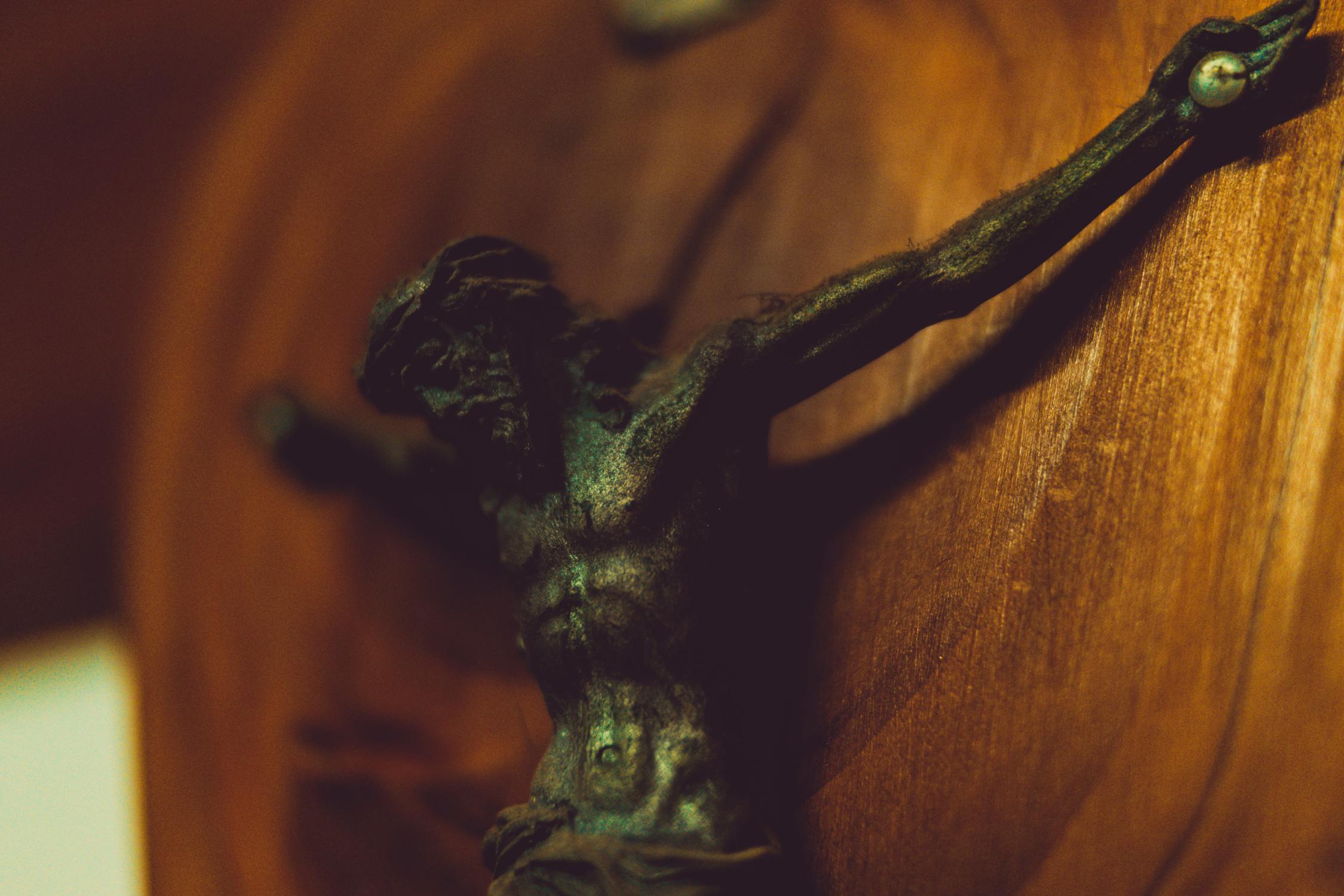
But as we look wider than just this passage, we find a couple of significant references to the snake. The first is that it becomes an object of idolatrous worship; the second is that it becomes a picture of Jesus’ death on the cross. John 3:15-16 refer back to this incident, and make the point that in a world of sin God showed his love towards the human race by lifting up his son on a wooden cross in order that those who chose to turn and look to him could be set free from the richly-deserved punishment for their sin. If you haven’t already found them, you might be interested in my series of four podcasts on John 3:16, which you can find here. But the first reiteration of this story is far more sinister. 2 Kings 18:4 tells us that the bronze snake had been given a name (Nehushtan) which means ‘The Great Serpent’ (or possibly ‘The Great Brass’, but in either case it’s ‘great’). It had also become an object of worship for the Israelites, who had been burning incense to it, in direct contravention of the second Commandment (Ex 20:4-5). So it had to be smashed up in order to prevent this idolatry.

What is interesting here is the fascinating reversal by which people moan at the true God, in an escalation of past stories where they only moan at Moses, but then go on to make a false God to worship. There is something deeply human about this. We love to put down God, and those who worship him, through posters on the side of buses, through the way we blame him for whatever goes wrong in our world, and through our failure to give thanks to him for what he has given to us (Rom 1:21 – the subject, by the way, of a series of podcasts coming to revjohnleachblog soon. That’s enough shameless plugs. Ed.). But then we do actually need objects of worship, so we create other things like the latest car, the next computer game, that long-awaited holiday, or our lottery tickets, to do what idols do, which is to rivet our attention, centre our activity, preoccupy our minds, and motivate our action. And of course even Christians aren’t immune – Israel was after all God’s chosen nation. It can be so easy to make that which is meant to turn us to Jesus into an object of worship in its own right, whether that be a particular style of worship, our favourite Prayer Book, the singing of worship-songs, the bread and wine of Communion, the furniture and equipment of our churches, a ‘lucky’ cross, or our favourite preacher on the God Channel. It’s all so easy, and all so tempting. This story reminds us that no bronze snake, nor any man-made stuff, can save us from the sin which is so viciously out to get us. Only looking to Christ crucified can do that. In a couple of weeks’ time we’ll have a special opportunity to gaze at Jesus on the cross, as we celebrate Passiontide. Let’s not see other things instead.

OT Lectionary

For those who want a change from the Gospel

Lent 3 – Exodus 20:1-17

Today’s passage is a very familiar one – what generations of Christians have called ‘The Ten Commandments’. But familiarity can breed contempt, and it can lead us to believe that we understand the passage fully. On one level, of course, understanding isn’t really the point – we just have to obey these commandments if we want to please God. But as always, to place this particular few paragraphs in their wider context will help us to see more of their richness.

The context, as far as our lectionary is concerned, is the idea of Covenant – this is the third OT covenant we have looked at during Lent. We have said that covenants are agreements between two parties, one stronger than the other, and that they are usually mutual, although the first, with Noah, was entirely one sided in that it was about what God would do for the human race, with no quid pro quo back the other way. This covenant is clearly different: God would be their God if they lived in these kinds of ways. But let’s put that idea in a bigger context. If these words are about what the people have to do, look at what God has already done. He has heard the cries of misery of the enslaved people; he has called Moses to set them free; he has revealed his divine name to the people, and through a series of mighty acts he has led them out of slavery, opened the Red Sea, and destroyed utterly those who would still be out to get them. It is also interesting that the preface in v.2 begins ‘I am the Lord your God’. This is crucial: the people do not keep these laws so that they can be in a relationship with God: they keep them because they are already in a relationship with God.

Secondly, though, let’s have a look at the words used here. Interestingly the word ‘commandments’ isn’t used anywhere in this passage. In the Hebrew they are simply the ten ‘words’. We might appropriately translated this as ‘teachings’, not commandments. And of course when you think about it, how can you command someone to love? Rather than being the hard and fast legal commandments we have thought them to be, these are much more like wise teachings for the smooth running of society. Actual Laws come later. These teachings are the basis of their covenant: God has done all this for you, he has become your God, so it would make good sense for you all to live like this.

As Christians there are clear parallels here, which St Paul is going to explore at length in his writings. As Christians we are not saved because we do what Jesus wants us to, or more specifically we don’t do what he doesn’t want us to do. We live in a particular way because of what Jesus has done for us, because of the relationship which he as initiated. I don’t pick up my dirty socks from the bedroom floor in order that I can be married to my wife: I do it because I have come to discover over the years that that is what she likes me to do, and my greatest aim in life is of course to please her. Paul is insistent that we are not saved by keeping the Law, even if we could, but because of what Jesus has already done.

But of course Paul then has to go on and answer the question ‘So what’s the point of the Law at all?’ His answer is twofold. The Law shows us how bad we are, and it stops us being worse. If there was no Law, we couldn’t break it. We could do exactly what we liked. Before March 18th 1935 there were no speed limits on British roads, so it was impossible to be nicked for speeding. But as soon as it was introduced, it was possible for people to break the law and become criminals. The Law suddenly showed people that they were sinners. But it also stops us being worse. Many people drive at 80 or 90 on British motorways because the legal limit is 70. But if there were no speed limits: well, suffice to say that I once got up to 125 on a German autobahn. We might break the law, but not as much as we would if it wasn’t there.

These Ten Teachings, therefore, are not there to show us how to enter into a relationship with God. They are there to show us what pleases him in the organisation of a society run with wisdom, love and care. And of course Jesus upped the stakes considerably when he expanded the Law to include what we thought as well as what we did. Without these Teachings, which, interestingly form the basis of the Laws in many many countries of the world, we would all be a lot worse, but even as we are we need a Saviour. No way could we do all this alone, and no way could trying to do so earn us God’s favour.

OT Lectionary

For those who want a change from the Gospel

Lent 2 – Genesis 17:1-7, 15-16

Last week our lectionary invited us to consider God’s covenant with Noah, and his promise never to flood the earth again. This week things move on, and Abram is the new partner in God’s purposes and their outworking through history. This time the covenant is a little less one-sided and unconditional: in v.1 Abram is instructed to ‘walk faithfully and be blameless’, echoing the description of Noah in 6:9, in sharp contrast to the rest of the human race. What’s in it for him? God promises him four things: descendants, a home, a new name, and a new badge. The third of these, the new name, is immediate. Abram the great father becomes Abraham the father of many, and Sarai the Princess takes on the much more honorific title ‘My Princess’. The fourth, circumcision, happens the same day (17:23), and functions in a way similar to the rainbow in Gen 9. It is an irreversible mark to remind not God but his people of the sacred relationship into which they have entered.

But what of the other two promises? Clearly they are not going to have happened before the end of that day. In fact they set the scene for much of the rest of the OT, and beyond. Their fulfilment is beset with obstacles to be overcome, dangers to be faced, and faith in God to be tested to the very limit. The first challenge is about the descendants part. Rather than the (to our culture illegitimate) son born to Hagar, Sarah’s servant, God promises that Sarah herself will give birth, an idea so ludicrous that Abraham falls about laughing. Even after, against all odds, Isaac is born, the next test is that God orders his sacrifice. And so the story goes on. The promise of the land as an eternal possession is even more difficult: first Abraham’s descendants must face famine, enslavement in Egypt, wandering in the desert, and finally the conquest of the Land against powerful enemies who, quite naturally, are not keen to be driven out. Even when it has been gained, the land is lost again, and the remaining Jews exiled to Babylon. Then it is occupied by one empire after another, and still today it forms a battleground between the descendants of Abraham’s two sons. So what of the covenant now?

The story serves to remind us of two things: that God’s promises are sure, and that they can be frustratingly slow in coming to fruition. Abraham’s faithless and cynical laughter must have been echoed hundreds of times down the centuries by people who had heard or sensed a promise which seemed totally impossible. Could God really make a ninety year old woman pregnant? Could he really feed them when the nearest grain store was in Egypt? Could he really free them from slavery, or from exile, or from Roman domination? These questions straddle both Testaments, and are alive and well in the Church today. Could God really get rid of Covid? Could he really provide for me the money I need, the job which has been snatched from me, a husband or wife at my age, healing from my cancer? The agonising questions go on, and maybe you have some in your life too. Are God’s promises meaningless? And if so, is he there at all?

Lent allows us, and in fact encourages us, to ask these kinds of questions. We’re used to thinking of it at a time when we focus on what we have done wrong to God – ‘Against you only have I sinned’, admits the Psalmist (51:40). But it is also a time for lament for what God has done to us, or what he has failed to do for us. The cry ‘How long, O Lord?’ echoes through the Psalms as people cry out in their frustration that God hasn’t just got on and done it, and can be used just as appropriately today in a world still waiting for the healing of all creation.

It is as though we are stretched on one of the mediaeval racks, with God’s covenant promises and his timing pulling us to bits from each end, and my goodness it hurts! I have no easy answers for you, other than describing how you might be feeling, acknowledging that others feel the same, and promising you that Easter is on its way. God seems to have set things up with frustration built in, presumably because he believes it is good for us, building character and strengthening our spirits. Lent encourages us to keep hanging on (as though we had much choice), but it also promises that just as God was faithful to Abraham, so he will be to his descendants for ever.

OT Lectionary

For those who want a change from the Gospel

Lent 1 – Genesis 9:8-17

For the first three Sundays of Lent our Lectionary gives us a mini-series, exploring three covenants made by God with Noah, Abraham, and Moses. So we will need to begin with a quick review of what a covenant is, so that we can then go on to explore the unique features of each of these three, and what they can each tell us about our God and how we relate to him.

In the Ancient Near East covenants were two-a-penny. They were often made between two parties, and usually involved some kind of deal with a quid-pro-quo clause, although they were not often equal in nature. For example a conquering king might make a deal with those he has defeated not to destroy them completely as long as they don’t attempt to rebel. The covenant would require the agreement and compliance of both parties, even though the power balance was clearly unequal. In our world perhaps the most common form of covenant is marriage, and one hopes that this deal will be a little bit less one-sided! Covenants are usually sealed with some legal paperwork (or perhaps stonework), and perhaps other symbols, such as wedding rings.

God’s covenant with Noah isn’t in fact, with Noah alone, but with the human race and the animal kingdom. Unlike most covenants this one is completely one-sided: there are no demands at all on humans, but merely a promise from God. This is one reason why people talk about the ‘unconditional love’ of God, which you may have heard me try to debunk in my podcasts on John 3:16, although the word ‘love’ does not feature in this passage at all. Taken in context of the other two covenants which we shall be examining, this one is a great starter for ten. It reveals something important about God, and is a good foundation for the more typical forms of covenant to come. This one may look unconditional, but the others certainly aren’t. Indeed only two verses before our passage for today is a command for capital punishment for murder, so the text will not allow us to go overboard on unconditional love.

So what’s the deal? In context God has wiped out most of the world population of humans and animals in an attempt to purge evil from his beautiful world. It clearly didn’t work, as the very next paragraph shows that the hero, Noah, is no better than anyone else when he’s had a few tinctures. And two chapters later we see the human race in arrogant rebellion against God at Babel. But the promise is there anyway: never again will God wipe out life from the earth with a flood. That is important: God does not promise never to destroy the earth, only that he will never flood it again. The text emphasises two things about this deal: universality and eternity. The covenant is with ‘you and your descendants … and with every living creature’. Whilst we’re going to see next week a special covenant with one particular race, that isn’t the original and best. This is about all living creatures. And it is for ever: the words ‘never again’ are repeated for emphasis.

The sign, the ‘wedding ring’, for this deal is the rainbow, a powerful and beautiful symbol which has been reappropriated (or ‘hijacked’, some might say) by the campaign for a united South Africa, the Gay lobby, and more lately, for reasons which are not clear, by supporters of the NHS. The range of colours speaks of inclusion, as do the words which emphasise that this deal is for all life for all time, and from a meteorological pint of view rainbows happen at the conjunction of rain and sunshine, reminding us that clouds literally have a silver lining.

This covenant, then, forms a little oasis in the desert of human sin and divine judgement. But it does reveal one more important thing about God, the fact that he ‘feels’ for his world. The Greek philosopher Aristotle thought of God as a ‘unmoved mover’, the one who causes stuff to happen but is completely untouched by any of it, perhaps like chess player who moves the pieces around but feels absolutely nothing for the pawn he has just sacrificed. The flood narrative, terrible though it is if we get beyond the Sunday School story and really wrestle with it theologically, reveals a very emotional God. He regrets, grieves, and now remembers. He draws up this covenant precisely because he has not simply washed his hands of the human race. He desires ongoing relationship with them, just as his Son is later going to be described as having chosen a Bride for himself for eternity.

Noah, then, offers us a paradox, one in which Christians live daily. God makes an unconditional promise to the human race, which demands nothing back from us, and yet he desires a response, a relationship, and, as we shall see soon, obedience. Christians talk about not being good in order to be saved, but being good because we have been saved. Noah introduces us to this idea by showing that the initiative first comes from God towards us, but we have to understand this alongside Abraham and Moses. So come back next week!

OT Lectionary

For those who want a change from the Gospel

Sunday before Lent – 2 Kings 2:1-12

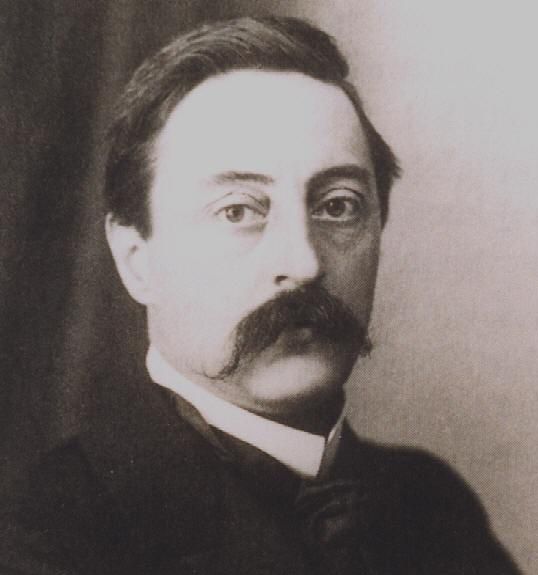
Arnold van Gennep was a French folklorist who lived from 1873 to 1957, and is most famous for his work on ‘Liminality’, describing what have come to be called ‘Rites of Passage’, or little ceremonies we pass through when things change in our lives. He identified three stages, the pre-liminal, the liminal, and the post-liminal (‘limen’ is the Latin word for a doorway or threshold). So a marriage, for example, is a ceremony which moves a couple from being two distinct people to one couple. In the pre-liminal phase couples arrange the wedding, go shopping for stuff for their house, try on dresses and suits and generally think their way into being married. The actual wedding day is the liminal phase, and then post-liminal life is about making it all work out in reality rather than fantasy!

The transition from Elijah to Elisha as being the key prophet in Israel is a story of liminality par excellence. It isn’t just a journey through change: there’s a physical journey too. In fact the journey is a reversal of Joshua’s route into the Promised Land, as they retrace his steps across to the far side of the Jordan, and the next section is going to show us Elisha returning alone to begin his ministry.

As with a wedding, a funeral, childbirth, a move from Cubs to Scouts or any other rite of passage, there are more people involved than just the immediate protagonists. In this story there are three ‘characters’: Elijah, the outgoing incumbent, Elisha his successor, and the ‘company of the prophets’, a kind of theological college full of students for ministry. All of these ‘characters’ plays their part in the narrative. The company sound a bit insecure at the thought of an incoming boss, and don’t seem quite sure what to make of Elijah or the coming transition. Elijah seems to want to shake off Elisha – perhaps he feels that his ministry is being ended prematurely and wants to busy himself and put off the evil day. Or maybe he’s testing Elisha – just how committed are you to this task? Wouldn’t you rather just stay where you are and put your feet up? And Elisha doggedly follows his master, determined not to miss the spectacular departure, and keen to take over the role with the Spirit’s help.

Times of transition are never easy to negotiate, even when the rite of passage is entirely positive and hoped for. There’s insecurity in the air, anxiety about how we will all play our parts in the story, and what the post-liminal phase will hold. There will be sleepless nights with a new baby, desperate grief after the death of a loved one, fears about how we’ll cope at a new school, university or job …

Today represents the pre-liminal part of Lent, which is of course itself the pre-liminal part of Holy Week and Easter. So what will it be like? And especially what will it be like this year? Our church has invited us to a virtual imposition of ashes via YouTube, reminding us of the importance of touch and action in our faith and our worship. What can we ‘give up’ when we have already given up so much for the past year? What might we ‘take up’ when we’re either rushed off our feet with homeschooling and working from home, or we’re furloughed and have already found more time than we know what to do with for prayer and Bible-reading.

But no-one need have worried – this is a story of the action of God, not the action of human beings. The company seem to adjust well to their new boss, even though his style is very different from that of his predecessor. God clears the way for Elijah’s ascension, opening the river in a reversal of Joshua’s entry into the land, and, when challenged in v.14 he proves his presence with Elisha by letting him back in. God’s ministry is going to continue whatever, and no-one need worry about that.

Where would you put yourself in this story? I’m Elijah: recently retired but keen that anything I might have achieved in 40 years of ministry will continue to bear fruit, although I’m sure in some ways I had never expected. Some of us might be contemplating some kind of a new role, and feeling a bit anxious about it. Will we be up to the task? Like Elisha we might be hungry for the anointing which the Spirit brings: God knows that and grants his request. By the way the ‘double portion’ in v.9 doesn’t mean that Elisha wants to be twice as good at it as Elijah was – it simply means he wants to be the heir – the eldest son who gets twice as much as any other heirs, and who will take over the family business.

Or maybe you feel like you’re in the crowd scene, where others play the major parts and you have no option but to get caught up in it and have your life changed by the actions of others. I guess we’re all feeling that quite a bit at the moment as our lives are governed and restricted by a little virus too small to see.

But the message here is that through change and chance God still leads on, doing what he wants to do, appointing and disappointing people who will influence the lives of others, and working towards what we know will be the end of the story, the making of a new heavens and a new earth. Lent reminds us of the insecurity of this life, our addiction to sin, and our need to be changed and blessed by God. But maybe what we need most of all this year is to rest in the loving arms of a God whose purposes can never be thwarted, who is never surprised by what goes on in his world, and who has promised that whatever changes he will lead us through and weave everything together for good.