Old Testament Lectionary

For those who want a change from the Gospel

Easter Day – Jeremiah 31:1-6

Jeremiah is not known as one of the most cheery or celebratory of the OT prophets, apart from that bit in chapter 29 which well-meaning people write on cards to you about God knowing the plans he has for us, a passage we might send a lot less if we consider what actually panned out for Jeremiah! But amidst the doom and gloom there are passages of hope which shine out, and todays OT lectionary reading is one of them, and it seems appropriate for this day of celebration, muted though it might be this year.

In fact all the OT prophets have to juggle the twin themes of judgement and salvation, of punishment and restoration. In our passage the people whom God has loved with an everlasting love are the same people who have survived the sword. The words of hope and future blessing in v.4-5 are spoken to people oppressed, exiled and far from home.

This tension, between judgement and promise, is one which Christians today have to negotiate too. So what does Easter Sunday have to say to us about it? Maybe there are three things in particular that it will not let us believe in.

It will not let us believe in cheap grace. Theologian Dietrich Bonhoeffer, who was to lose his life under the Nazi regime in Germany, coined the term to mean ‘the preaching of forgiveness without requiring repentance, baptism without church discipline, Communion without confession. Cheap grace is grace without discipleship, grace without the cross, grace without Jesus Christ, living and incarnate.’ In other words we celebrate the triumph of Easter through the lens of the cross, knowing that the resurrection is the way of salvation for those who understand their desperate need of a Saviour, and who commit themselves wholeheartedly to him from this day forward. Jeremiah’s words of hope come to those who know punishment, and are living with the consequences of sin.

It will not let us believe in a vengeful God. The fact that the prophets had to cope with both the anger and the mercy of God witnesses to this. Punishment is never something God does, and certainly not what he enjoys doing: it is simply the consequences of disobeying and rejecting his will. We do that all the time, of course, and sometimes we pay the price, but his perfect will is never vengeance or retribution, but rather forgiveness, reconciliation and restoration. Today we celebrate, in the words of the Christmas carol, ‘God and sinners reconciled’.

It will not let us believe that this is all there is. This morning I woke up to the news that a very good friend had just died from Covid-19 – the first time the pandemic has really come that close to our family. In the announcement of his death I was struck by the phrase ‘He is more alive now than he has ever been’. Resurrection opens the gates of glory to all who choose to walk with Christ through them, and while we might read Jeremiah’s promise of eternal tambourine-playing as a picture of heaven (I so hope that it isn’t!) there is both a present and a future power to the truth of the resurrection. There is nothing that can’t be undone by God, no situation too powerful for him to turn around, but, as the young men in the furnace realised, if not, there is still eternity.

This is a very strange Easter Day, but our resurrection hope is for far more than a return to ‘normal’ as soon as possible. Indeed there are many things I hope will never be normal again. Our hope is eternal, and, like Job, even if he slays us, yet will we hope in him.
Covid Podcasts

From the Diocese of Lincoln’s Homilies Project

Easter Day

Conversation Questions

  1. As you think of our world today, what does the word ‘resurrection’ mean to you?
  2. As you hear the readings today, what does the word ‘resurrection’ mean to you?
  3. What would you like to say to Jesus today?
  4. What would you like to hear him say to you?
  5. Is there anything else from the passage not already discussed that speaks to you? What is it?
  6. What will you do this week in your Monday-to-Saturday ministry in response to what you have heard today? #everydayfaith

Holy Saturday

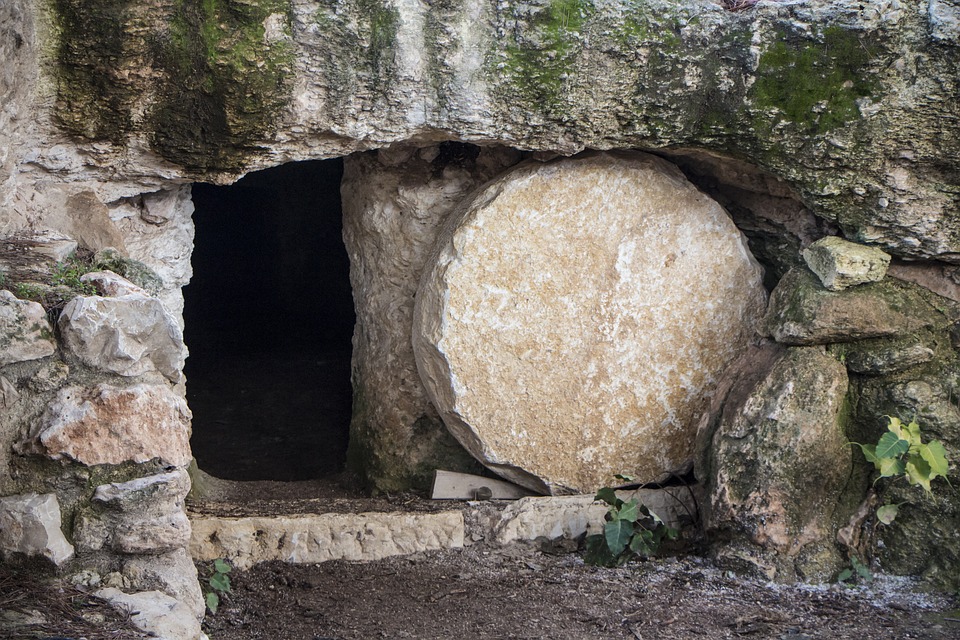
Yesterday I gave you my favourite collect: today I offer my favourite poem. It’s called ‘Good Friday Evening’ but I love it on this day of nothingness, of waiting, of wondering …

Now lies the Lord in a most quiet bed.
Stillness profound
steeps like a balm
the wounded body wholly,
more still than the hushed night brooding around.
The moon is overhead,
sparkling and small,
and somewhere a faint sound of water,
dropping,
in a cistern,
slowly.
Now lies the Lord in a most quiet bed.

Now rests the Lord in perfect loneliness.
One little grated window has his tomb,
a patch of gloom
impenetrable,
where the moonbeams whiten
and arabesque its wall
with leafy shadows, light as a caress.
The palms that brood above the garden brighten,
but in that quiet room
darkness prevails;
deep darkness fills it all.
Now rests the Lord in perfect loneliness.

Now sleeps the Lord secure from human sorrow.
The sorrowing women sometimes fall asleep
wrapped in their hair,
which, while they slumber,
yet warm tears will steep,
because their hearts mourn in them ceaselessly.
Uprising, half-aware,
they myrrh and spices and rich balms,
put by for their own burials,
gather hastily,
dreaming it is that morrow
when they the precious body may prepare.
Now sleeps the Lord secure from human sorrow.

Now sleeps the Lord unhurt by love’s betrayal.
Peter sleeps not.
He lies yet on his face and has not stirred
since the iron entered in his soul red-hot.
The disciples, trembling, mourn their disillusion
that he whose word
could raise the dead;
on whom God had conferred power,
as they trusted,
to redeem Israel,
had been that bitter day put to confusion,
crucified and interred.
Now sleeps the Lord unhurt by love’s betrayal.

Now rests the Lord, crowned with ineffable peace.
Have they not peace tonight who feared him,
hated and hounded to his doom,
the red thirst of their vengeance sated?
No, they still run about and bite the beard,
confer, nor cease
to tease the contemptuous Pilate,
are affeared still of Him tortured, crushed, humiliated
cold in a blood-stained tomb.
Now rests the Lord, crowned with ineffable peace.

Now lies the Lord, serene, august, apart,
that mortal life his mother gave him ended.
No word save one
or Mary more,
but gently as a cloud
on her perdurable silence has descended.
Hush! In her heart
which first felt the faint life stir in her Son
perchance is apprehended
even now new mystery;
grief less loud clamours,
the Resurrection has begun.
Now lies the Lord, serene, august, apart.

Margaret Louisa Woods (1856-1929)

Covid Podcasts

From the Diocese of Lincoln’s Homilies Project

Holy Saturday

Conversation Questions

  1. What does living through this ‘Holy Saturday’ period feel like to you? Can you relate to some of the feelings which the disciples must have experienced?
  2. What difference does the fact of the resurrection make to you at this period of your life?
  3. How does your hope in Jesus equip you to be good news to others during this period of isolation?
  4. Is there anything else from the passage that speaks to you? What is it?
  5. What will you do this week in your Monday-to-Saturday ministry in response to what you have heard today? #everydayfaith

Old Testament Lectionary

For those who want a change from the Gospel

Good Friday –  Isaiah 52.13 – 53.12

 ‘Tell me, please, who is the prophet talking about, himself or someone else?’ asks the Ethiopian official in Ax 8. This question has provided hours of fun for theological students down the ages, but of course we all know that this was a prophecy about Jesus’ passion which was to happen 500 years or so in the future. Or was it? Of course it is easy to see how the NT writers could see Jesus as having fulfilled this and other OT passages (such as Psalm 22, the Psalm set for today), but to read this merely as a fulfilled prophecy is to break the golden rule of hermeneutics (interpretation): ‘a passage means what the original author meant the original hearers to understand by it’. That’s why context is so important. So we need to forget Golgotha for now, and ask about historical and literary context.

The passage is part of the writings of ‘Deutero-Isaiah’, an unknown prophet who ministered in Babylon towards the close of the exile, and whose works were attached to the book of Isaiah of Jerusalem written around 200 years earlier. Chapters 40-55 of our book of Isaiah are essentially an extended commentary on its first couple of verses:

Comfort, comfort my people,
    says your God.
2 Speak tenderly to Jerusalem,
    and proclaim to her
that her hard service has been completed,
    that her sin has been paid for,
that she has received from the Lord’s hand
    double for all her sins.

The exile is coming to an end, and the people will soon be on their way home.

Part of this writing is four ‘Servant songs’ of which our lectionary passage is the final. Like the Ethiopian eunuch, scholars have debated long and hard who it is that these songs refer to, but the general consensus is that the nation as a whole is God’s servant. They have been battered, disfigured beyond all recognition, they have been the recipients of violence and cruelty, but through all this suffering salvation is coming. The nations will discover through Israel the way to salvation, and will come to her to find wisdom and life. And – and here is the most profound message of this passage – this wounding and suffering didn’t happen by accident, or simply because of the cruelty of others. It was all within God’s plan. Through suffering salvation comes.

Of course it is easy to see how Jesus fits the bill perfectly, and there are some uncanny similarities between the sufferings of exiled Israel and their archetypical manifestation in Jesus the Jewish Messiah. Of course the NT writer could not help but write up Jesus’ passion using the language of Isaiah 52-53. But what a contextual reading of the passage tells us is that the ‘salvation through suffering’ motif belongs not just to Jesus but also to his followers. On this day the Church traditionally prayed for all ‘Jews, Turks, Infidels and Hereticks’, a somewhat politically incorrect reminder that down the ages God’s people have suffered persecution at the hands of others (Common Worship prays more sensitively for ‘God’s ancient people’ and for greater understanding). But the fact is that today Christians around the world are in exile of various kinds, are treated cruelly and even martyred for their commitment to Jesus. Jesus’ followers are indeed called to take up our crosses and follow him. We can’t, of course, win our own salvation through suffering, but we do walk the path of the cross because of the salvation won by our pioneer.

My personal favourite collect was the one we used a few weeks ago on Lent 3, but it is as relevant today as then:

Almighty God,
whose most dear Son went not up to joy but first he suffered pain,
and entered not into glory before he was crucified:
mercifully grant that we, walking in the way of the cross,
may find it none other than the way of life and peace;
through Jesus Christ your Son our Lord,
who is alive and reigns with you,
in the unity of the Holy Spirit,
one God, now and for ever.

Amen.

Common Worship: Services and Prayers for the Church of England, material from which is quoted here, is copyright © The Archbishop’s Council, 2000

Old Testament Lectionary

For those who want a change from the Gospel

By Edsel Little – Passover Seder 5771 – The Seder Plate, CC BY-SA 2.0, https://commons.wikimedia.org/w/index.php?curid=78085308

Maundy Thursday – Exodus 12:1-14

Why this blog series on the OT readings from the lectionary? For two reasons: firstly, I love the OT and feel keenly its neglect in a church which has become in practice if not in theology virtually Marcionite*, and secondly because there is so much richness to be found in its take on some of our lectionary themes. Maundy Thursday is perhaps one of the most guilty manifestations of Gospel-centricity: I’m sure that in the vast majority of churches sermons or meditations today will be about servant leadership and/or the importance of the Eucharist. But by looking at the OT background we can add layers of richness to the tired and politically correct footwashing narrative.

So what themes emerge from the instructions given for the first Passover? The immediate thing to strike me was the sense of new start: ‘This month is to be for you the first month, the first month of your year.’ v.2. The Passover represented a brand new beginning’. That’s the significance of unleavened bread. Part of the previous batch of bread would be left to go mouldy, and that would form the starter yeast for the next. So to eat bread without yeast meant a sharp discontinuity and the need to start from scratch after the break. We might meditate on the discontinuity for us before and after coming to Jesus on the cross, particularly in these days when we are told that ‘Damascus Road’ conversions are no longer the ticket.

Then there is the theme of salvation, seen here as rescue. After nine unsuccessful plagues God was about to unleash his most powerful weapon, and this, finally was going to be the means through which Pharaoh’s will was broken and the Israelites freed. Now it is the Father who loses his Son, and we who can be set free from the cruel and oppressive rule of sin in our lives. Again, my guess is that we rarely see it like that, and that for most of us Jesus is the icing on the cake of a comfortable life, not the means of rescue from a life bound for destruction. This can lead to a devaluing of the cross and a cheapening of what Jesus has done for us. It really is rescue.

Thirdly, how about the sense of journey? One of the memorable events in our family history is of eating our meal on Maundy Thursday with our coats and hats on and with walking sticks in our hands (no easy task). Our grown-up boys still talk about this, and the symbolism contains elements of haste and urgency, and, we know from hindsight, a long and winding journey to freedom. The footwashing symbolism is about arrival and preparation for the banquet: the Passover is about setting out. The cross is for us both a departure and an arrival. In the famous words, we have been saved, we are being saved, and we will be saved. But we have a long journey of sanctification, becoming more like Jesus, ahead of us, and our Passover meal provides rations for that journey.

My fourth theme from the Passover institution narrative is a particularly poignant one at the moment: that of sharing. Verses 3-4 give instructions for the meal to be shared with others, and God’s care for the solitary, whom he sets within families (Ps 68:6), is shown in this caring passage. Today we will worship via the gift of Zoom or Facebook, and sharing with others, particularly those who have no-one else, will need more creativity than usual. Let’s remember that what we are being called to by our government is physical distancing, and need not mean social distancing, and as we remember and journey forwards, let’s remember those with whom we walk.

*Marcion of Sinope was a 2nd century heretic who taught that the God of Jesus was a different God from the one of the OT, and so tried to expunge from his Bible the OT and all NT references to it. It was a very thin book!

Covid Podcasts

From the Diocese of Lincoln’s Homilies Project

Maundy Thursday

Conversation Questions

  1. What are the challenges you face in loving one another?
  2. What do you think your church community is known for in the parish?
  3. Is there anything else from the passage not already discussed that speaks to you? What is it?
  4. What will you do this week in your Monday-to-Saturday ministry in response to what you have heard today? #everydayfaith

Covid Podcasts

From the Diocese of Lincoln’s Homilies Project

Palm Sunday

Conversation Questions

  1. What most struck you hearing this familiar passage afresh today?
  2. What do you think it means for Jesus to be king in our lives, our families, our town/village/community and our world today?
  3. Is there anything else from the passage not already discussed that speaks to you? What is it?
  4. What will you do this week in your Monday-to-Saturday ministry in response to what you have heard today? #everydayfaith

Old Testament Lectionary

For those who want a change from the Gospel

Palm Sunday – Psalm 118

The NT writers saw many OT passages, including the Psalms, as being fulfilled by Jesus in his earthly ministry. Ps 118 has long been associated with Palm Sunday, and it is not difficult to see why. The Psalm is a complex one, and our lectionary fillets out the middle section, which seems less easy to apply to Jesus’ triumphant entry into Jerusalem. But what was the Psalm about originally? Was it merely a prophecy about something which was to happen centuries later? What would the original users of this Psalm have made of it?

Like Psalms 15 and 24 it looks very much like an entrance liturgy, rather like an introit in churches today, and may have been used at the gates of the city by pilgrims coming for one of the festivals, probably the Feat of Tabernacles. Like Psalm 24 it is a kind of antiphonal ‘Who goes there? Friend or foe?’ kind of dialogue at the city gates. This is an important question, because the ‘gates of righteousness’ of verse 19, or, more correctly, ‘the gates of the righteous’ are there to allow only those who are righteous to come in, and to keep out anyone else. The congregation assert that they are allowed in, because God has been good enough to save them and therefore to declare them righteous. They are stones which have been rejected, but are now seen to be important enough to be part of the building of God’s people, all because of the grace of God. God has acted this very day, not at some remote point in history, and so it is a day of rejoicing. So, as God’s people, let’s go! Join in the procession, and come to worship the God who has saved us and declared us righteous.

This is an interesting twist on the Psalm which is so often read as being about Jesus. Yes, he was rejected but then exalted, and yes, he did ride into the city in a triumphal procession, but that is NT spin, not OT exegesis. So today let’s make the bold step of reappropriating the Psalm for ourselves, because it is about us, not about Jesus. We are those who this world so often counts as nothing, labelling us as ‘religious nuts’, ‘hypocrites’, ‘losers’ and several other less than flattering epithets which are often flung at Christians. But God has welcomed us! God has forgiven us, set our feet on a rock, turned our lives around, and invited us to join in the procession of worship.

Andrew Lloyd-Webber’s Superstar Jesus gets this nuance completely:

Sing me your songs,
But not for me alone.
Sing out for yourselves,
For you are blessed.
There is not one of you
Who cannot win the kingdom.
The slow, the suffering,
The quick, the dead.

In this difficult period of isolation, fear and anxiety, let’s sing out for ourselves this Palm Sunday, for we are indeed blessed, and privileged beyond all measure.

What did Covid-19 ever do for us?

Monty Python: What have the Romans ever done for us? - YouTube

Like the Romans in 1st century Palestine, the Covid virus is nasty, cruel, all-pervading, and has killed a lot of people. Our hearts go out to those who have lost friends or relatives, to those sick with the virus, and to many more feeling vulnerable and frightened. This post is not in any way intended to be insensitive or superficial, but a discussion earlier today made me begin to wonder what grains of comfort we might find in the midst of this crisis. It’s an ill wind blows nobody any good, they say. So might there be some positives for those with a mind to look for them? The more I think about it, I can see the potential for appreciation of the more positive side-effects of these disastrous times.

I can become thankful. I know that for extraverts this is a highly difficult time, but I’m actually quite enjoying it as a introvert. I’m thankful that, courtesy of the C of E, I have a lovely roomy house in which to be locked up, with a lovely garden in a tree-lined street. I give thanks for the technology which can allow me to communicate with others, but then put them on mute, and for a freezer full of food which needs eating up. Little things which I have always taken for granted now become opportunities to give thanks to God.

I can become prayerful. The other side of all this, of course, is that so many people don’t have any of those things for which to be thankful. I know that I am pretty privileged, but that fact can encourage my prayers for those who aren’t, like that bit we often tag on the end of our grace at meals about God making us mindful of the needs of others. So my heart goes out to those in accommodation they hate, or none; with people they don’t get on with, or even those who might harm them; those struggling without income and worried about food. Such people have always been there, but today I am much more aware of them.

I can read and study. Christians often have the mindset of going to church once a week ‘to be fed’. Whilst church leaders are working with technology to make virtual worship and teaching available, and climbing an almost vertical learning curve, what a glorious opportunity for Christians to get their Bibles off their shelves and just spend time reading and praying. Biblical literacy is at an all-time low in our nation, and a weekly dose of ‘a thought I had while I was reading the gospel for today’ will never breed biblically confident disciples. There are all kinds of resources out there for individual Bible Study, and all kinds of blogs and podcasts like this one which can help us engage with Scripture on our own or in small virtual groups.

I can be a good neighbour. I can remember a speaker once asking what was the next stop on from discipleship. The expected answer came, of course – Leadership. But the speaker disagreed: the next step for good disciples is to become good citizens. Citizenship is a much neglected subject in our preaching, yet a vital ingredient in NT discipleship. This current crisis is a wonderful opportunity to be even better neighbours, even better members of our local communities, even if we have to do it down the phone. Roman Emperor Julian wrote in the 4th century complaining that ‘it is a disgrace that . . . the impious Galilaeans [Christians] support not only their own poor but ours as well.’ Elsewhere he urged that the Roman Empire should copy what the Christians were doing in terms of social services. Now’s our chance!

I can work better. Whilst I have plenty to do, it is interesting to notice how my working life is changing. I’m actually stopping for lunch, rather than eating a sandwich at my desk in the office while keeping going. I’m spending time each day on that cross-trainer which I had previously used for hanging towels on. I’m being forced to become a learner as well as a teacher, and I’m being encouraged to rethink all I thought I knew about how to teach. Paradoxically I’m finding myself less likely to pop into my study during the evening just to do something or other for 10 minutes: when my working day ends, the study door closes.

I can imagine a different future. When our world is rocked our natural desire is to get things back to normal as soon as possible, and the broadcasting of virtual services is a manifestation of this: how can we keep the show on the road as near as possible to the way we used to do it? That is all good, and we need to do that, but I’m really hoping that in some ways Church won’t return to normal. Perhaps Covid can challenge our idolatry of our buildings, our passive and unthinking going-through-the-motions services, our dependence on the paid professionals, and our desire to be fed rather than to feed ourselves. Perhaps we are learning to be church instead of going to church.

I’m finding myself praying about Covid a lot, of course – aren’t we all? But I tend not to pray ‘Lord, take this away and help us all to resume normal services as soon as possible’. Instead I’m praying that we will learn quickly whatever it is that God is wanting to teach us through this time of the shaking of the foundations.

So what has Covid done for you?