OT Lectionary December 7th Advent 2 Isaiah 40:1-11

Regular thoughts on the oft-neglected Old Testament Lectionary passages.

Usually it’s good to hear a passage read before listening to a sermon about it, but I have found that there is great impact from this particular text if you do it the other way round. It marks the transition from Isaiah of Jerusalem to so-called ‘Deutero-Isaiah’, who was writing around the end of the exile in Babylon. So why not just take a moment to think yourself into the world of his original hearers?

You’ve been snatched from your homeland and marched across the desert to a strange, foreign land with a weird language, an unknown culture, all kinds of alien gods. You are suffering from what sociologists nowadays would call ‘cultural dislocation’, with all its attendant anxiety. Some of you are working like slaves at hard physical toil, under taskmasters who can be extremely cruel.

But at a level deeper than the mere physical and mental pain there are a set of theological questions to be answered. What are we to make of God in this current situation? Prophets (like Isaiah) have been warning you that unless you turned back to God you’d be in trouble, but, hey, those prophets can get a bit grumpy: they need to lighten up a bit and enjoy life. Maybe they were right all along, and God has washed his hands of us. We know that God has been patient with us for years, but now maybe we’ve blown it once and for all. He’s used up all his mercy and now we’re on our own.

Or maybe there’s a different problem. Lots of the nations around us treat their gods as though they were in the Anglican parish system. Depending on where you live you have a different god looking after you. So while we were back home in Jerusalem Yahweh was our God, but now we’re in Babylon, have we moved out of his patch? Should we be praying to Bel, Nebo or one of the others to save us? We know our God is a mighty God, but maybe his power doesn’t extend this far.

Or is it about punishment? OK, we can now grudgingly admit that we might just have been a little bit naughty as a nation, and we know that God hasn’t always been pleased with us. But is this it now? Is he going to punish us for ever, with no hope of forgiveness or restoration?

You can just hear the agonised theological questioning, can’t you? And then, without warning, a new voice is heard in the land: a new prophet. We know nothing about him except what we can discern from his writings. But the message he brought, in fact the first sentence of the message he brought, swept away all their anxious questioning in one go.

‘Comfort, comfort my people, says your God’

Doesn’t sound all that, does it, until you put in some italics:

‘Comfort, comfort my people, says your God

When you look back through the OT there is a formula which is used again and again of the covenant relationship between God and Israel – ‘You will be my people and I will be your God.’ Isaiah deliberately uses this phraseology in his very first sentence, and the meaning is abundantly clear: the deal is still on! Whatever you’ve done, God’s mercy is still there for you. Imagine the relief!

But there is one more beautiful twist to this tale, and it hangs on the Hebrew word translated ‘double’ in v 2. The word Kiphlaim does mean ‘double’, but not in the sense of twice as much. If you have a ‘double’ it means that someone somewhere looks exactly like you do, a complete match. So the prophet is  saying that the punishment you have received for your sins is the exact equivalent. It’s done, it’s over, appropriate sentence has been served, and there is no more debt to pay. You’re free! You’re going home!

The next 15 chapters merely unpack there themes further, but the real good news comes all in the first two verses.

OT Lectionary 30th November Advent Sunday Isaiah 64:1-9

Regular thoughts on the oft-neglected Old Testament Lectionary passages

In the past one of my fave worship-songs was Graham Kendrick’s Restore, O Lord. It was a call for God to get up and do something, so that people would recognise his power and sovereignty as he shook the earth again, and come to him in reverent fear. This passage his a similar feel to it, although when we look more deeply there are several inconsistencies which draw our attention. So as always, let’s look at the wider context.

Isaiah 63:7 to 64:12 is a psalm of corporate lament. People are beginning to return from Babylon to Jerusalem, but the with exhilaration of freedom comes a sense of a daunting task of rebuilding, and the fact that actually we are never going to be able simply to turn back time. Sadder and wiser, the people are aware that the experience of exile has scarred them and dented their relationship with God. This psalm celebrates the glorious past when God did intervene in their lives, calls upon him to do it again, but also blames him for his absence.

So our passage begins with a cry for God to manifest his power so that his enemies will see and be very afraid. But the enemies quickly become ‘us’ – indeed ‘all of us’ is a repeated refrain which loses the prominence in English which it has in the Hebrew. Whilst there is an acknowledgement that the nation has sinned, there is an apparent excuse for this: God has hidden himself from them and left them to it (v 7). Like an adulterous husband who blames his wife’s lack of attention for his own playing away from home, Israel claims that it is God’s ignoring of them which has left them no option but to sin. No-one bothers to call on God because he has deliberately turned away from them, so what’s the point?

And yet this blaming of God is bracketed between two examples of the people doing exactly what they claim no-one does: calling on him. In v 1-2 there is a desperate cry for his attention, and in v 9 there is a call for him to put aside his anger and ‘look upon’ his people. What are we to make of all this?

It’s worth noting first that lament is not always logical. When we’re upset and pour out our hearts to God, we don’t always do it with faultless logic or sound theology. God, and the Bible, seem big enough to understand and take it. But it is also interesting to ask some questions about who exactly are the players in this little drama. Just who are ‘we’? I wonder whether a prophetic picture from my past might be apposite.

I had recently been appointed by a bishop to turn around a church which he perceived as being in need of the gospel and the Spirit. Fairly early in, and experiencing some stiff resistance, I found myself pondering the famous Laodicea passage in Revelation 3. In my head I heard God asking me ‘How many people does it need to get up from the table and open the door when Jesus knocks?’ The obvious answer is ‘Just the one’. If the doorbell rings during a dinner party, it is not normal for the entire company to get up to go and answer it. In the same way I felt that for Jesus to have greater access to the life of the church, it didn’t really matter that not everyone was keen on the idea. As long as there was someone to welcome him in, that would do. That little conversation became formative for our prayers over the next few years, and we did indeed see significant renewal and a far more central place for Jesus.

I wonder if there is something similar in play here? Maybe the ‘we’ crying out so desperately in verses 1-2 and 9 is a just a subset of the ‘we’ who have sinned so grievously. It is, of course, biblical bad form to pray about ‘them’ from the lofty moral high ground: great intercessors always identify with the sinful community even if they personally haven’t been involved[1]. When I pray for the church which I belong to, love deeply, but hate for its weakness, sin and compromise; when I cry to God for his earth-shaking presence to be felt once again, I need to remember that ‘I’ am included in the ‘we’.

[1] See for example Ezra’s prayer in Ezra 9 about how ‘we’ have intermarried. In the next chapter there is a list of the guilty parties, a list from which Ezra’s name is gloriously absent.

OT Lectionary October 19th Trinity 18 Isaiah 45:1-7

Our passage for today comes from the second part of the book of Isaiah, and therefore dates from the period when Israel was in exile in Babylon. Towards the end of their imprisonment God sent a prophet, known only to us as ‘Deutero-Isaiah’, to proclaim their coming release and repatriation. Today’s passage forms the epicentre of his message, and it contains some deeply counter-cultural messages if we can unpack the background and understand them.


We must begin with the prevailing view of God, or rather ‘gods’. It worked a bit like the Anglican parish system – depending on where you lived, there was a particular god who ruled over your patch. So it was a common feeling among the exiles who, in spite of the fact that they should have known better, became infected with this worldview, and therefore thought they had moved out of Yahweh’s patch and so now were beholden to the gods of Babylon. There was also a sense of conflict among the different gods, a kind of ‘my-god-can-beat-up-your-god’ mentality, which suggested that Yahweh was just one among many, and might well be liable to lose when playing an away match. This passage, like much of Deutero-Isaiah, sets out to subvert these worldviews.


So the previous chapter contains a vicious attack on idols and those who manufacture them, as satirical as any stand-up comic today. The message is that Yahweh alone is God, there simply is no-one else with whom to fight, and certainly no-one to whom he might lose the fight. The chapter comes to a climax in v 24-26 with the declaration that God is the Redeemer, the Creator and the Lord, who promises that Jerusalem will be restored and reinhabited.

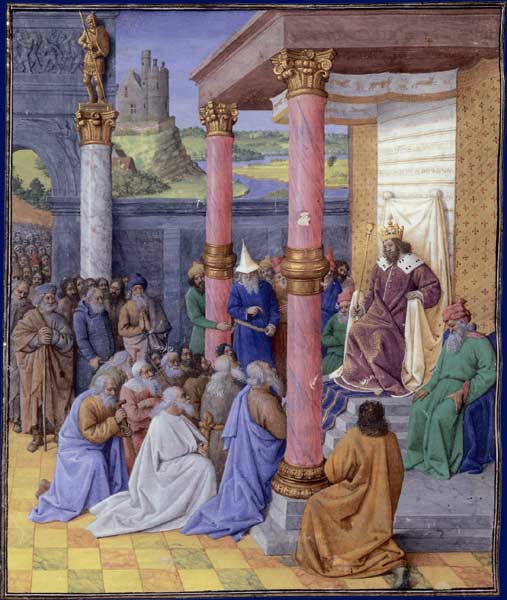
 File:Cyrus II le Grand et les Hébreux.jpg

But then ‘Cyrus’ walks onto the stage. Whohe? In fact he would have been something of a celeb to the Israelites, but the way he is described would have shocked their socks off. He was the king of Persia, the latest up-and-coming nation, who in fact was to go on and rule over one of the largest empires ever in the area. Yet he is described by the prophet as God’s ‘shepherd’, at whose command Jerusalem is to be rebuilt. But an even greater shock comes in 45:1 where Cyrus is announced as God’s ‘anointed’ – the word is literally ‘Messiah’. What came to pass was that Persia conquered Babylon (you can read that story in the book of Daniel) and decided to let the Israelite slaves return home. All this, the prophet claims, is what God is doing, moving the nations and leaders around like pieces on a chessboard for his purposes and for the good of his people. Not only is he the only God: he is also more than able to use pagan rulers to further his purposes.


So how would we react if a preacher told us that the one true God has called ISIS to fulfil his purposes, or to have referred to Usama bin Laden the ‘Messiah’? I think we have a similar degree of shock here among the exiles at the prophet’s words. Yet we are still tempted to believe that we have a powerless God, who has been defeated by the combined forces of secularism, the multi-faith society and Richard Dawkins. We are still tempted to divide the world into two – the bits God rules over (ie church) and the rest where he has little power. We need Isaiah’s radical message as much as ever, although we need to remember that the exiles had been living as slaves, and believing their delusions for a long time before it was heard.

OT Lectionary May 4th Easter 3 Zephaniah 3:14 – 20

Zephaniah 1:1 tells us that this prophecy dates from the reign of King Josiah, which would place it in the early 600s BC, and therefore before the Babylonian exile. This certainly fits with the earlier chapters of the book, which are full of dire warnings to the Israelites of the coming judgement when God the Mighty Warrior will turn on them and give them the come-uppance they so richly deserve for their opulent and profane lifestyles. But then at 3:14 there is an abrupt change of tone: suddenly the people are called to rejoice and celebrate because God has commuted their punishment, defeated their oppressors and purified their nation.

As with the book of Isaiah, which we have looked at previously in this blog, it does seem likely that the final paragraphs are later additions, the happy ending written much later towards the end of or after the judgement and purification of the exile. It would rather seem to undermine the prophet’s message of warning if he went on to tell the people that it was all going to end up fine. Neither, as history clearly tells us, was it the case that the restoration happened before the punishment, or instead of it. It was only through the experience of abandonment and punishment that Israel could learn her lesson and step back into God’s favour.

As a post-Easter reading this seems to speak to us of cheap grace. The salvation of the human race, whilst it had always been God’s plan, didn’t happen without judgement or punishment. It was only through the cross that we could be restored to our inheritance as God’s people. I have often said to different congregations, whilst talking about that greatest of post-modern virtues ‘tolerance’, that God is not tolerant; he is forgiving, and there is all the difference in the world between those two concepts.

File:2008-03-13 Rave crowd.jpg


But once we have been ransomed, healed, restored and forgiven, just look at the scenario which Zephaniah paints for us! Once the Mighty Warrior is for you rather than against you, there is no need for fear, no room for oppression, no call for dishonour or shame. When the one who was fighting against you because you were living against him starts singing songs of joy over you as a beloved daughter, you know something dramatic has happened. In the past it took a generation or more of exile: in Christ it took three days. Hallelujah – what a Saviour!

So often when we come to worship we see ourselves as in some way putting on a performance which we hope God will enjoy. This passage helps us to see things differently. In a most un-Anglican way God is seen singing, shouting, delighting, rejoicing. He may even have put his arms in the air like a good charismatic: who knows? The really good news is that we are invited to join in. He is not in the audience holding up cards with numbers on to assess our attempts at worship: he is partying with all he’s got, and inviting us to the party too.