Through the Bible in Just Over a Year – 2 Samuel

1 Samuel ends with the death of King Saul, who has lost the plot spiritually: 2 Samuel begins with David, his successor, lamenting over his death before taking the throne, first in Hebron, anointed to rule over the tribe of Judah, and then eventually in the newly-captured city of Jerusalem to reign over the whole nation. There is of course some infighting between Saul’s supporters and David’s, but pretty quickly things settle and David begins what will go down in history as the golden age for Israel. Two key events have great significance for David’s reign. Firstly the Philistines are defeated. For years the nation, which, like Stoke-on-Trent, was an agglomeration of five cities, have been thorn in Israel’s side: we have already seen the trouble they got Samson into, and David’s defeat of their champion Goliath. But from now on they get hardly a mention, as they cease to be much of a problem ever again to Israel.

 As a result of this, secondly, the Ark of the Covenant, that important symbol of God’s presence with the people, which had been captured and carried off by the Philistines, is brought back to its home, which is to become the site of the Temple in Jerusalem. Indeed, it seems almost disappointing that David himself did not build the Temple, but we are told that it was his idea. So his reign becomes symbolic of everything going right at last, with royalty and worship established in the new ‘City of David’.


But it isn’t very long before the ‘warts and all’ picture of David begins to emerge. Under the surface we have a king with not enough to do turning lustful eyes towards another woman, leading to intrigue and murder. Meanwhile conflict between various individuals demonstrates something of a leadership vacuum, leading eventually to rival claims to the throne, even from within David’s own family. The book ends with David ready to step down, and the next episode of the history begins with David old and frail, although still sharp enough to make sure that his son Solomon succeeds him.


So what we have is 2 Samuel is a portrait of a strong and godly yet flawed leader. The Bible is never a book of pure hagiography, and whitewash is never applied to its characters. Yet what we do see is David’s basic integrity: when confronted with his sin he repents quickly and thoroughly, and right to the end of the book he is still a worshipper at heart, someone who celebrates and depends on his courageous friends and colleagues, someone who has God’s desires for the nation deep in his spirit. That fact that he loses the plot sometimes should only encourage us, because we do that too, but it doesn’t mean we’re bad people, or that our attempts to live the Christian life are all in vain. In fact David, hero though he was and remains, struggled with all the things which trouble us: sex, family conflicts, the use of power, personal enemies – all the stuff of daily life. Like David we will not always get it right first time: like David may we always have the grace to deal with what we do wrong, coming quickly to God in penitence and receiving quickly his forgiving and redemptive grace.

OT Lectionary December 7th Advent 2 Isaiah 40:1-11

Regular thoughts on the oft-neglected Old Testament Lectionary passages.

Usually it’s good to hear a passage read before listening to a sermon about it, but I have found that there is great impact from this particular text if you do it the other way round. It marks the transition from Isaiah of Jerusalem to so-called ‘Deutero-Isaiah’, who was writing around the end of the exile in Babylon. So why not just take a moment to think yourself into the world of his original hearers?

You’ve been snatched from your homeland and marched across the desert to a strange, foreign land with a weird language, an unknown culture, all kinds of alien gods. You are suffering from what sociologists nowadays would call ‘cultural dislocation’, with all its attendant anxiety. Some of you are working like slaves at hard physical toil, under taskmasters who can be extremely cruel.

But at a level deeper than the mere physical and mental pain there are a set of theological questions to be answered. What are we to make of God in this current situation? Prophets (like Isaiah) have been warning you that unless you turned back to God you’d be in trouble, but, hey, those prophets can get a bit grumpy: they need to lighten up a bit and enjoy life. Maybe they were right all along, and God has washed his hands of us. We know that God has been patient with us for years, but now maybe we’ve blown it once and for all. He’s used up all his mercy and now we’re on our own.

Or maybe there’s a different problem. Lots of the nations around us treat their gods as though they were in the Anglican parish system. Depending on where you live you have a different god looking after you. So while we were back home in Jerusalem Yahweh was our God, but now we’re in Babylon, have we moved out of his patch? Should we be praying to Bel, Nebo or one of the others to save us? We know our God is a mighty God, but maybe his power doesn’t extend this far.

Or is it about punishment? OK, we can now grudgingly admit that we might just have been a little bit naughty as a nation, and we know that God hasn’t always been pleased with us. But is this it now? Is he going to punish us for ever, with no hope of forgiveness or restoration?

You can just hear the agonised theological questioning, can’t you? And then, without warning, a new voice is heard in the land: a new prophet. We know nothing about him except what we can discern from his writings. But the message he brought, in fact the first sentence of the message he brought, swept away all their anxious questioning in one go.

‘Comfort, comfort my people, says your God’

Doesn’t sound all that, does it, until you put in some italics:

‘Comfort, comfort my people, says your God

When you look back through the OT there is a formula which is used again and again of the covenant relationship between God and Israel – ‘You will be my people and I will be your God.’ Isaiah deliberately uses this phraseology in his very first sentence, and the meaning is abundantly clear: the deal is still on! Whatever you’ve done, God’s mercy is still there for you. Imagine the relief!

But there is one more beautiful twist to this tale, and it hangs on the Hebrew word translated ‘double’ in v 2. The word Kiphlaim does mean ‘double’, but not in the sense of twice as much. If you have a ‘double’ it means that someone somewhere looks exactly like you do, a complete match. So the prophet is  saying that the punishment you have received for your sins is the exact equivalent. It’s done, it’s over, appropriate sentence has been served, and there is no more debt to pay. You’re free! You’re going home!

The next 15 chapters merely unpack there themes further, but the real good news comes all in the first two verses.

Reflections on Discipleship

My job at the moment is developing discipleship in one Anglican diocese, so as you can imagine I do quite a bit of thinking about what discipleship is, what it means, and what it looks like. Here are some random thoughts, gleaned from my reflection on the Bible and current thinking …


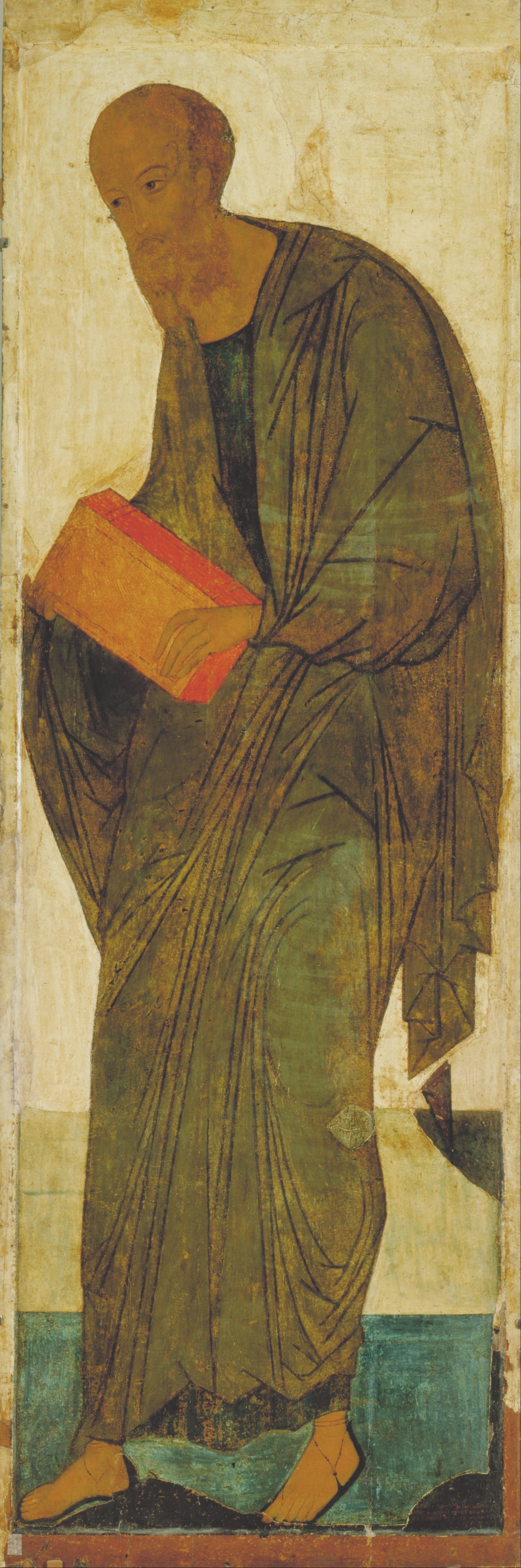
Paul, a servant of God and an apostle of Jesus Christ to further the faith of God’s elect and their knowledge of the truth that leads to godliness … (Titus 1:1)


We so easily skip over the boring introductory bits of the epistles, yet here to begin our thoughts on discipleship is a real nugget of gold. Paul (if you believe that he wrote this letter) is saying ‘Hello’ to his friend, but hidden in here is a whole chunk of truth about how he sees his role as a Christian minister.

File:Andrei Rublev - St Paul. From Deisus Tier - Google Art Project.jpg

 He begins with what he is, and then moves on to why. He is firstly a servant of God. The Greek uses the stronger word, doulos, which means something more like a slave than a gentleman’s butler: he is under compulsion to do what his master commands, and he has no rights of his own to follow his own agenda in life. Then he is an apostle of Jesus Christ, one literally ‘sent’ to go where Jesus tells him and to do what he’s told. These are strong callings, and as a church leader he takes them seriously, as many other passages bear witness.

But even more interesting is what he thinks he is called and sent to do. We usually think of Paul as an evangelist and church-planter, and a pretty driven one at that. The purple passage in Philippians is about his desire to keep on pressing forwards, and in Romans 15 he tells us that having ‘finished’ the eastern end of the Mediterranean he now longs to strike off west towards Spain. Yet there is much more to Paul than an itinerant evangelist, and he goes on to explain to Titus just what is important to him, in terms far more to do with discipleship than with evangelism. His calling has three ingredients: to further the faith of God’s elect, to make sure they know and understand the truth, which, in turn, will lead them to godliness. I don’t think you can have a much clearer model of discipleship than that.

Faith needs furthering: disciple-makers know that simply leading someone to Christ is only the very first tottering step of the journey of faith, and there is a vital ministry, so often neglected in the church, of leading brand-new Christians by the hand through those first bewildering months and years of seeking to follow Christ.

Truth needs teaching: I’m often struck by the number of times Paul, in seeking to correct some kind of dis-ease in one of his churches, exclaims in exasperation ‘Don’t you know…!?’ If only we knew, the implication is, we would be a whole lot less dysfunctional. Disciple-making involves the ministry of skilled teachers to help people know and understand.

Godliness needs living out: again, there are all kinds of condemnations in Scripture for those who say one thing but live an entirely different way. Once we know the truth, we then need help to make it live in us, and burst out of us, 24/7.

So there’s a good starting-point in this trawl through biblical references to discipleship: a disciple is someone who is growing in their faith, who is learning more and more about what it means to follow Jesus, and who is allowing this new knowledge to shape their lifestyle and choices.


How are we doing, both as disciples and disciple-makers?


OT Lectionary 30th November Advent Sunday Isaiah 64:1-9

Regular thoughts on the oft-neglected Old Testament Lectionary passages

In the past one of my fave worship-songs was Graham Kendrick’s Restore, O Lord. It was a call for God to get up and do something, so that people would recognise his power and sovereignty as he shook the earth again, and come to him in reverent fear. This passage his a similar feel to it, although when we look more deeply there are several inconsistencies which draw our attention. So as always, let’s look at the wider context.

Isaiah 63:7 to 64:12 is a psalm of corporate lament. People are beginning to return from Babylon to Jerusalem, but the with exhilaration of freedom comes a sense of a daunting task of rebuilding, and the fact that actually we are never going to be able simply to turn back time. Sadder and wiser, the people are aware that the experience of exile has scarred them and dented their relationship with God. This psalm celebrates the glorious past when God did intervene in their lives, calls upon him to do it again, but also blames him for his absence.

So our passage begins with a cry for God to manifest his power so that his enemies will see and be very afraid. But the enemies quickly become ‘us’ – indeed ‘all of us’ is a repeated refrain which loses the prominence in English which it has in the Hebrew. Whilst there is an acknowledgement that the nation has sinned, there is an apparent excuse for this: God has hidden himself from them and left them to it (v 7). Like an adulterous husband who blames his wife’s lack of attention for his own playing away from home, Israel claims that it is God’s ignoring of them which has left them no option but to sin. No-one bothers to call on God because he has deliberately turned away from them, so what’s the point?

And yet this blaming of God is bracketed between two examples of the people doing exactly what they claim no-one does: calling on him. In v 1-2 there is a desperate cry for his attention, and in v 9 there is a call for him to put aside his anger and ‘look upon’ his people. What are we to make of all this?

It’s worth noting first that lament is not always logical. When we’re upset and pour out our hearts to God, we don’t always do it with faultless logic or sound theology. God, and the Bible, seem big enough to understand and take it. But it is also interesting to ask some questions about who exactly are the players in this little drama. Just who are ‘we’? I wonder whether a prophetic picture from my past might be apposite.

I had recently been appointed by a bishop to turn around a church which he perceived as being in need of the gospel and the Spirit. Fairly early in, and experiencing some stiff resistance, I found myself pondering the famous Laodicea passage in Revelation 3. In my head I heard God asking me ‘How many people does it need to get up from the table and open the door when Jesus knocks?’ The obvious answer is ‘Just the one’. If the doorbell rings during a dinner party, it is not normal for the entire company to get up to go and answer it. In the same way I felt that for Jesus to have greater access to the life of the church, it didn’t really matter that not everyone was keen on the idea. As long as there was someone to welcome him in, that would do. That little conversation became formative for our prayers over the next few years, and we did indeed see significant renewal and a far more central place for Jesus.

I wonder if there is something similar in play here? Maybe the ‘we’ crying out so desperately in verses 1-2 and 9 is a just a subset of the ‘we’ who have sinned so grievously. It is, of course, biblical bad form to pray about ‘them’ from the lofty moral high ground: great intercessors always identify with the sinful community even if they personally haven’t been involved[1]. When I pray for the church which I belong to, love deeply, but hate for its weakness, sin and compromise; when I cry to God for his earth-shaking presence to be felt once again, I need to remember that ‘I’ am included in the ‘we’.

[1] See for example Ezra’s prayer in Ezra 9 about how ‘we’ have intermarried. In the next chapter there is a list of the guilty parties, a list from which Ezra’s name is gloriously absent.

Through the Bible in Just Over a Year – 1 Samuel

After last week’s brief digression into the love story of Ruth, we return to the heart of the Deuteronomic History with the four books of Samuel and Kings. Between them they tell the story of Israel’s journey from tribalism, through greatness, into exile and slavery. We have already discovered that the Deuteronomic History was written to explain how the nation got to the point of near-destruction, and we noted two key themes, both of which had, in the eyes of God, been violated. One was about the need to remain separate from and untainted by the nations around, and the other had to do with worshipping God where and how he demanded to be worshipped. There two motifs are a bit hidden to begin with, but are going to become more explicit as we go through the story over the next four weeks.


1 Samuel begins with the birth of the prophet Samuel, the kingmaker who sets Israel on the path of monarchy, albeit with some reluctance. His birth, like that of several biblical heroes, has a supernatural dimension to it: the message is that God clearly wanted him around, and so specially provided for his birth. The ever-present threat of the Philistines, whose territory lay to the south west of Israel, and the discontent with the tribal amphictiony, leads Israel to ask Samuel for a king ‘such as all the other nations have’. Samuel is reluctant, and tries to spell out for the people what this might look like in real life, but in the end he hears God telling him that although this is a rejection of bother their leaderships he should go ahead and give them a king. Saul is duly selected, and he looks a good choice, but it is only a few chapters before God rejects him.


So what did he do wrong? Not surprisingly, given the point of view of the writers, he offers a sacrifice which it was not his place to do (13:13), which is about keeping God’s rules for worship, and then in 15:8-9 he disobeys God by failing totally to destroy Agag, king of Amalek, and taking plunder from the battle. This violates the ‘separation’ theme, but fortunately Samuel remedies the situation in one of the most beautiful verses in the Bible: ‘Samuel hewed Agag in pieces before the Lord at Gilgal’.

 File:Felix-Joseph Barrias - Annointing of David by Saul.jpg

From this point on we see a new star rising, as Samuel is told by God to look for a replacement king for Saul. David is picked, even though he is so unlikely that he wasn’t even invited to the interview, and then a series of stories portrays the early life of this new hero, his prowess in battle, his acceptance into the royal court, and the growing jealousy of his king. As Saul descends into occultism and madness David keeps his integrity, refusing just to finish him off and showing loyalty to him, because he is still the Lord’s anointed king. When Saul finally dies in battle David’s grief is genuine, but more of that next week.


So how do we read this book today? As a history lesson and background to the high-point of Israel’s life, the reign of David, it is invaluable, but it also stresses the values of the Deuteronomic historians, made explicit in 15:22-23


Does the Lord delight in burnt offerings and sacrifices
    as much as in obeying the Lord?
To obey is better than sacrifice,
    and to heed is better than the fat of rams.
For rebellion is like the sin of divination,
    and arrogance like the evil of idolatry.


From the other side of the cross this truth is still as important as ever for Christian disciples, particularly in a culture where anything goes and ‘tolerance’ is the highest virtue of our society. What God says matters, and he expects us to listen and obey. We may not get rejected, or even hewed in pieces, if we disobey, but we severely hold up God’s purposes and rob ourselves of blessing when we try to live with cheap grace.

OT Lectionary Nov 23rd Christ the King Ezekiel 34:11-24

Regular thoughts on the oft-neglected Old Testament Lectionary passages

(First of all apologies to my faithful readers for the missing edition last week – I’ve been in bed with flu for seven days. That might also excuse this week’s ramblings)

If ever there was a passage which needed its context this is one. You only really get the ‘myself’ of v 11 and 15 if you read v 1-10, where the prophet is having a go at the ‘rulers’ of Israel for their self-centred ‘fat cat’ lifestyles. In a series of attacks on the ‘shepherds’ of Israel, God, through the prophet, condemns their selfish and indulgent lifestyle, their failure to care for the weakest in society, their brutality, their lack of concern that the people had become scattered across the land. The picture of ‘shepherd’ is not primarily about pastoral care: it is often used to describe kingship. The role of the king is to rule over people well so that they and the nation as a whole thrive. Get that wrong, and both the people and the corporate life of the nation suffer. So, says God, because you have got it so horribly wrong, and because I simply cannot find anyone who is up to doing the job properly, there is only one possible alternative: I myself will do it.

So to v 11: God himself will search for his lost sheep, rescue them, gather them once again in Israel, because they have been so badly led down by their human leaders. There is clearly a reference here to the restoration of the nation after the Babylonian exile.

But the text moves on: after the completely unnecessary piece of filleting of v 17-19 the prophet turns from the rulers to the people themselves. By all accounts they have not behaved any better. There are still fat and lean in society, and an unholy scrabbling for position, things which again God himself will have to sort out.

But this raises an important question, to which we already know the answer. What is the relationship between corrupt rulers and ungodly people? Obviously that bad leadership trickles down and affects the general behaviour of the public. You simply can’t have corrupt politicians running a godly nation. Whatever people see in their leaders they will imitate. Our own times have seen a massive loss of respect for political leaders who are seen to be sleazy, dishonest, often corrupt, possibly child-abusers, and ultimately self-serving. Other institutions such as the monarchy, police, the judiciary, banks and of course the Church are treated with the utmost suspicion. The rich elite get richer as the poorest get poorer still. The cry goes out ‘Whom can we trust?’

Into a world like that the prophet’s words ring out. What we need is a shepherd, a king, in whom we can put our trust, one who is for us not against us; one who will care for us rather than harm us. The festival of Christ the King reminds us not just of the possibility but actually the certainty of such a reign, and our daily newspapers remind us how desperately we need it. That’s why from Advent Sunday next week we’ll be praying all the more fervently ‘Come, Lord Jesus!’

Through the Bible in Just Over a Year – Ruth

The Book of Ruth is a bit of an oddity, to be honest. It’s a love story, a story of family loyalty, self-sacrifice, and also a little bit of scheming. So where do you stick books like that in the Bible? And why here, interrupting what we have already described as the ‘Deuteronomic History’? The clue comes in 1:1, where we’re told that this story took place in the time of the Judges, so it might as well go in here as a pleasant diversion from the somewhat depressing story of the road of Israel into Babylonian exile.

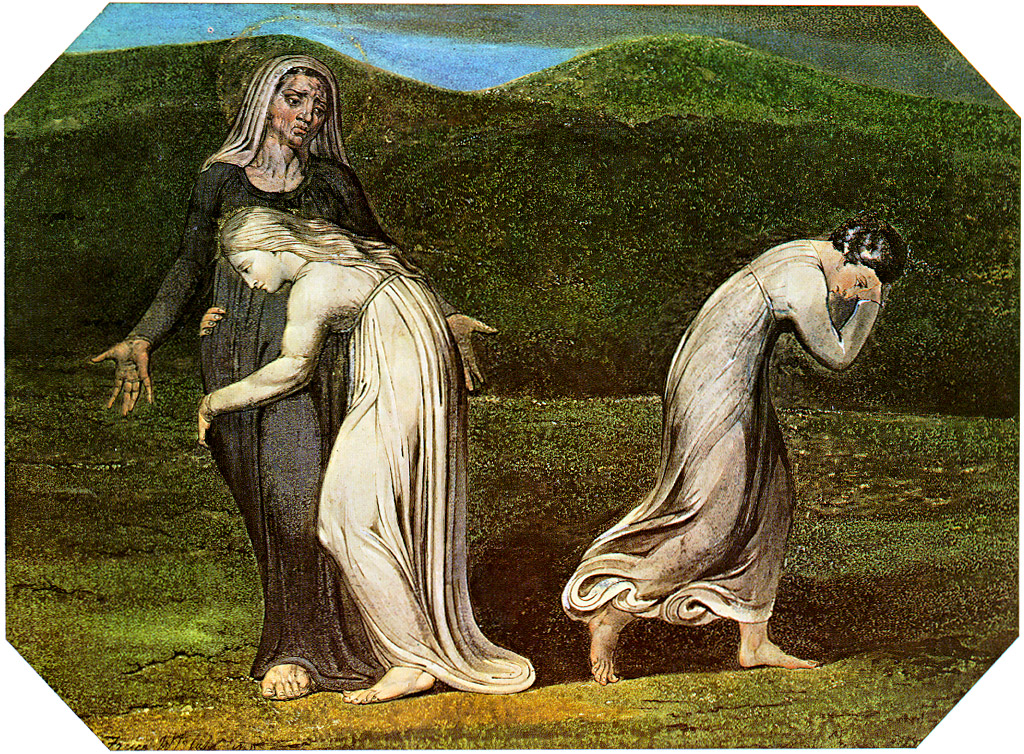
The story is straightforward if tragic. Elimelech, trying to escape famine in Israel, migrates to Moab, taking with him Naomi his wife and his two sons, who both marry Moabite women (in clear contravention, by the way, of Moses’ previous instructions about keeping separate from the surrounding nations). The sons both die, as does their father, leaving the three women, Naomi and her daughters-in-law Orpah and Ruth.

Perhaps feeling that escaping the famine in Israel by going to Moab was a bit like the transition from frying pan to fine Naomi decides to go home. Her daughters-in-law set out with her, but she urges them to turn back, which Orpah does whilst Ruth refuses, in the purple passage of the book:

Where you go I will go, and where you stay I will stay. Your people will be my people and your God my God. Where you die I will die, and there I will be buried. (1:16-17)

File:1795-William-Blake-Naomi-entreating-Ruth-Orpah.jpg

The rest of the book concerns Ruth’s wooing and winning of Boaz, a local landowner of some standing, and a relative of Naomi’s late husband. Naomi organises things so that Ruth, whom Boaz has already noticed, lets him know in no uncertain terms that she is available to marry him. Different commentators vary in the degree to which they see any hanky-panky going on in 3:1-14, but the outcome again emphasises the honourable nature of Boaz as he realises that under the Jewish law there is another who has more right to her than he has, and who therefore must be bought out. This is quickly arranged, and the marriage goes ahead.

All very sweet, but why is this story in the Bible? The clue can be found in two places: at the very end of the book, and in Matthew 1. Boaz and Ruth have a son, whom they call Obed, who turns out to be the grandfather of David, Israel’s greatest king. And of course further down the line great David’s greater son, Jesus, appears. There are two women amongst all the men in the genealogy in Matthew 1: Rahab, Boaz’s mother, and Ruth. If Rahab is indeed the same Rahab who appears in Joshua 2, she is a Canaanite prostitute who shows kindness and hospitality to the spies, and therefore is saved in the destruction of Jericho. Add to her Ruth the Moabitess , and both women were foreigners, who married into Israel against the strict instructions of Moses, and yet who are honoured as ancestors both of David and Jesus.

Both women had clearly ‘converted’ to the Jewish faith, and as such were welcome. But that of itself doesn’t invalidate Moses’ instructions. We’re very keen to tell members of our youth groups not to be ‘unequally yoked’ with those who don’t share their faith, and we occasionally hear stories of those who have been eventually won to faith through relationships or marriage.  But the rest of the OT warns us that this is a very high-risk evangelistic strategy, and far more often faith is compromised or shipwrecked.

I think we also have here one outworking of God’s call to Abraham to be a blessing to all nations. Centuries before the Early Church were debating the issue in Acts 15, God showed a welcome to those who under the Law were ‘outsiders’. This doesn’t negate the ever-present danger of compromise: it just reminds us how careful but also welcoming we need to be.

Through the Bible in Just Over a Year – Judges

 The word to know this week is ‘amphictiony’. It has its background in ancient Greece, when a bunch of nearby tribes would form a loose alliance with one another, whilst retaining most of the time their own tribal life. This is a good description of life in Israel during the period of the Judges. They were still identified strongly with their tribes and associated territories, but could club together in times of external threat into a loose affiliation.


But things were not good for the nation, and much of their trouble came from their failure completely to eradicate the nations already in the land, who remained thorns in their side for centuries to come, with the ever-present temptation to compromise, idolatry and immorality. So a cycle began to happen, which is spelt out most clearly in 2:10-19. The people forget God and turn to idols; God becomes angry and they find themselves under attack from nations around them; in their distress they turn back and call out to God; he raises up a charismatic leader (or ‘Judge’) to lead them to victory; life settles down again; they become complacent and turn to idols, and round the cycle goes again. In fact we see this happening 13 times during the course of the book, and the Judges are both household names, like Samson and Gideon, and relative unknowns like Jair, whose main claim to fame was that he had 30 sons who rode on 30 donkeys, and Ehud, whose gory exploit I preached on at my son’s wedding, but that’s another story.


Clearly this was no way to run a nation, and the book serves to both to create the need for and to set the scene for the rise of the monarchy, which we are going to encounter the week after next. Indeed the people are seeking a king even here: Gideon is asked to take on the role, and after slaughtering his 70 brothers Abimelek does actually get crowned king, at least briefly, thus creating a good trivia quiz answer that it wasn’t really Saul who was the first King of Israel as everyone was taught in Sunday School.


There are some great stories here if you like violence and gore, but as with much of the Deuteronomic history, the twin themes of the people’s vacillation and unfaithfulness contrasted with God’s patience and faithfulness are interwoven. Judges also has a thoroughgoing supernaturalism: God appears and speaks with people, brings victory in battle, and anoints his chosen judges with the Spirit. Samson is a Nazirite, a member of a group whom we first encountered in Numbers 6, who, rather like monks and nuns today, took certain vows, vows which he systematically broke one after another.


The book invites us to consider the nature of our discipleship: are we fair-weather Christians who treat God like a fire-engine: we only call on him in emergencies, and the rest of the time desperately hope we won’t need to? The judges are those who, even though they have their struggles, know themselves to be called by God, and know the anointing of the Spirit to lead others into the ways of godliness. They are ordinary people, but once God’s Spirit anoints them the lead supernaturally, and they encourage us to open ourselves afresh to the Holy Spirit, and seek the vocation God has put on us.

OT Lectionary Nov 9th 3 before Advent/Remembrance Sunday Amos 5:18-24

At first sight it isn’t easy to see what this passage has to do with the ‘Remembrance’ theme which will be uppermost in everyone’s minds this week. Personally I prefer chapter 4, which I have preached on several times on Remembrance Day: ‘”I killed your young men with the sword … yet you have not returned to me”, says the Lord.’

 What we have today is something of a purple passage for the bashing of charismatics by those who think that social justice is the most important thing for Christians to be doing, and indeed that is what Amos appears to be saying, although of course in the broader sweep of the book he isn’t saying don’t worship, but rather when you worship make sure it is with integrity, holiness and concern for others.

File:Tower of London Poppy.jpg

 So how are we to read this passage in the context of Remembrance, with all its associated and contradictory themes of courage, thankfulness, pacifism, if you’ve died in battle you get to go straight to heaven, and so on? What can we learn about the nature of God?

 The background, of course, is the Israelite belief in ‘the Day of the Lord’, that coming time when God would step in and intervene, defeat once and for all those nations who had been so nasty to the Jews, and put Israel back in their place as Top Nation. Yes, says Amos, the Day of the Lord is coming, but you lot are in for a nasty shock. If God is coming to punish and overthrow evildoers, you are at the top of his list. You’re longing for that day to come, but it will be you, not the nations around you, who will be in for a bit of divine smiting. Light won’t dawn for the nation: it’ll be pitch darkness instead. As such this oracle is a warning against presumption and comfortable neglect of God’s standards. Let those who think they stand beware lest they fall.


But the second part of the passage is more difficult. We know that God loves justice and righteousness more than mere music without integrity – that’s a given. So what are justice and righteousness? And in particular, what are justice and righteousness in the context of Islamic State, the Taliban, radicalisation and terrorism? Is the right thing to do to avoid violence and warfare at any cost? Or are there times when injustice and bloodshed demand a righteous response of military action? The pacifist point of view would argue that violence is never justified under any circumstances, but others would disagree. I can remember a Baptist minister who was influential in my teenage years, and who had been a forces chaplain in North Africa, on the beaches of Normandy and ultimately in Belsen, preaching on this subject. ‘When you saw what Hitler was doing’, he told us, ‘I knew that he just had to be stopped.’ So what is the just and righteous response today in 2014? I’ll let you answer that for yourself, but what we can say is that to bury our heads in heavenly worship without agonising over that question is not an option.

Through the Bible in Just Over a Year – Joshua

The narrative of the journey from slavery in Egypt to the Promised Land continues for the first 12 chapters of this book, but after that it gets less interesting, although it does raise some very interesting questions. The book ends with the people, now apparently settled, getting another pep-talk from Joshua, along similar lines to that from Moses at the end of Deuteronomy, and publicly renewing their covenant relationship with God. Joshua dies peacefully, and we reach the end of an era, with a brand new chapter starting in the next book, Judges.


The main problem with the land promised to the people of Israel by God is the fact that it is already populated by several nations who quite understandably are not too happy about this new nation coming in believing that their God has promised it to them. Put that together with the previous instructions to remain separate from the nations around them, and the Israelites seem to have little option but to embark on a bit of serious ethnic cleansing. That is exactly what they do, much to the consternation of today’s readers of the book who find it difficult to cope with a God who commands such inhumanity.


It is a standard principle of biblical interpretation that we use the Bible to interpret itself wherever we can, so on one level the question ‘Why did God command the slaughter of all those people?’ is easily answered, from Deuteronomy 9, where the take is that the nations deserved all they got because of their sin and idolatry, and that God was using Israel to bring upon them the punishment they so richly deserved. We might not like that, but it is clearly what the Bible teaches, and we can begin to realise the depth of God’s patience and mercy that he hasn’t (yet) done the same to Britain. It was Billy Graham’s wife who said that if God didn’t judge America, he would have to go back and apologise to Sodom and Gomorrah. And in fact subsequent history suggests that this policy was the right one: most of the trouble in which Israel later found herself came because of compromise, intermarriage and worship infected with idolatry. Even in this book the instructions to destroy the other nations completely are not fully carried out. The suffering of generations was the result of this kind of compromise: later we’ll see this truth worked out in the book of Amos. As one who has undergone extensive surgery for cancer I fully understand that some things need rooting out completely, lest they reinfect the whole body and lead to its death.


But on the plus side, though, we have here the story of a God of miracles, who acts powerfully for the salvation of his people. Walls collapse, water parts in a scaled-down version of Moses’ earlier miracle, thus validating Joshua’s leadership in the eyes of the people. Victories are won in battle against overwhelming odds, sin is revealed and rooted out, and even the sun stands still. So this book highlights in a very clear and powerful way the choice which is made explicit in the final chapter: ‘Choose for yourselves this day whom you will serve’. To serve God means the powerful protection and salvation of a loving saviour, but to choose something else means that one makes an enemy of God and must face the consequences. This was the same challenge set before the people by Moses, and the same one which faces us today.