Through the Bible in Just Over a Year – Ruth

The Book of Ruth is a bit of an oddity, to be honest. It’s a love story, a story of family loyalty, self-sacrifice, and also a little bit of scheming. So where do you stick books like that in the Bible? And why here, interrupting what we have already described as the ‘Deuteronomic History’? The clue comes in 1:1, where we’re told that this story took place in the time of the Judges, so it might as well go in here as a pleasant diversion from the somewhat depressing story of the road of Israel into Babylonian exile.

The story is straightforward if tragic. Elimelech, trying to escape famine in Israel, migrates to Moab, taking with him Naomi his wife and his two sons, who both marry Moabite women (in clear contravention, by the way, of Moses’ previous instructions about keeping separate from the surrounding nations). The sons both die, as does their father, leaving the three women, Naomi and her daughters-in-law Orpah and Ruth.

Perhaps feeling that escaping the famine in Israel by going to Moab was a bit like the transition from frying pan to fine Naomi decides to go home. Her daughters-in-law set out with her, but she urges them to turn back, which Orpah does whilst Ruth refuses, in the purple passage of the book:

Where you go I will go, and where you stay I will stay. Your people will be my people and your God my God. Where you die I will die, and there I will be buried. (1:16-17)
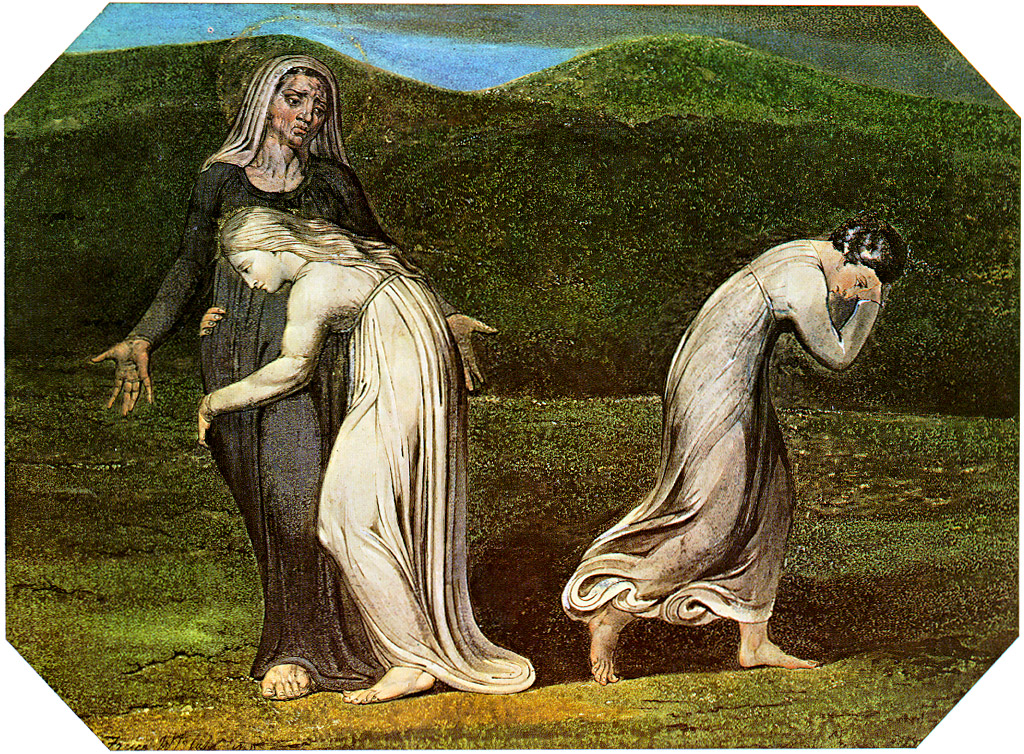
File:1795-William-Blake-Naomi-entreating-Ruth-Orpah.jpg

The rest of the book concerns Ruth’s wooing and winning of Boaz, a local landowner of some standing, and a relative of Naomi’s late husband. Naomi organises things so that Ruth, whom Boaz has already noticed, lets him know in no uncertain terms that she is available to marry him. Different commentators vary in the degree to which they see any hanky-panky going on in 3:1-14, but the outcome again emphasises the honourable nature of Boaz as he realises that under the Jewish law there is another who has more right to her than he has, and who therefore must be bought out. This is quickly arranged, and the marriage goes ahead.

All very sweet, but why is this story in the Bible? The clue can be found in two places: at the very end of the book, and in Matthew 1. Boaz and Ruth have a son, whom they call Obed, who turns out to be the grandfather of David, Israel’s greatest king. And of course further down the line great David’s greater son, Jesus, appears. There are two women amongst all the men in the genealogy in Matthew 1: Rahab, Boaz’s mother, and Ruth. If Rahab is indeed the same Rahab who appears in Joshua 2, she is a Canaanite prostitute who shows kindness and hospitality to the spies, and therefore is saved in the destruction of Jericho. Add to her Ruth the Moabitess , and both women were foreigners, who married into Israel against the strict instructions of Moses, and yet who are honoured as ancestors both of David and Jesus.

Both women had clearly ‘converted’ to the Jewish faith, and as such were welcome. But that of itself doesn’t invalidate Moses’ instructions. We’re very keen to tell members of our youth groups not to be ‘unequally yoked’ with those who don’t share their faith, and we occasionally hear stories of those who have been eventually won to faith through relationships or marriage.  But the rest of the OT warns us that this is a very high-risk evangelistic strategy, and far more often faith is compromised or shipwrecked.

I think we also have here one outworking of God’s call to Abraham to be a blessing to all nations. Centuries before the Early Church were debating the issue in Acts 15, God showed a welcome to those who under the Law were ‘outsiders’. This doesn’t negate the ever-present danger of compromise: it just reminds us how careful but also welcoming we need to be.

Through the Bible in Just Over a Year – Judges

 The word to know this week is ‘amphictiony’. It has its background in ancient Greece, when a bunch of nearby tribes would form a loose alliance with one another, whilst retaining most of the time their own tribal life. This is a good description of life in Israel during the period of the Judges. They were still identified strongly with their tribes and associated territories, but could club together in times of external threat into a loose affiliation.


But things were not good for the nation, and much of their trouble came from their failure completely to eradicate the nations already in the land, who remained thorns in their side for centuries to come, with the ever-present temptation to compromise, idolatry and immorality. So a cycle began to happen, which is spelt out most clearly in 2:10-19. The people forget God and turn to idols; God becomes angry and they find themselves under attack from nations around them; in their distress they turn back and call out to God; he raises up a charismatic leader (or ‘Judge’) to lead them to victory; life settles down again; they become complacent and turn to idols, and round the cycle goes again. In fact we see this happening 13 times during the course of the book, and the Judges are both household names, like Samson and Gideon, and relative unknowns like Jair, whose main claim to fame was that he had 30 sons who rode on 30 donkeys, and Ehud, whose gory exploit I preached on at my son’s wedding, but that’s another story.


Clearly this was no way to run a nation, and the book serves to both to create the need for and to set the scene for the rise of the monarchy, which we are going to encounter the week after next. Indeed the people are seeking a king even here: Gideon is asked to take on the role, and after slaughtering his 70 brothers Abimelek does actually get crowned king, at least briefly, thus creating a good trivia quiz answer that it wasn’t really Saul who was the first King of Israel as everyone was taught in Sunday School.


There are some great stories here if you like violence and gore, but as with much of the Deuteronomic history, the twin themes of the people’s vacillation and unfaithfulness contrasted with God’s patience and faithfulness are interwoven. Judges also has a thoroughgoing supernaturalism: God appears and speaks with people, brings victory in battle, and anoints his chosen judges with the Spirit. Samson is a Nazirite, a member of a group whom we first encountered in Numbers 6, who, rather like monks and nuns today, took certain vows, vows which he systematically broke one after another.


The book invites us to consider the nature of our discipleship: are we fair-weather Christians who treat God like a fire-engine: we only call on him in emergencies, and the rest of the time desperately hope we won’t need to? The judges are those who, even though they have their struggles, know themselves to be called by God, and know the anointing of the Spirit to lead others into the ways of godliness. They are ordinary people, but once God’s Spirit anoints them the lead supernaturally, and they encourage us to open ourselves afresh to the Holy Spirit, and seek the vocation God has put on us.

Through the Bible in Just Over a Year – Joshua

The narrative of the journey from slavery in Egypt to the Promised Land continues for the first 12 chapters of this book, but after that it gets less interesting, although it does raise some very interesting questions. The book ends with the people, now apparently settled, getting another pep-talk from Joshua, along similar lines to that from Moses at the end of Deuteronomy, and publicly renewing their covenant relationship with God. Joshua dies peacefully, and we reach the end of an era, with a brand new chapter starting in the next book, Judges.


The main problem with the land promised to the people of Israel by God is the fact that it is already populated by several nations who quite understandably are not too happy about this new nation coming in believing that their God has promised it to them. Put that together with the previous instructions to remain separate from the nations around them, and the Israelites seem to have little option but to embark on a bit of serious ethnic cleansing. That is exactly what they do, much to the consternation of today’s readers of the book who find it difficult to cope with a God who commands such inhumanity.


It is a standard principle of biblical interpretation that we use the Bible to interpret itself wherever we can, so on one level the question ‘Why did God command the slaughter of all those people?’ is easily answered, from Deuteronomy 9, where the take is that the nations deserved all they got because of their sin and idolatry, and that God was using Israel to bring upon them the punishment they so richly deserved. We might not like that, but it is clearly what the Bible teaches, and we can begin to realise the depth of God’s patience and mercy that he hasn’t (yet) done the same to Britain. It was Billy Graham’s wife who said that if God didn’t judge America, he would have to go back and apologise to Sodom and Gomorrah. And in fact subsequent history suggests that this policy was the right one: most of the trouble in which Israel later found herself came because of compromise, intermarriage and worship infected with idolatry. Even in this book the instructions to destroy the other nations completely are not fully carried out. The suffering of generations was the result of this kind of compromise: later we’ll see this truth worked out in the book of Amos. As one who has undergone extensive surgery for cancer I fully understand that some things need rooting out completely, lest they reinfect the whole body and lead to its death.


But on the plus side, though, we have here the story of a God of miracles, who acts powerfully for the salvation of his people. Walls collapse, water parts in a scaled-down version of Moses’ earlier miracle, thus validating Joshua’s leadership in the eyes of the people. Victories are won in battle against overwhelming odds, sin is revealed and rooted out, and even the sun stands still. So this book highlights in a very clear and powerful way the choice which is made explicit in the final chapter: ‘Choose for yourselves this day whom you will serve’. To serve God means the powerful protection and salvation of a loving saviour, but to choose something else means that one makes an enemy of God and must face the consequences. This was the same challenge set before the people by Moses, and the same one which faces us today.


Through the Bible in Just Over a Year – Deuteronomy

Deuteronomy is one of the most important books of the OT: without it we wouldn’t really be able to make much sense of several later books. It is presented as three sermons from Moses as the people overlook the Promised Land, which through their own faithlessness and grumbling the previous generation were doomed not to enter. So before he dies at the end of the book Moses gives the people a pep talk, reminding them of the journey so far, of some of the laws from Exodus (hence the book’s name, which means ‘second law’) and telling them how they and their children should live when they did cross the border.

Two themes ring out from this book: one has to do with separation, the other with worship. These two areas are to become foundational for what lies ahead. The Israelites are to keep themselves separate and holy by not compromising with the standards of the nations around them, when it comes to morality and idolatry. And they are to worship God as he demands, not as they might fancy, and in particular they are to worship him in the place which he is going to choose, which will turn out to be Jerusalem. These principles are set out clearly in chapters 12 and 13.

The next few books, Joshua, Judges, Samuel and Kings, are known collectively as the ‘Deuteronomic History’. Like all history they are written up from a particular point of view, and that point of view is set out in Deuteronomy, the ‘preface’. A few centuries later the people find themselves in exile in Babylon, and they can’t help but ask themselves the question ‘What went wrong? How did we get ourselves into this mess?’ The answer they come up with is that we have systematically violated the two principles set out in the book of Deuteronomy: we have not kept ourselves separate and holy to God, and we have tried to worship in places other than Jerusalem. The Deuteronomic history books, and some would say Deuteronomy itself, were almost certainly compiled during the exile, and served both as a review of the past but also a warning for the future. So we shall see in a few weeks that all the kings of Israel and Judah are judged almost exclusively on whether they adhered to the policy of ‘centralisation of worship’, in other words did they allow worship only in Jerusalem or did they tolerate it elsewhere?

A distinctive section of the book is the ‘blessing and cursing’ section in chapters 27 to 30. If the people will do as they are told, they will experience a long list of blessings throughout the land, particularly centred around victory over their enemies and fruitful harvests, whereas if they choose disobedience (which of course they subsequently did most of the time) they would know God’s curse in the shape of defeat in battle, sickness, removal of possessions, unfruitfulness and lack of harvest. Finally the choice is set before them in the starkest of terms: life or death (30:11ff).

Moses then prepares for the future by appointing Joshua, who along with Caleb, the other faith-filled spy are the only ones from that generation to enter the land, as his successor as leader, a poisoned chalice if ever there was one. After blessing the people he dies on Mt Nebo, is mourned, and the stage is set for Joshua to lead them over into the land.

How are we to read this book today? Surely the same two principles around which the book is centred apply every bit as much to those the other side of Christ’s cross: we are to be holy and different from those around us, and we are to worship God on his terms and not our own. Blessing and cursing may not be quite so clear cut as they are set out in Deuteronomy: indeed we shall see much agonising as we continue through the OT about why innocent people suffer and the nasty get away with it. But ultimately the choice is ours, on an eternal canvas – death or life?

Through the Bible in Just Over a Year – Numbers

If you think you’ve kind of got the idea having read Leviticus, I should begin with Numbers around chapters 9 or 10, as the first section is really more of the same, with various laws and regulations, some censuses of the population (which is where the name of the book comes form), a long list of the offerings at the dedication of the tabernacle, and how to tell if your wife has been unfaithful. However there are a couple of important nuggets even in these uninspiring chapters: the lovely priestly blessing in 6:22-27, and the section on Nazarites at the beginning of the same chapter: this is going to become important later in the OT.


But the more exciting narrative section begins at 10:11 where the cloud over the tabernacle lifts, signalling that it is time for the Israelites to move on from the foot on Mt Sinai where they have presumably been since Exodus 19. What we have in these chapters is a miserable account of fallen human nature, with its fear, lack of vision, conservatism, backward-lookingness, and general moaning. It takes less than two years to get from Egypt to the edge of the Promised Land, but when they get there and send in 12 spies they are too scared to go on in, and so comes one of the saddest verses of the whole Bible in 14:25 ‘Turn back tomorrow and set out towards … the Red Sea’. You’ve said so many times that you want to go back to Egypt, so off you go! The rest of the book is about those years of wandering, with various interactions with neighbouring peoples, and it ends with the people on the edge of the Promised Land, having been told by God that none of that faithless generation would make it in, including Moses who has led them on the journey.

 File:Marokko Wüste 02.JPG

As a church leader, now working at Diocesan level, I find this an incredibly powerful book which could have been written yesterday. It is a study in unredeemed human nature and in the leadership of such people, and I have long admired Moses as my own model for leadership. I love his glorious political incorrectness: his calling from God was to get the people to the Promised Land, by hook or by crook, whether they wanted to go or not. Democracy doesn’t get a look in: if it did they’d have been back in Egyptian slavery in a trice. And yet we see also in Moses a heart of compassion, a mighty ministry of intercession, and some of the real emotional struggles of a leader working among people who just don’t get it. Shining out like two diamonds among the dust are Joshua and Caleb, who symbolise the small number of people one usually finds among the faithless crowd, who really are on message, can see God’s opportunities rather than human problems, but whose voices are so often drowned out by the crowd.


Numbers is a depressing book, and one which we would do well to look into as one might a mirror. It can show us our fears, intransigence and conservatism, our reluctance to enter into the new things which God may be trying to lead us to, and it can give us a glimpse of the agonies we sometimes put our leaders through. It can remind us also, though, of the mercy and patience of God, who does in the end get the people to the edge of the Land. They have severely delayed his purposes, and caused themselves great hardship in the meantime, but they have not ultimately thwarted them.


Through the Bible in Just Over a Year – Leviticus

In part three of our journey we come to the book everyone loves to hate – Leviticus. Most people have never read through it, and who can blame them? Half of it is about cutting up animals, and the rest is about stuff you mustn’t do or eat. The book raises all kinds of awkward questions, like ‘Who on earth thought this lot up?’ and ‘What has this got to do with me trying to live for Jesus in the 21st century?’ Realistically we ignore it much of the time: the fact that wearing polycotton clothes is forbidden does little to affect my lifestyle: think of all that extra ironing if I stuck to pure cotton. And whilst I’ve never been tempted to sit down to a nice hoopoe madras I do happen to love prawns, so I happily ignore that stuff too. And yet when Christians see, for example, homosexual acts roundly condemned in the same book, they want to stick rigidly to that particular law.

File:Prawn cocktail.jpg

There is also the question of importance. Not selling your daughter into prostitution seems quite a good idea, but is it really in the same league of holiness as not cutting the edge of your beard? The book seems weird, outdated, disproportionately concerned with pointless details, and yet somehow we can’t seem just to do away with it in its entirety. So what do we do with it?

Standing back and taking a bigger view, we can soon see that it does tell us some significant truths. Three seem to stand out: worship is important, we need rules to live by, for our health and stability, and we screw up and somehow have to cope with that.

The amount of attention given to the minutiae of the celebrations and festivals shows us a God who wants to be worshipped, and who wants to be worshipped well. Taken as a whole there is a balance of different moods, seasons and occasions. We have already seen from Exodus that the physical setting for worship is important, and that only the best will do. Perhaps surprisingly Leviticus urges Christians to think about how we worship, the quality of it, and, most pointedly, whether we construct our worship around what we happen to like, or on God’s terms.

 File:POUPA - Hoopoe - Upupa epops.jpg

Secondly Leviticus reminds us that any society needs rules to live by. Whilst we might find some of these a bit strange, in context they make some sense if you remember that ‘health’ for a society involves physical wellbeing (so be careful what you eat – pork harbours tapeworms, molluscs can really get you into trouble, and hoopoes … well!); and it involves stable family life, so no prostitution or anything which would compromise family and tribal stability, and make punishments fair and not excessive. In addition, though, for the Israelite community it meant purity for their worship and identity, hence all kinds of laws which were like visual aids to them that if you mix and match, things go wrong. You only have to look at the subsequent history of Israel to see how often things went pear-shaped when their devotion to God was compromised through syncretistic worship and lifestyle. So polycotton shirts may not be mortally sinful, but they could be a daily reminder of the need to remain single-mindedly devoted to your God.

Thirdly there is so much detail about sacrifice and sin-offerings because in the human race there is so much sin. The seriousness of the solution speaks volumes about the seriousness of the problem, a problem which must involve the shedding of blood (Heb 9:22), and which is only going to be solved finally when the blood of Christ is shed on the cross.

What really makes the book fascinating, though, is the issue of ‘hermeneutics’, the branch of theology which deals with the appropriate interpretation of the Bible for today. How does it all work? Is it OK to read Lev 18:22 and interpret it to mean “‘Having sexual relations with a man as one does with a woman is fine by me”, says the Lord.’ And how is that different from eating a prawn cocktail? There are answers to these questions, rules in the hermeneutics game, as it were, but they are not simple, and that is partly why this book comes over as difficult. However, we still need it!

Through the Bible in Just Over a Year – Exodus

Last week we looked at Genesis and said that we should read it as an overture, a set of Just-So stories, and a scene-setter for the rest of the story. This week the story begins with the exit, or exodus, of the Israelite nation from their slavery in Egypt, but once again the story, as it moves on, introduces some themes which are going to become increasingly important.

A brief list of names follows, and we are going to find quite a few of those lists over the next just-over-a-year, since the story is, after all, the story of real people, whose part in the drama matters. We’re told that two things happen: the Israelites, guests in Egypt, multiply considerably, and that a new Pharaoh, to whom Joseph meant nothing, takes the throne, and decided that these immigrants were not as welcome as his predecessor had thought they were. So they were pressed into slavery, and for 400 or so years God apparently watched in silence as they were subject to increased oppression. But then Moses appears on the stage, miraculously saved from perinatal death, brought up in the Egyptian court, and called by a burning bush. He is the one who, after many years preparation, is to confront the king, and with the help of God’s powerful plagues, to lead the people to the edge of the Red (or Reed) Sea. There the sea miraculously opens, Israel escapes and their oppressors are drowned. This is the central point of God’s purposes of salvation for Israel, and much is made of the symbolism of passing through water into a new way of living in the New Testament as it talks about baptism. Again and again God is described as the one ‘who brought you up out of Egypt’: this saving act becomes the centrepiece and milestone of God’s redemptive love.

The next stopping point is Mount Sinai, where Moses receives from God the Law, or ‘Ten Commandments’, which remain formative in the ethics and law of most civilised countries to this day. ‘Commandments’ is really a mistranslation: the Hebrew literally speaks of Ten ‘Words’, and they are best understood as ‘teachings’: if you want life and society to run well, then live like this. But whilst Moses is up the mountain receiving these ‘Words’, the people below are demonstrating the natural human bent for rebellion, and we see something which we are going to see again and again: false worship leading to dissolute behaviour. The journey continues towards the Promised Land, but we are not going to see them arrive until next week, and even then with tragic consequences.


The other major theme of Exodus is worship, and the good ordering of it. Chapter after boring chapter discuss precise details of the furniture, fittings and clothing to be used in the worship of the tabernacle, a portable ‘temple’ which could accompany them on their journey and provide a focus for their worship. Since we have already seen the relationship between idolatry and immorality it seems important that we get worship right, and very little here is left to chance. The book ends with the glory of God covering the tabernacle in a cloud, symbolising his presence among his people, another motif to which we shall return.


To think about:

How do you react to up to 400 years of slavery and oppression before God ‘remembered’ his people (2:24)? Why do you think he works so much more slowly than we would prefer?

Has all the formal and liturgical stuff about worship in Exodus, and the precise regulations for making robes etc been superseded in Jesus? Or can carefully ordered and symbolically rich worship speak to us about God as form us as Christians?

Through the Bible in Just Over a Year – Genesis

Welcome to this new blog, which is designed to help us see the huge picture of the Bible, by encouraging us to read one book per week. As promised it certainly won’t be the last word in scholarship, but I hope it will help people to read their Bibles more and with greater understanding.


So … Genesis. The word means ‘beginnings’, and the Hebrew words with which it begins simply mean ‘In the beginning …’ It helpful to think of the book in three ways: as an overture, as a book of ‘Just So’ stories, and as a scene-setter. It contains the well-known stories of Adam and Eve, Noah’s Ark, Abraham and the Patriarchs, and Joseph with his amazing coat. Just like an overture for an opera of musical, the book introduces briefly some of the themes we’re going to hear played out more fully as the story unfolds. So we see God as creator, but also destroyer, we see the idea of covenant relationships, of calling, of journey and pilgrimage, of sacrifice and mercy, and of a purposeful working out of God’s plans for redemption. In the story of Abraham we see both the calling of the ‘chosen people’, but also the idea that the only reason God chose a nation was to be the purveyors of good things to the whole earth. Their calling was to be blessed but also to bless, a theme which I have explored before. Maybe you could trace some of these themes through the rest of the Bible and see how they are developed, just as a composer develops his original musical hints into full numbers.

File:The Creation - Bible Historiale (c.1411), vol.1, f.3 - BL Royal MS 19 D III.jpg

But the other purpose of Genesis is to answer some questions which will later arise. The technical term for this is ‘aetiology’ – a ‘just-so’ story which you can imagine parents telling their children to explain something which they observe as they go through life. Another technical term here is ‘myth’, which doesn’t strictly mean ‘not actually true’, but rather that it explains something. So the stories of creation are there to explain how we all got here, and to argue whether Adam and Eve were literal historical characters is to miss the point entirely, and is about as useful as arguing about whether Pandora’s box was made of wood or metal. ‘Why is that pretty coloured thing up in the sky?’ is another question we can imagine children asking, and the story of Noah and the flood answer that question. Similarly questions such as ‘Why are we living where we’re living?’ can be answered by the story of the call of Abraham to go to ‘a land which I will give you’.


Thirdly, though, the book acts as a scene-setter for the drama to come. THE pivotal event in Israel’s history is the Exodus from Egypt, which we will come to next week, but before God can get his people out of Egypt he has to get them in there, so the long story of Joseph is there to explain how it came to be that those who had been promised God’s favour and a land of their own are working as slaves far from home under cruel foreign domination. To be continued …

Caravaggio. The Sacrifice of Isaac.

To think about:


  • Why are there two different stories of creation? What is each meant to teach us?
  • What can the story of Abraham’s call (Gen 12) say to the church today?
  • What can you learn about the ministry of Jesus from reading Genesis?


Through The Bible in Just Over a Year – Intro


In my formative 20s I attended a church with a very strong teaching ministry, and one of the series we did took us through every book of the Bible, a week at a time. We were blessed with not one but two sermons, one on the background to each book, and one on its practical application for today (or rather the 70s!). I lapped it up, and owe so much to the teaching I received not just through that series but through all my eight years at that church.

Now that my day job is to work at Diocesan level to promote Christian discipleship I am amazed and frequently appalled at the lack of solid teaching in today’s C of E. I’m not sure how many churches value the teaching ministry, or how many clergy see their primary task as feeding the people of God with both milk and meat as appropriate. I’m struck by how often St Paul, when seeking to correct some error in the life of one of his churches, wrote ‘Don’t you know …?’ Bad or lack of teaching leads to misunderstanding and bad living. So in my small way I have a heart for seeing the teaching ministry restored to the church, so that healthy and mature Christians are produced, Christians able confidently to join in with the mission of God to our communities and nation. Working in the area of discipleship one of my key texts has become Gal 4:19, where Paul tells his ‘dear children’ that he is in ‘the pains of childbirth until Christ is formed in you’. I lament the lack of this kind of passion in many church leaders today, and in this new blog series I want to recreate a kind of overview of the Bible, the primary means through which God reveals himself to us and forms us as disciples. I’m going to take you through the Bible in just over a year.


What you won’t get from this blog, obviously,  is in-depth scholarly stuff, loads of Hebrew and Greek, and the latest in academic thought. There are plenty of other places to find that stuff, and frankly I’m not that good at it. But what I do hope to do is to help us to read each book with some understanding of why it is in the Bible, and what it might say to us today. If I gave you a train timetable and a book of metaphysical poetry you would obviously use them very differently, and the books of the Bible are like that: you have to know what each book is trying to do so that you can read it with understanding.


I’m also aware that whenever we read Scripture we need the help of the Holy Spirit. People who know me well and have read my books often tell me that they ‘could just hear me speaking as they read. It’s so “you”’. In the same way we read the Bible differently when we know the author well. So there’s a circularity: we get to know God through reading Scripture, and we read Scripture better when we know God better. I hope this blog series might help on both counts.


So – next week – Genesis, the book of beginnings.