Reflections on Discipleship – Live Life Better

My job at the moment is developing discipleship in one Anglican diocese, so as you can imagine I do quite a bit of thinking about what discipleship is, what it means, and what it looks like. Here are some random thoughts, gleaned from my reflection on the Bible and current thinking …

If you’re one of those people who think the Sunday lectionary is a good idea, I wonder whether you were struck as I was by something from the gospel for last Sunday? In Mark 6:30 the disciples, returning from a mission trip, are invited to spend some time with Jesus to debrief and recharge their spiritual batteries. However, if spite of his efforts to get away the crowds find him, and his compassion for them takes over, because he sees them as like ‘sheep without a shepherd’.

Those of us in pastoral ministry know this scenario well. In spite of our best efforts at time management, prioritising and the rest, our hearts often take over and we can’t help but respond to real need. But what struck me was the nature of this response. Just what do these shepherdless sheep need? A visit from the vicar? A bunch of flowers and a cup of tea? A promise to pray for them? Or just money? Jesus saw things differently: seeing their lostness he began teaching them.

Eritrean platter at London restaurant.jpg

It is a hobby horse of mine, but I never cease to be amazed at the poor state of the teaching ministry in today’s church. We believe that the Bible contains the wisdom of God, both the words of eternal life and common sense for good living now, but we seem to have lost our nerve in preaching and learning from it. In a sound-bite culture we have forgotten the art of listening deeply, studying, memorising and learning from Scripture, and teachers have been replaced by pastors or administrators as the default models for church leadership. I find it ironic that in many evangelical churches the Bible is never read publicly, but merely alluded to in sermons.

And yet there is a hunger among people. In one diocese in which I worked the Bishop cleared his diary one Lent, and travelled around the Diocese five nights a week for six weeks giving lectures on John’s gospel. It was standing room only, and people were deeply impacted by his teaching ministry, which of course used to be one of the main roles of bishops.

One church in which I used to minister developed as its strapline ‘Meet friends; meet God; live life better’ which pretty much sums up for me what church ought to be about. Archbishop Rowan Williams apparently said that the next stage on from discipleship isn’t leadership; it’s citizenship. Disciples are engaged in the process of becoming more Christ-like people, and this must show at every level. We need the Bible’s wisdom to grow and mature, and we need the ministry of teachers to help us do that.

Crookes

There is, I think, a cyclical thing going on here. People in our churches are seldom hungry for God’s word, until someone sets before them a feast, when they begin to realise just how starving they actually are. We need to pray, I believe, for those with teaching gifts to be raised up, and for God’s people to served up banquets of good things from his word.

Image:  “Eritrean platter at London restaurant” by Secretlondon – Own work. Licensed under GFDL via Wikimedia Commons

Through the Bible in Just Over a Year – Haggai

I love this book as it provides my sole contribution to the C of E’s Common Worship corpus – if you look on p 116 of New Patterns for Worship you’ll see my lectionary module to help with a preaching series on Haggai. All my own work!

The book dates from the period after the return from the Babylonian exile, and as we have already seen in Ezra and the third section of Isaiah things were not going as well as they might. Released from the hardship of exile and slavery, the people seem to have returned to their homeland and simply flopped. Haggai is called by God to wake the people up from their stupor and refocus on their worship of God. In particular they are called to rebuild the Temple, the symbol of God present among his people.

The spiritual stupor, though, was not one of slumber, but rather of self-centredness. In 1:4 the term ‘panelled houses’ implies a programme of home improvements for the people, while the Temple still lies in ruins. A modern rewriting of this book might include a concentration on block paved driveways and fitted kitchens, along with a neglect of spiritual life and values. In other words it is a book which speaks directly to well-off Christians feeling they deserve a bit of ease after the rigours of life. Yet it is a lifestyle which does not satisfy: Haggai describes in 1:5-6 and 2:15-19 the materialistic lifestyle which is never enough, in a way which speaks uncannily accurately into 21st century consumerism.

File:On the Building Site (3935937274).jpg

Unlike many prophets Haggai’s words do not fall on deaf ears, and there is a speedy response. If you look carefully at the chronology of the book the whole thing happens over a period of months. The people are motivated to work in around three weeks, and the work appears to be completed within around three months. But with it come some promises from God: the future is going to be even better than the past, and that the rebuilding will mark a turning point in the people’s fortunes.

Haggai also brings encouragement to the nation’s leaders, Zerubbabel and Joshua, and promises the presence of his Spirit with them. The book ends with an apocalyptic-sounding glimpse of a victorious future for the remnant of the people.

The book reminds us of two important truths: the temperature of our spiritual lives cannot but affect everything else, and that outward ease and prosperity are shallow if they are not the gifts of God. The ‘peace’ promised in 2:9 sounds an altogether different thing from the implied ease and comfort of 1:4. The more we procrastinate over our spiritual lives, symbolised here by the state of the Temple, the less the things of this world will bring us satisfaction. I write as the schools are breaking up for the summer, and church life often trims back to give everyone a well-deserved rest. But I know only too well how easy it is to forget God when life gets easier. It is paradoxical that the gift of rest, which is our eternal destiny, can serve to help us forget God when we have it down here.

The second truth, though, is the good news of fresh starts, as many as we need. How many times in our lives have we heard God saying to us ‘From this day on I will bless you’? Praise him for his mercy and patience.

Image:       By Alex Proimos from Sydney, Australia (On the Building Site  Uploaded by russavia) [CC BY 2.0 (http://creativecommons.org/licenses/by/2.0)%5D, via Wikimedia Commons

Old Testament Lectionary 26th July Trinity 8 2 Kings 4:42-44

Old Testament Lectionary 26th July Trinity 8 2 Kings 4:42-44

Regular thoughts on the oft-neglected Old Testament Lectionary passages.

This small and relatively unknown periscope has obviously been chosen to tie in with Jesus’ feeding of the crowds in today’s gospel. It is a simple story, but hidden within it are two larger questions: just who is God, and who is his prophet?

This incident is the fourth miracle story since Elisha has taken over from Elijah as the ‘man of God’, and they function to prove his worthiness for the task. Even at the very start of his ministry Elisha seems to want to prove his worth: in 2 Kings 2:13 he takes Elijah’s cloak and throws down the challenge: ‘Where now is the Lord, the God of Elijah?’ the resulting division of the water confirmed that God was indeed with him and that Elijah’s mantle had literally fallen upon him. Then follow a series of miracles which validate this position, although they do seem to be of a different nature from Elijah’s: we might best describe them as being more domestic, although no less powerful. Raising from the dead is no mean trick.

File:Food 004.JPG

But it may be that we have a continuation in this story of another of Elijah’s miracles. It all hangs on the place from which the man comes to Elisha: Baal-Shalisha. It has been suggested that this town is to be identified with Bethlehem, which literally means ‘House of Bread’, the place from which David came, and in which the Messiah was later to be born. Bethlehem is indeed a place from which God feeds his people. But the name ‘Baal’ also suggests a place where a particular god had a temple or shrine in Canaanite worship. ‘Shalisha’ means ‘three’ or ‘third’, so this place is where the Lord or master over three was worshipped. Elijah’s clashes with the prophets of Baal are well-known and dramatic, but we might expect Elisha’s to be tamer although just as powerful. It would be typical of both prophets for Elijah to summon fire from heaven, but for Elisha to feed hungry people. So it may be the case that what we have here is a much more subdued ‘Mount Carmel-type’ contest to find out who is the real god. Does the bread come from Yahweh’s House of Bread, or from Baal’s Shalisha? And can Elisha, still proving himself as Elijah’s successor, win the contest in his own style?

Elijah has his enemies put to the sword, but Elisha instead brings life as the bread is used to feed starving people in a time of famine. In the gospels the miraculous feedings have a different point, as they demonstrate the authority of Jesus not just over sin and sickness but over fallen and hostile nature itself. Linked as it is to the stilling of the storm, it serves to reveal even more about who this Jesus is, and what authority he has. Perhaps this story of Elisha serves a similar purpose.

Through the Bible in Just Over a Year – Zephaniah

Zephaniah was an approximate contemporary of Jeremiah, prophesying not long before Judah was exiled to Babylon, but in many ways his book has similarities with Amos. it is about the univ3ersal judgement of god, not just on those who are his ‘chosen people’, but on all the nations. The Philistines (2:4-7), Moab and Ammon (2:8-11), Egypt (2:12) and Assyria, who had overrun the Northern Kingdom of Israel (2:13-15) are all to get their come-uppance from God as he executes his judgement on people. Some of the nations’ crimes are spelled out: Moab and Ammon have insulted God’s people, always a dangerous thing to do, and Assyria have been presumptuous and complacent. We’re not told what Egypt or Philistia have done, although we know that they have both at different times oppressed God’s people.

But the plot thickens: in 3:6 we are told that God has already wreaked destruction on other nations. He expected that Judah would see this and make the connection with her own sin. Seeing the anger of God expressed on others ought to have led her to repentance herself. But no, and therefore she too will be subject to his judgement. But there is still time: if people can only read the signs of the times, watch what God is doing to other nations, make the links and come in penitence to him there is the possibility of forgiveness and redemption. That ‘perhaps’ motif, which we encountered in Joel 2:14, is present here too.

So the book is, like Amos, a corrective to people who think that because they are God’s chosen people they are immune from punishment and can do exactly what they like. Instead they should gather – this is more corporate than individual – seek God, humility and righteousness. If they do that, perhaps God will spare them when he judges everyone else.

The book ends, though, as so many of the prophetic books do, with a promise of redemption. History tells us that this promise did not prevent exile and punishment, but it did heal it. The language is not of rescue but rather of restoration. Scattered people will be gathered, purified and re-created as a truthful, honest and fearless nation. In the one verse which anyone knows from this book, we have the beautiful picture in 3:17 of God rejoicing and singing with delight over his people. The Mighty Warrior has almost been overcome with delight and compassion.  The shame and contempt which the nation has received, not just from Moab and Ammon but also from many other nations will be removed, to be replaced with honour and praise from all who see them.

It is very tempting to read OT books like these individualistically: Jesus has saved me and so all this stuff applies to me as one of his people. It is good to remember that the Bible thinks ‘corporate’ far more than it thinks ‘individual’. If we read this book against the current world scene, and think national rather than personal, it provides some severe warnings about presumption, oppression and national penitence.

Old Testament Lectionary 19th July Trinity 7 Jeremiah 23:1-6


Regular thoughts on the oft-neglected Old Testament Lectionary passages.

The motif of God himself stepping in to care for his people because of the lack of care given by their earthly ‘shepherds’ is not an uncommon one in the OT. Ezekiel notably uses this image in chapter 34. Clearly a metaphor for the kings and rulers of the nation, the shepherds have failed to administer justice or rescue the oppressed and the victims of crime (21:12). Instead they have their hearts set on dishonest gain, oppression and bloodshed (22:17). Therefore God is going to do two things: he is going to step in and shepherd his people himself, and make a proper job of it, but he is also going to raise up a new king who will do what is just and right (23:5). It is not clear whether this will be as well as God’s own care for the people, or after it, or even whether God’s personal ministry will be exercised through this new Davidic king, whom of course we know to be his Son, and whose ministry the gospel reading for today picks up, as he ministers to sheep who have no shepherd at all.

Renderklippen 058.JPG

But what is going to happen in the meantime? Clearly in context Jeremiah is writing on the eve of the Babylonian exile, and in this passage he explains, somewhat confusingly, that it is the false shepherds who have ‘scattered’ the people into exile, (v 2), but also that it is God who has done the scattering (v 3) and will also do the re-gathering. This raises an interesting question about the exile, and about our own experiences of suffering and abandonment. When in my other blog I discussed Jonah, I made the point that the whale wasn’t punishment for Jonah: it was rescue, unpleasant and scary though that rescue may have been. Is it possible, therefore, that the exile was less a punishment on the oppressed people, and more a rescue from their oppressors? It is certainly the case that after the exile the monarchy never functioned in the ways it had before: this was real and radical regime change, and it may have been the case that the old system needed not just breaking but destroying totally in order that something more functional could replace it.

Of course there are many other references to the culpability of the ordinary people and their punishment through the exile, but maybe it doesn’t have to be one or the other. When disaster hits us it is a common reaction to ask the question ‘What have I done to deserve this?’ and in some cases there will be a clear answer to that question. But I wonder whether another question, equally valid, might be to ask ‘From what or whom is this going to save me?’ Only this last week I was surprised to hear myself in prayer giving thanks to God for one of the greatest disappointments of my life, because it saved me from what would have ended up as a disastrous career move. Maybe there are things which you can see in the same way. And maybe, like me, you can find new hope and faith in the fact that God’s plans are perfect, painful though they may be at the time.

Image: “Renderklippen 058” by Koosg – Own work. Licensed under CC BY-SA 3.0 via Wikimedia Commons – https://commons.wikimedia.org/wiki/File:Renderklippen_058.JPG#/media/File:Renderklippen_058.JPG

Through the Bible in Just Over a Year – Habakkuk

We know less about Habakkuk than just about any of the other biblical prophets. We have no idea about his surname, his place of birth or his career, apart from some vague traditions that he might have been a musician or Levite attached to a shrine somewhere. Someone with his name (which seems to be Akkadian rather than Hebrew) is mentioned in the apocryphal book of Bel and the Dragon, but that’s about as much as we know.

What we do know, though, is that he was a brave man. Many of us experience times of doubt, often when we believe God to be acting out of character and causing us suffering, But few of us dare to stand up to God as Habakkuk does, and tell him off because of his behaviour. Job can have a bit of a moan from time to time, but Habakkuk really goes for it. It looks as though he is prophesying in the South, not long before the Babylonian invasion of Jerusalem. The nation had seen their northern neighbours in Israel carried off by the Assyrians 100 or so years earlier, and the signs were that their fate was heading in a similar direction. Habakkuk begins by complaining that in spite of his intercessions God has done nothing to halt the violence and corruption of the nation. God responds by saying ‘Just you wait and see!’, and promises swift and furious destruction of the wicked at the hands of Babylon.

File:La rocco tower and lighthouse.JPG

But this only makes things worse. How can a righteous God, who cannot even look at evil, use a nation even more wicked that Judah as the instruments of his punishment? Habakkuk poses this question, and then stations himself on his watchtower to wait for a convincing answer. You can just see him there with his arms defiantly folded. Again God answers, and it is basically the same message, ‘Just you wait and see!’ Babylon is eventually going to be punished herself, this time, history tells us, at the hands of Persia. It isn’t that God is allowing them to get away with it, any more than he is Judah. Fortunately Habakkuk decides not to push it by demanding who is going to punish Persia: he has got the point, and reaches the conclusion in chapter 3 that God pretty much has the right to do what he likes. In the one purple passage of this book he stakes his faith that whatever the state of things God is worthy of our praise. He seems to be aware that a time of great tribulation is shortly to come upon the nation, but that through it all God’s purposes are going to be worked out, and that he is to be worshipped come what may.

This book tells us two things, one about us and one about God. God is big enough to cope with our rants, and Habakkuk validates the human desire to argue back when things seem unjust. Simple compliant trust and acceptance of God’s will are often held up as virtues in good Christian circles, and they may well be, but for some of us at some times we simply can’t manage that. We want to rage, shout and argue, and Habakkuk gives us permission to do so. Habakkuk’s experience is that this behaviour leads to greater understanding and deeper praise.

Image: By Dan Marsh (Own work) [CC BY 3.0 (http://creativecommons.org/licenses/by/3.0)%5D, via Wikimedia Commons

OT Lectionary July 12th Trinity 6 Amos 7:7-15

Regular thoughts on the oft-neglected Old Testament Lectionary passages

We may not often shoot messengers nowadays, but we very often want to silence them. ‘The first responsibility of a leader i s to define reality’ according to American businessman Max de Pree, but sometimes communities just don’t want reality defined. They prefer the status quo, however sick it might be. It appears that Amos’ vision of the plumbline is the last straw which causes Amaziah, the priest of the sanctuary at Bethel, to report him to the king and to try to put an end to his prophetic ministry, at least around here.

What is so offensive about a plumbline? The vision begins with God standing next to a wall which has been built correctly, and warning Amos that he is about to test the nation of Israel by the same standard. The implication is that it will found to be out of true. We already know that – every paragraph of the book so far says the same thing, in different ways.File:Fil à plomb.jpg

But the big question is this: what do you do with a wall which you discover is out of true? I’m no bricklayer, but my guess is that it’s pretty hard to straighten it out, particularly once the cement has set. I suspect that tweaking bricks is an impossible task. The only possibility is a drastic one: demolish the whole thing and build it again properly. So Amos’ prophecy against Israel isn’t just a warning of judgement: it’s a warning of total destruction. God spells this out: both the sanctuaries for worship and the reigning family of Jeroboam will be spared no longer.

Various tactics are used against Amos, as they continue to be today against any leaders who try to bring unpalatable truths to the powerful stakeholders in the community. They misunderstand him: in v 12 they assume he is merely doing this for a living, failing to see the call of God burning within his guts. They dob on him to the king like schoolkids who have fallen out in v 10, and they try to bully him with the threat of the king’s anger behind them (v 13). And they simply tell him to go away and leave them alone (v 12). I, and others who have been bullied during the course of Christian ministry, will know these tactics only too well.

But Amos has a higher calling than local politics. In the only bit of biography we have in this book, he explains that he was just a working man, but when the call of God to a prophetic ministry hits you, you have no choice but to obey, whatever the cost. When God speaks, you simply can’t disobey, any more than you can fail to be afraid when a lion roars in your ear (3:8).

The other interesting thing about this passage is that it merely the third of three oracles of judgement in this chapter. In the previous two God’s threats of locust and fire are met with intercession by Amos, which causes God to relent and allow more time. But the third time there is neither intercession nor mercy. It appears that it is possible to exhaust the patience of God. How close we are to that in our nation no-one knows, but in the meantime our prophetic calling as God’s people continues to be one of announcement and intercession. ‘Who knows: God may turn and relent and leave behind a blessing’ (Joel 2:18).

Reflections on Discipleship – No Pressure!

My job at the moment is developing discipleship in one Anglican diocese, so as you can imagine I do quite a bit of thinking about what discipleship is, what it means, and what it looks like. Here are some random thoughts, gleaned from my reflection on the Bible and current thinking …


During a long and boring but accident-prone print run this morning I happened to pick up a book helpfully left on the windowsill in our print room, a book of devotional thoughts from that great preacher C H Spurgeon. The book happened to fall open at July 3rd (today), which either means that someone else had just been devotional with it or God wanted to speak to me particularly. The verse for the day was, unpromisingly, Genesis 41:4:


‘And the cows that were ugly and gaunt ate up the seven sleek, fat cows.’


Spurgeon went on to explain this verse in terms of the fact that times of spiritual gauntness quickly ate up the spiritually more healthy times. When he stayed close to God he made great strides forward, but the odd off-day quickly undid all the good that the good days had achieved, and set him back on his quest for true Christlikeness. His aim, he explained, was to make sure that every day was a spiritual high, and not to let any bad days or seasons undo all that he had achieved so far.


You can kind of see what he means, but even reading the passage made me feel exhausted! I am still pondering whether or not a) he is right, and b) whether this is a helpful kind of approach to discipleship to preach and teach around the Diocese. To me, it comes dangerously close to salvation by works, something which I would have thought that Spurgeon of all people would want to avoid teaching. It makes discipleship hard work, which on one level it is, but on another it shouldn’t be, since the Jesus whom we follow has a burden which is light. It also seems to negate those times when, according to the Bible, suffering does us good. I have grown as much, if not more, through times of spiritual aridity than I have through the good years.

 File:Snakes and ladders1.JPG

In any case, the definition of a disciple is someone who fails – you can see that again and again in the gospels. I’m not convinced that failure makes us slide back down the snake to square one: rather I think it can send us forward sadder but wiser. My God of infinite forgiveness doesn’t like to watch me fall, but when I do he is quick to restore, forgive and reinstate. So no pressure!

Through the Bible in Just Over a Year – Nahum

It’s an ill wind which blows nobody any good. Imagine, in the middle of world War II, a prophet standing up and announcing God’s judgement on Hitler and Nazi Germany. Bad news for the Nazis, but a great relief for France, Poland, the UK and the rest of Europe. That’s what Nahum is doing as he predicts the destruction of Nineveh, capital city of the Assyrians. The nations who had suffered at the hands of Assyria’s legendary brutality and cruelty would be cheering this prophet, whose name means ‘Consolation’.

All we know about the guy is that he came from Elkosh (1:1), but since we have no idea where Elkosh is that doesn’t help much. It has been identified with what became Capernaum (literally ‘the village of Nahum’)  but we just don’t know. We can, however, date this book fairly accurately, since we know that Nineveh was in fact destroyed in 612 BC. We also know that the destruction of Thebes, to which he likens Nineveh’s downfall (3:8-11), took place in 633 BC, so we have a fairly narrow window. His message is one of unremitting judgement on the city, for its violence, described graphically in 3:1-4, and in particular for its attacks on Israel.

What is interesting about this book, though, is the comparison with Jonah, which probably dates from 150 or so years earlier. We saw that Jonah was called to preach to a city even then legendary for its evil, and that when he was obedient to this call (eventually), the city repented and turned to God. Yet within a few generations the Assyrians are up to their old tricks again, and this time there is neither repentance nor, according to Nahum, any chance of it. Whilst Jonah preached God’s mercy, Nahum preaches only destruction.

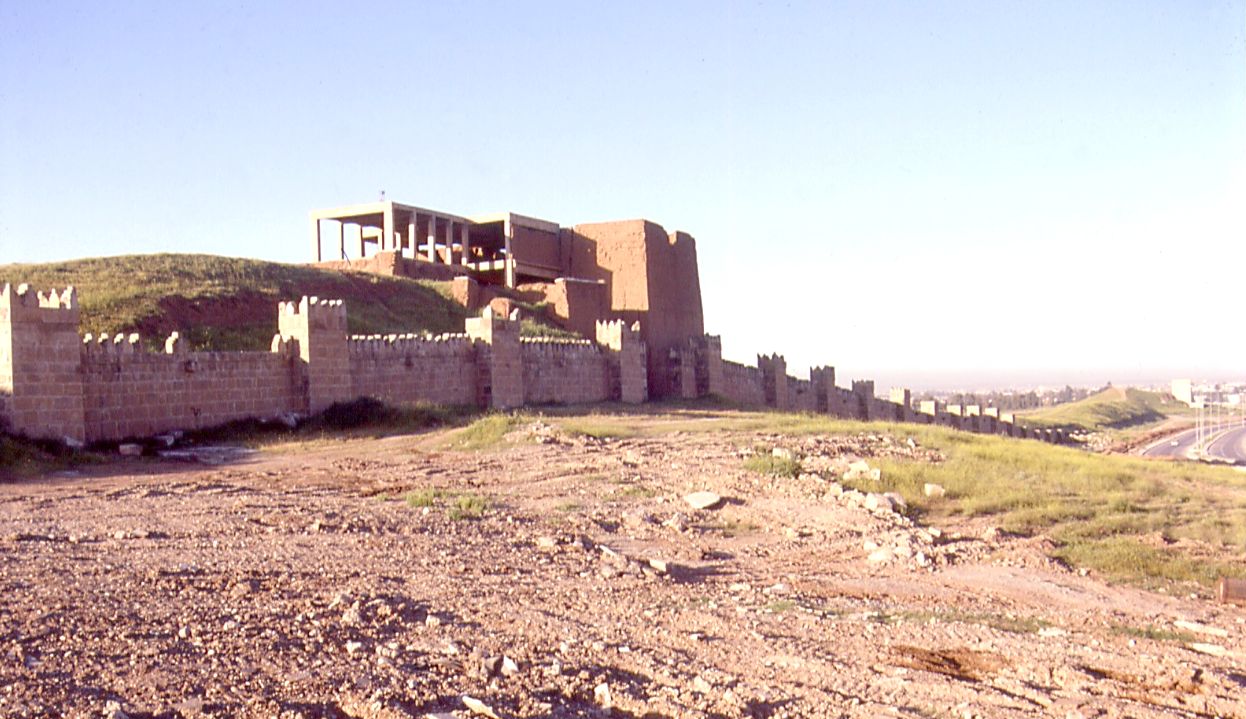
Adad gate exterior entrance north3.JPG

So this book raises all kinds of questions about God’s judgement and mercy, the permanence or otherwise of repentance, and ultimately the famous ‘Once saved always saved’ controversy in the Christian church. History shows us that in spite of her earlier repentance after Jonah’s ministry Nineveh had again become renowned for her brutality, and that the averted destruction did happen in the end. What we don’t know is whether the people’s earlier repentance was genuine or not, although God seemed to think so at the time. So Nahum’s message reminds us that each generation has to choose afresh whether or not it is going to serve God, and that repentance on behalf of our children is not possible. It also reflects the reality that sometimes people do lose the plot and slide back from an earlier commitment to God. It may also be that the reference to ‘witchcraft’ in 3:4, which is not developed any further by Nahum, points to some spiritual disease in the land which, without healing, simply causes the behaviour to manifest itself again in future generations. We can see this dynamic at work in all sorts of ways, for example in churches which repeat patterns of sinful behaviour keep occurring, although manifested by a new set of people. Deep repentance and healing, of the kind advocated by people like Russ Parker[1] is necessary to break sinful cycles.

Fortunately we live the other side of the cross from Nahum, so there is never, in this life, a point where judgement completely rules out the offer of mercy. We still have the responsibility of making sure that our repentance sticks, but even when it doesn’t we have a God to whom we can return, again and again.

[1] Notably in his Healing Wounded History (London: SPCK, 2012)

Image: “Adad gate exterior entrance north3” by Fredarch – http://en.wikipedia.org/wiki/Image:Adad_gate_exterior_entrance_north3.JPG. Licensed under CC BY-SA 3.0 via Wikimedia Commons

Old Testament Lectionary July 5th Trinity 5 Ezekiel 2:1-5

Regular thoughts on the oft-neglected Old Testament Lectionary passages.

For a while when I was young and stupid I genuinely believed in UFOs, space aliens and the like, and I devoured books about so-called encounters with extra-terrestrial beings. (I was also genuinely convinced that Jimi Hendrix had come from another planet, since no human could play that well.) Ezekiel chapter 1was a kind of proof text for UFO-freaks, since what was described there was clearly a visitation from another galaxy. But if that vision, whatever it was, was not scary enough for Ezekiel, the start of the next chapter should have had him genuinely quaking in his sandals. His prophetic call, God tells him, is to a ‘rebellious nation’ (a phrase particularly used in this book), who will refuse to hear his message, and be obstinate and stubborn instead. It is one thing to feel a sense of reluctance when called to an admiring audience, but when you know from the outset that your ministry is going to be rejected it must take quite a bit of courage to begin it in the first place. However God wants to leave the people no excuse: they will at the very least know that a prophet has been among them, even if his words fall on deaf ears. They can’t say he didn’t warn them.

File:Ezekiel's vision Zurich Bible.jpg

When we get to this passage church leaders and preachers automatically read it as though they are the prophets and their congregations, or at least some members of them, are the stubborn and rebellious ones who won’t do what they’re told. This may well be the case. I have a failed ministry under my belt, and it is easy for me to see myself as the prophet without honour, hounded out of town because my message was too uncomfortable. Sometimes as leaders we are called to speak hard words to stubborn people, although it goes without saying that being unpopular is not necessarily a sign that we are right and the others are rebellious. We might just be unpopular because we’re doing it wrongly! But to be able to confront as well as to comfort, to challenge as well as affirm, is an important tool in the leader’s toolbox.

But I wonder if there is another way of reading this passage which is less individual. As the church of Jesus Christ we are called to a prophetic role in wider society, and our voice is not always welcomed. As a townie working in a very rural diocese I’m struggling to understand rural spirituality, which appears to be very different from the urban version, although that does mean that I can look at the scene with new eyes and maybe see some blindspots more clearly. It seems to me that at its worst the rural church is all about joining in the ‘secular’ activities of the village (although I have been told off for using the term ‘secular’ because we’re all God’s children). As one priest put it ‘Of course we’re not here to evangelise the village’. Sadly many urban churches would agree with this sentiment.

The church often has a reputation for ‘ramming the Bible down people’s throats’ and the like, and we obviously can behave like that. But part of the calling of the whole people of God, surely, is to speak the unpopular, the challenging, the threatening word to a society which can be stubborn and rebellious with the best of them. They may not like us for it, but if we chicken out in favour of ‘niceness’ we are failing to be the church Christ calls us to be.