OT Lectionary Aug 30th Trinity 13 Deuteronomy 4:1-2, 6-9

Regular thoughts on the oft-neglected Old Testament Lectionary passages

I wonder if you were a space alien from the planet Tharg and you landed by mistake in Britain, whether your first and instinctive reaction would be to exclaim ‘Surely this great nation is a wise and discerning people!’ Our passage today, along with the Gospel from Mark 7, is about the Law, and I have already discussed elsewhere what place the Law has in the lives of Christians who have been saved by grace. We concluded that the Law is meant to be a delight to God’s people, not because it restricts them but because it points the way to life and wisdom, the kind of savoir faire which helps us to live effectively. But today’s passage reminds us that this is not just an individual characteristic but a corporate one as well.

There is a common motif in the OT about the surrounding nations observing Israel and seeing them as wise and effective, and acknowledging that their god is indeed a good one. This thought lies at the heart of this passage: in v 7-8 the repeated cry of ‘what other great nation?’ displays the awe with which those outside Israel regard their national life. Would that that were true of 21st century Britain!

The Law is hallmarked by wisdom and justice. It is not to be tampered with according to personal taste, it needs guarding jealously and living out zealously, and above all it needs passing on to generations yet to come. Proverbs 24:34 tells us that ‘righteousness exalts a nation’, and it is clearly meant to exalt the nation in the eyes of other nations, so that they may see both the presence of God among us, and the goodness of that God.

File:Statue Of 'Justice' Old Bailey.jpg

But this is not just a nice idea. Our lectionary compilers have again filleted out the more awkward verses from v 3-5, but to reinsert them reminds us that actually this is a matter of life and death. We don’t just keep the Law so that we’ll look good, but that we may live. To ignore it is to dice with death – literally. Whether that is the quick death of idolators punished by God, or the long, slow death of a nation in moral decline, it is equally inevitable.

It is worth reminding ourselves, though, of the place of the whole book of Deuteronomy, which purports to be Moses’ final instructions as the nation enters a new phase, having left behind slavery and wandering. Now they are to become more of a settled nation, it is good to get the foundations in place as the new phase of life begins. In the final verse Moses urges the people to keep careful watch on themselves lest what he is telling them fades from memory. If you want to see what happens to nations which may be built on good foundations but which have lost the plot over the years, you have only to watch the news. This passage calls forth intercession from me, that God would have mercy on a nation well down the road of disobedience and decay.

Old Testament Lectionary 23rd August Trinity 12 Joshua 24:1-2, 14-18

Regular thoughts on the oft-neglected Old Testament Lectionary passages.

One of the ideas which has become a lot less fashionable nowadays is that of the in-or-out nature of faith. Yet the NT is full of that kind of language which suggests that there is a very clear dividing line between those who are actually God’s and those who are not. For a recent conference I listed over 50 occurrences of such language from the Epistles and Gospels: darkness to light, no people to God’s people, enemies to friends of God, children of the Devil to God’s children, wise and foolish … the list goes on. This provides a major stumbling block for universalists and for rural Christians, both of whom tend either to blur the boundaries or to remove them altogether.

Today’s gospel differentiates clearly between those who are in and out, and even demonstrates the possibility of moving from in to out. And the background to that kind of choice is to be found in the stark choice with which Joshua faced his people in this famous passage, much beloved by evangelists. The chapter in my Bible is headed ‘The covenant renewed’, and the occasion is the completion of the conquest of the Promised Land and the start of a more settled period in Israel’s history. It never hurts, when entering into new phases, to stop and recommit ourselves to God.

File:Fork in Road - geograph.org.uk - 760119.jpg

Joshua’s words, though, provide an interesting commentary on faith in God and its alternatives. First of all, it is a deliberate choice, which we can and must make, one way or the other. Making the choice to turn to Christ (as the Anglican liturgy puts it) involves also the choice to turn our backs on other things. There is very little which we can bring into the kingdom with us, and Jesus warned about the impossibility of trying to serve two masters.

However, for those a bit hesitant about taking this step, Joshua sets out some possible alternatives. If you don’t want to serve the living God, he tells the people, then you might like to try one of two alternatives. The first is about the past: you can chose to remain in the unenlightened state in which you lived formerly. This is a constant danger for God’s people. Nostalgia, it has been said, isn’t what it used to be, but it is still very powerful, and the draw of ways of living which seemed to work in past generations is strong, whether it is about liturgical texts and forms of worship, buildings, or the pleasures of youth. These are the gods, Joshua tells them, that they ought really to throw away.

If the past is not attractive, though, the second option is the surrounding culture and its gods. Merely to go along with what everyone else is doing and thinking, and how they are living, can often be the path of least resistance, and can seem very attractive as opposed to the radical and unpopular path of following Christ.

The people’s enthusiastic response in v 18 is a good example to us all of giving the right answer, and fortunately our lectionary compliers, wanting as ever to keep things nice, stop us reading before Joshua’s somewhat cynical but nevertheless realistic comment in v 19-20. Choosing the right path is always a struggle, always a battle, and it is only through faith and gritted teeth that we can stick to it at every crossroads.

Image: Ian Paterson [CC BY-SA 2.0 (http://creativecommons.org/licenses/by-sa/2.0)%5D, via Wikimedia Commons)

Old Testament Lectionary 16th August Trinity 11 Proverbs 9:1-6

Regular thoughts on the oft-neglected Old Testament Lectionary passages.

The parallels with today’s gospel reading are clear: Wisdom, so often personified as a socially intelligent woman, offers to all who are interested a feast of food and wine. A glance at two other passages will help us get the best from this one, though.

The first is in the previous chapter, a passage which is the classic text on the personification of wisdom. She (perhaps because the Hebrew for ‘wisdom’ hokmah is a feminine noun) is pictured as being present at the creation of the world. She was the very first thing to be created by God (8:22) and was at his side throughout the process of creation (8:30). Whether the wisdom tradition writers saw her as a distinct being, or an aspect of God’s creativity, or even as the Holy Spirit is unclear, but the point is that wisdom is an absolutely fundamental and foundational characteristic of God’s intentions for his world.

Then we have her in our passage, preparing a banquet, starting as far back as building her own banqueting hall. The reference to the seven pillars carved out and/or set up by her suggests both significant size, and therefore room for all, and the perfection which seven represents. There may also be a reference back to the seven days of creation. The ‘simple’ (pethi) are invited, but so is absolutely everyone else. The simple are both those who are naïve through lack of experience, but also those culpably lacking in savoir faire because they have turned down the invitations to the feast. This makes them both gullible and reckless. The food and wine are sumptuous, and provide food for ‘insight’. The mention of ‘walking’ suggests not just a one-off flash of inspiration, but rather a life lived in the right direction long-term.

File:Bulgarian-national-ethnographic-museum-ritual-bread.jpg

The concept of wisdom isn’t about what we might call intelligence or cleverness, but much more about knowing the prudent way to act in any situation, hence the French term above which best captures this meaning. But to understand it better we need to read the whole chapter, which the author surely intended us to. In the second part, from v13, we get Wisdom’s ugly sister ‘Folly’. She is simple, but in a way a bit more sinister than merely being naïve. She too sits in her doorway calling out to all comers. She purports to offer wisdom, but actually her house is full of deadness, and what she offers is dishonesty and cheap thrills.

Both Wisdom and Folly’s houses are at the highest point of the city, as the temple and royal palace would have been, and are therefore in a commanding and highly visible position. One can’t help but compare the messages sent out to us constantly through the media, TV adverts and so on, all claiming that in their products are to be found health, wealth and happiness. As with Folly’s wares, much of what we are sold turns out to be dead and empty, but the wise and experienced have learnt more discernment. I have often encouraged people in my congregations to ‘shout back at the Telly’: when someone says something crass, stupid or just plain wrong, just argue back with a wiser and more Christian perspective. I have a theory that the people on the telly can’t actually hear you, but your family can and it teaches us all not simply to absorb all that comes out at us, but to use the mind of Christ to see things from a different perspective. Whilst not brimming with Christian content the         TV show Gogglebox shows us different families interacting, often encouragingly, with the media.

In the gospel reading Jesus also offers food and drink, but not just for this life. Food and wine from Christ nourish us into eternity.

Image: Vassia Atanassova – Spiritia [GFDL (http://www.gnu.org/copyleft/fdl.html) or CC BY-SA 3.0 (http://creativecommons.org/licenses/by-sa/3.0)%5D, via Wikimedia Commons

Old Testament Lectionary 9th August Trinity 10 1 Kings 19:4-8

Regular thoughts on the oft-neglected Old Testament Lectionary passages.

The study of the whole of 1 Kings 19, as an example of a nervous breakdown, burnout and depression, is a fruitful area for pastoral preaching. Today sadly we get a mere snippet, which has, I would argue, to be seen in the larger context of Elijah’s collapse and restoration.

First there is the request for the relief of death, a not uncommon motif in the Bible among leaders who find themselves facing opposition, conflict and personal attack. Who knows how many of the people in our churches week by week have prayed, or have been tempted to pray, like this? God’s response is to give him three precious gifts: sleep, food and drink, and a new purpose. When I used to be an avid fan of EastEnders, back in the days before I got a life, I used to be amused at the instinctive response to any problem, however small or large: ‘I’ll put the kettle on and we’ll have a nice cup of tea!’ God appears to understand Maslow’s hierarchy of needs as he cares first for Elijah’s physical state. Those who are deeply depressed can easily neglect the basics of life, and God knows that his gentle surgery is best done on a rested person with some food inside them. File:Delftware plaque with the Prophet Elijah fed by the Ravens.jpg

Then God calls him on a journey, which is to prove to be a journey of recovery. God is going to listen to him (repeatedly), help him put things in perspective, and recommission him for further service, whilst giving him an apprentice with whom to share the load. This mixture of the practical, the logical and the emotional is the stuff of great counselling, and there is much to learn from this text about helping friends in need.

At a deeper level, though, this is a passage which gives permission and reassurance as well as practical guidance. In a church and indeed a nation where the standard response to ‘How are you doing?’ is ‘I’m fine!’ or ‘I’m good!’ depending on your age, we are allowed to see the depths of Elijah’s despair, as he asks God to do Jezebel’s work for her. Whilst continual miseries can get a bit pastorally wearing, everyone is allowed a rough patch, and even an extremely rough patch. It has always been my desire to lead church communities where reality is the name of the game, and where it is OK to admit weakness as well as strength.

Secondly God reassures him that his life and ministry are not yet over. Those who have been chased out of jobs or places like bullies like Jezebel, who use intimidation and fear to wear us down, will know the joy of hearing that God still has a role for us somewhere else, and some new companions to strengthen us along the way. When we have taken a dive, for a variety of reasons, it is good to know that there can be a way back, and that we have a God who is more concerned to keep us alive than we sometimes are ourselves.

Read the whole chapter – It’s fantastic stuff!

Old Testament Lectionary 2nd August Trinity Exodus 16:9-15

Regular thoughts on the oft-neglected Old Testament Lectionary passages.

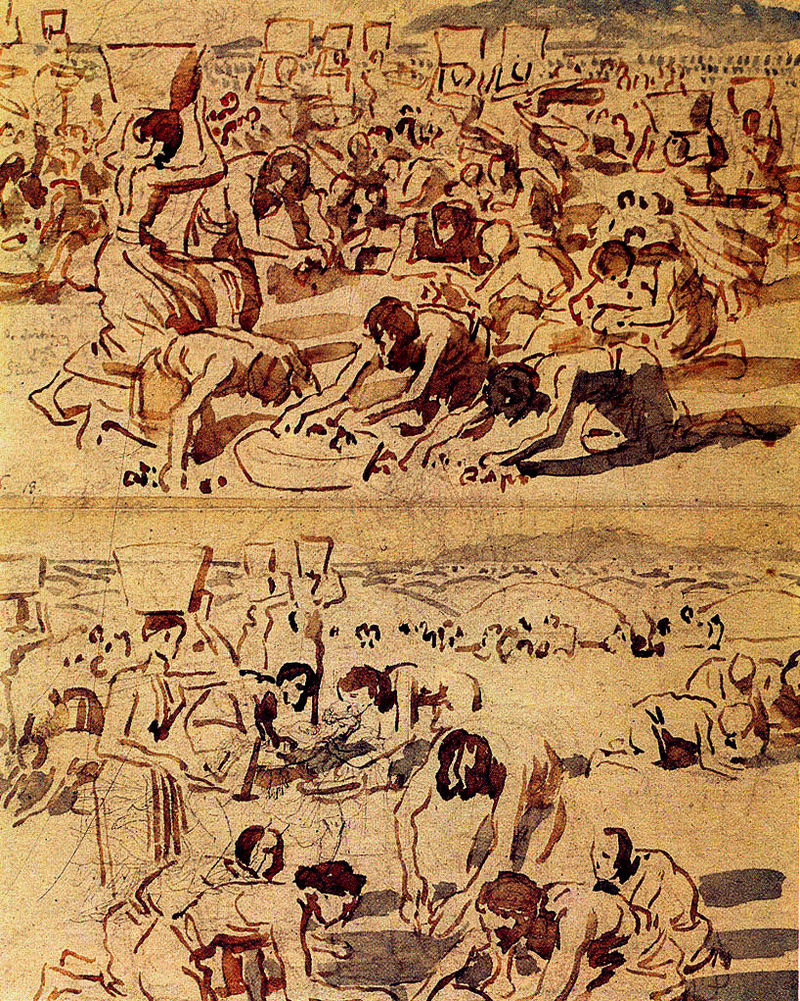
‘Surely this is the Prophet who is to come into the world’ exclaimed the crowds who had just been fed with loaves and fishes in last week’s gospel. Who is this ‘Prophet’ whom they were expecting, and why did the feeding of the crowds make people think he had turned up? The answer is expanded in this week’s readings, but first we have to know about Deuteronomy 18:14ff and Moses’ promise of a ‘prophet like me’. This idea evolved into an understanding that the Messiah would come and repeat some of Moses’ miracles. It is easy to see, therefore, how the crowds saw Moses and the manna in Jesus and the loaves.

But as always my concern is not to reinterpret the OT readings in the light of the gospels, but to let them speak for themselves, in context. And, as so often in the Exodus narrative, the context is the people’s grizzling. Of course the grumbling of people in uncertain times is a common motif, and we can easily read this text thinking what an awful, faithless lot they were. But the text makes no such judgement, and God seems not to either at this point. The people are a month or so into their journey, and quite understandably they are fearful. Having faced thirst at the end of the previous chapter, they now face the very real threat of starvation. We might condemn them for their lack of faith, having seen the provision of God before, but we might also feel that they are justified in having a bit of a moan.

Alexandr Ivanov 081.jpg

That said, however, we might wish for a little bit more sense and insight for the people. So often our reaction, when faced with problems, or change, is to go backwards. There is an attraction in what we know, where we have been, even if our memories get a bit selective: nostalgia, is, after all, not what it was. The Israelites get nostalgic about life in Egypt – we might have been slaves, but at least we got food! Churches long for the golden age when the pews were full and the Sunday Schools thriving, and even those with a penchant for revival pray ‘Lord, do it again!’. They seem to have lost sight of a God who does new things, who is able constantly to surprise them, and who knows their needs even before they ask.

Anyway, God invites them to bring their complaints near to him. At least a moan is a cry for help, and God delights to help. The miraculous provision of bread and meat follows, and even though the people remain pathologically stupid in the way they handle it, they can’t fault God for his provision. So to all the grizzlers out there: bring your complaints to God: this passage in no way suggests that to cry out in despair to God is a bad thing to do. Experience his patience, see his power, and benefit from his provision. But then try to learn from it: we have a God who is faithful, and we don’t need to be anxious.

(By the way, a PS for real theological anoraks: it is possible to translate v 15 with the people asking ‘Who is he? For they did not know who he was’. This identification of Moses the provider with the manna itself might be one root of John’s tradition that Jesus himself is the bread of life, coming down from heaven to give life to the world. Just saying.)

Image:  “Alexandr Ivanov 081” by Alexander Andreyevich Ivanov – http://etnaa.mylivepage.ru/image/238/7793_Народ_собирает_манну_небесную.jpg. Licensed under Public Domain via Wikimedia Commons

Old Testament Lectionary 26th July Trinity 8 2 Kings 4:42-44

Old Testament Lectionary 26th July Trinity 8 2 Kings 4:42-44

Regular thoughts on the oft-neglected Old Testament Lectionary passages.

This small and relatively unknown periscope has obviously been chosen to tie in with Jesus’ feeding of the crowds in today’s gospel. It is a simple story, but hidden within it are two larger questions: just who is God, and who is his prophet?

This incident is the fourth miracle story since Elisha has taken over from Elijah as the ‘man of God’, and they function to prove his worthiness for the task. Even at the very start of his ministry Elisha seems to want to prove his worth: in 2 Kings 2:13 he takes Elijah’s cloak and throws down the challenge: ‘Where now is the Lord, the God of Elijah?’ the resulting division of the water confirmed that God was indeed with him and that Elijah’s mantle had literally fallen upon him. Then follow a series of miracles which validate this position, although they do seem to be of a different nature from Elijah’s: we might best describe them as being more domestic, although no less powerful. Raising from the dead is no mean trick.

File:Food 004.JPG

But it may be that we have a continuation in this story of another of Elijah’s miracles. It all hangs on the place from which the man comes to Elisha: Baal-Shalisha. It has been suggested that this town is to be identified with Bethlehem, which literally means ‘House of Bread’, the place from which David came, and in which the Messiah was later to be born. Bethlehem is indeed a place from which God feeds his people. But the name ‘Baal’ also suggests a place where a particular god had a temple or shrine in Canaanite worship. ‘Shalisha’ means ‘three’ or ‘third’, so this place is where the Lord or master over three was worshipped. Elijah’s clashes with the prophets of Baal are well-known and dramatic, but we might expect Elisha’s to be tamer although just as powerful. It would be typical of both prophets for Elijah to summon fire from heaven, but for Elisha to feed hungry people. So it may be the case that what we have here is a much more subdued ‘Mount Carmel-type’ contest to find out who is the real god. Does the bread come from Yahweh’s House of Bread, or from Baal’s Shalisha? And can Elisha, still proving himself as Elijah’s successor, win the contest in his own style?

Elijah has his enemies put to the sword, but Elisha instead brings life as the bread is used to feed starving people in a time of famine. In the gospels the miraculous feedings have a different point, as they demonstrate the authority of Jesus not just over sin and sickness but over fallen and hostile nature itself. Linked as it is to the stilling of the storm, it serves to reveal even more about who this Jesus is, and what authority he has. Perhaps this story of Elisha serves a similar purpose.

Old Testament Lectionary 19th July Trinity 7 Jeremiah 23:1-6


Regular thoughts on the oft-neglected Old Testament Lectionary passages.

The motif of God himself stepping in to care for his people because of the lack of care given by their earthly ‘shepherds’ is not an uncommon one in the OT. Ezekiel notably uses this image in chapter 34. Clearly a metaphor for the kings and rulers of the nation, the shepherds have failed to administer justice or rescue the oppressed and the victims of crime (21:12). Instead they have their hearts set on dishonest gain, oppression and bloodshed (22:17). Therefore God is going to do two things: he is going to step in and shepherd his people himself, and make a proper job of it, but he is also going to raise up a new king who will do what is just and right (23:5). It is not clear whether this will be as well as God’s own care for the people, or after it, or even whether God’s personal ministry will be exercised through this new Davidic king, whom of course we know to be his Son, and whose ministry the gospel reading for today picks up, as he ministers to sheep who have no shepherd at all.

Renderklippen 058.JPG

But what is going to happen in the meantime? Clearly in context Jeremiah is writing on the eve of the Babylonian exile, and in this passage he explains, somewhat confusingly, that it is the false shepherds who have ‘scattered’ the people into exile, (v 2), but also that it is God who has done the scattering (v 3) and will also do the re-gathering. This raises an interesting question about the exile, and about our own experiences of suffering and abandonment. When in my other blog I discussed Jonah, I made the point that the whale wasn’t punishment for Jonah: it was rescue, unpleasant and scary though that rescue may have been. Is it possible, therefore, that the exile was less a punishment on the oppressed people, and more a rescue from their oppressors? It is certainly the case that after the exile the monarchy never functioned in the ways it had before: this was real and radical regime change, and it may have been the case that the old system needed not just breaking but destroying totally in order that something more functional could replace it.

Of course there are many other references to the culpability of the ordinary people and their punishment through the exile, but maybe it doesn’t have to be one or the other. When disaster hits us it is a common reaction to ask the question ‘What have I done to deserve this?’ and in some cases there will be a clear answer to that question. But I wonder whether another question, equally valid, might be to ask ‘From what or whom is this going to save me?’ Only this last week I was surprised to hear myself in prayer giving thanks to God for one of the greatest disappointments of my life, because it saved me from what would have ended up as a disastrous career move. Maybe there are things which you can see in the same way. And maybe, like me, you can find new hope and faith in the fact that God’s plans are perfect, painful though they may be at the time.

Image: “Renderklippen 058” by Koosg – Own work. Licensed under CC BY-SA 3.0 via Wikimedia Commons – https://commons.wikimedia.org/wiki/File:Renderklippen_058.JPG#/media/File:Renderklippen_058.JPG

OT Lectionary July 12th Trinity 6 Amos 7:7-15

Regular thoughts on the oft-neglected Old Testament Lectionary passages

We may not often shoot messengers nowadays, but we very often want to silence them. ‘The first responsibility of a leader i s to define reality’ according to American businessman Max de Pree, but sometimes communities just don’t want reality defined. They prefer the status quo, however sick it might be. It appears that Amos’ vision of the plumbline is the last straw which causes Amaziah, the priest of the sanctuary at Bethel, to report him to the king and to try to put an end to his prophetic ministry, at least around here.

What is so offensive about a plumbline? The vision begins with God standing next to a wall which has been built correctly, and warning Amos that he is about to test the nation of Israel by the same standard. The implication is that it will found to be out of true. We already know that – every paragraph of the book so far says the same thing, in different ways.File:Fil à plomb.jpg

But the big question is this: what do you do with a wall which you discover is out of true? I’m no bricklayer, but my guess is that it’s pretty hard to straighten it out, particularly once the cement has set. I suspect that tweaking bricks is an impossible task. The only possibility is a drastic one: demolish the whole thing and build it again properly. So Amos’ prophecy against Israel isn’t just a warning of judgement: it’s a warning of total destruction. God spells this out: both the sanctuaries for worship and the reigning family of Jeroboam will be spared no longer.

Various tactics are used against Amos, as they continue to be today against any leaders who try to bring unpalatable truths to the powerful stakeholders in the community. They misunderstand him: in v 12 they assume he is merely doing this for a living, failing to see the call of God burning within his guts. They dob on him to the king like schoolkids who have fallen out in v 10, and they try to bully him with the threat of the king’s anger behind them (v 13). And they simply tell him to go away and leave them alone (v 12). I, and others who have been bullied during the course of Christian ministry, will know these tactics only too well.

But Amos has a higher calling than local politics. In the only bit of biography we have in this book, he explains that he was just a working man, but when the call of God to a prophetic ministry hits you, you have no choice but to obey, whatever the cost. When God speaks, you simply can’t disobey, any more than you can fail to be afraid when a lion roars in your ear (3:8).

The other interesting thing about this passage is that it merely the third of three oracles of judgement in this chapter. In the previous two God’s threats of locust and fire are met with intercession by Amos, which causes God to relent and allow more time. But the third time there is neither intercession nor mercy. It appears that it is possible to exhaust the patience of God. How close we are to that in our nation no-one knows, but in the meantime our prophetic calling as God’s people continues to be one of announcement and intercession. ‘Who knows: God may turn and relent and leave behind a blessing’ (Joel 2:18).

Old Testament Lectionary July 5th Trinity 5 Ezekiel 2:1-5

Regular thoughts on the oft-neglected Old Testament Lectionary passages.

For a while when I was young and stupid I genuinely believed in UFOs, space aliens and the like, and I devoured books about so-called encounters with extra-terrestrial beings. (I was also genuinely convinced that Jimi Hendrix had come from another planet, since no human could play that well.) Ezekiel chapter 1was a kind of proof text for UFO-freaks, since what was described there was clearly a visitation from another galaxy. But if that vision, whatever it was, was not scary enough for Ezekiel, the start of the next chapter should have had him genuinely quaking in his sandals. His prophetic call, God tells him, is to a ‘rebellious nation’ (a phrase particularly used in this book), who will refuse to hear his message, and be obstinate and stubborn instead. It is one thing to feel a sense of reluctance when called to an admiring audience, but when you know from the outset that your ministry is going to be rejected it must take quite a bit of courage to begin it in the first place. However God wants to leave the people no excuse: they will at the very least know that a prophet has been among them, even if his words fall on deaf ears. They can’t say he didn’t warn them.

File:Ezekiel's vision Zurich Bible.jpg

When we get to this passage church leaders and preachers automatically read it as though they are the prophets and their congregations, or at least some members of them, are the stubborn and rebellious ones who won’t do what they’re told. This may well be the case. I have a failed ministry under my belt, and it is easy for me to see myself as the prophet without honour, hounded out of town because my message was too uncomfortable. Sometimes as leaders we are called to speak hard words to stubborn people, although it goes without saying that being unpopular is not necessarily a sign that we are right and the others are rebellious. We might just be unpopular because we’re doing it wrongly! But to be able to confront as well as to comfort, to challenge as well as affirm, is an important tool in the leader’s toolbox.

But I wonder if there is another way of reading this passage which is less individual. As the church of Jesus Christ we are called to a prophetic role in wider society, and our voice is not always welcomed. As a townie working in a very rural diocese I’m struggling to understand rural spirituality, which appears to be very different from the urban version, although that does mean that I can look at the scene with new eyes and maybe see some blindspots more clearly. It seems to me that at its worst the rural church is all about joining in the ‘secular’ activities of the village (although I have been told off for using the term ‘secular’ because we’re all God’s children). As one priest put it ‘Of course we’re not here to evangelise the village’. Sadly many urban churches would agree with this sentiment.

The church often has a reputation for ‘ramming the Bible down people’s throats’ and the like, and we obviously can behave like that. But part of the calling of the whole people of God, surely, is to speak the unpopular, the challenging, the threatening word to a society which can be stubborn and rebellious with the best of them. They may not like us for it, but if we chicken out in favour of ‘niceness’ we are failing to be the church Christ calls us to be.

Old Testament Lectionary June 28th Trinity 4 Lamentations 3:23-33

Regular thoughts on the oft-neglected Old Testament Lectionary passages.

Being quite keen on the proper Bible I’ve chosen the Lamentations option, the one key purple passage in the book which I have discussed further here. It’s a great passage, standing proud like a lighthouse on the dark stormy seas of the rest of the book, and there is much encouragement to be had from it, but I found myself more interested on this occasion in the later verses, from v 25 onwards, and the advice it gives to suffering Christians.

This mini-section begins with the idea that God’s people (‘those whose hope is in him’) have a God who is basically good to them, although of course it doesn’t always feel like that. Therefore, in holding these two paradoxical truths together, we have to ‘bear the yoke’ and to ‘wait quietly’. It gets worse: we have to sit in silence, remembering that this is in fact God doing all this to them, and to ‘bury our faces in the dust’ in case there is any hope.

This language is uncannily reminiscent of Job’s comforters, and, whilst it reflects Israel’s Wisdom tradition, is in the end rejected by Job in favour of an inscrutable God who has the right to do whatever he likes. Indeed, reiterates the author here, it is God who causes suffering, though he doesn’t do it for fun, and he always mixes it with compassion, because that’s who he is. So are we any the wiser?

File:Child in the ruins of St Casimir Church.jpg

As always it will probably help us to set this passage in its historical context, so that we don’t try to make it say something to us which it never intended to say. Stuff it tells us about God is probably reliable, but not necessarily that which it says about our reaction. So let’s go back to the final days before the exile, when the Holy City has been devastated, God’s punishment on an apostate nation has been wreaked, and people are left in despair. So what do we do now?

Well, the author says, the time for penitence in the hope that God will let you off the hook is over. You had every opportunity to turn back to him, but you didn’t, and now there is no way of undoing the punishment which he warned you would come upon you. Your only hope now is to suck it up, keep your heads down and wait. You can be sure that the God who has brought this punishment on you will temper it with compassion, but you will have to sit through it. God would have loved to have seen you repent and therefore avoid this catastrophe, but you weren’t interested, so now you have to take what was coming to you.

This does, I think, put the words in one particular historical setting, and it also sets us free from believing that they apply directly to us today. They underline the importance of reading carefully, of not making blanket transfers down the years and across the miles, and of asking deeper questions about what from here we can take as truth for us today.

We have a God of compassion, but also a God of punishment (I have often said, in the face of our society’s valuing of ‘tolerance’ above all virtues, that God is not tolerant: he’s forgiving, which is a very different thing). He doesn’t enjoy putting people through hard times, but he understands when it is necessary. And, we know from our perspective the other side of the cross, that there is after all the chance to escape punishment, because his Son took it for us. This I call to mind, and therefore I have hope.